
[Paper Review] A Survey of Optimization-based Task and Motion Planning: From Classical To Learning Approaches
This survey presents a comprehensive review of optimization-based task and motion planning (TAMP), unifying classical hybrid optimization methods with modern learning-based approaches. It highlights hierarchical and distributed algorithmic structures for solving complex, contact-rich locomotion and manipulation tasks, while emphasizing synergies with large language models and trajectory optimization for long-horizon, dynamic robot behaviors.
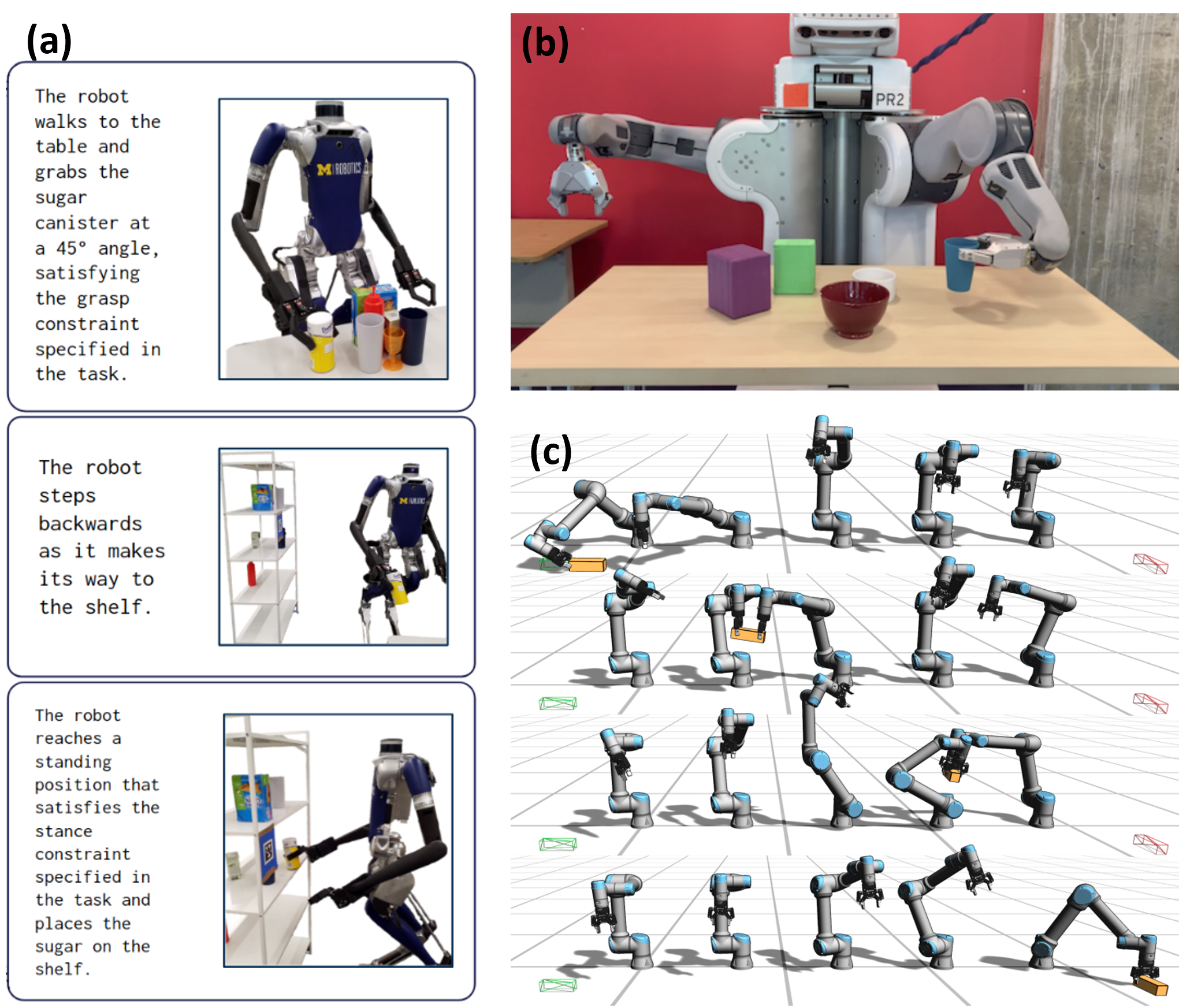
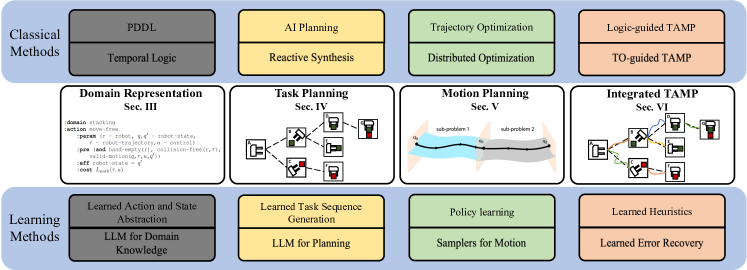
Task and Motion Planning (TAMP) integrates high-level task planning and low-level motion planning to equip robots with the autonomy to effectively reason over long-horizon, dynamic tasks. Optimization-based TAMP focuses on hybrid optimization approaches that define goal conditions via objective functions and are capable of handling open-ended goals, robotic dynamics, and physical interaction between the robot and the environment. Therefore, optimization-based TAMP is particularly suited to solve highly complex, contact-rich locomotion and manipulation problems. This survey provides a comprehensive review on optimization-based TAMP, covering (i) planning domain representations, including action description languages and temporal logic, (ii) individual solution strategies for components of TAMP, including AI planning and trajectory optimization (TO), and (iii) the dynamic interplay between logic-based task planning and model-based TO. A particular focus of this survey is to highlight the algorithm structures to efficiently solve TAMP, especially hierarchical and distributed approaches. Additionally, the survey emphasizes the synergy between the classical methods and contemporary learning-based innovations such as large language models. Furthermore, the future research directions for TAMP is discussed in this survey, highlighting both algorithmic and application-specific challenges.
Motivation & Objective
- To provide a systematic review of optimization-based TAMP frameworks that integrate symbolic task planning with continuous trajectory optimization.
- To analyze the interplay between logic-based task planning and model-based trajectory optimization in handling complex, dynamic robotic tasks.
- To identify algorithmic advancements—especially hierarchical and distributed approaches—that improve scalability and efficiency in long-horizon planning.
- To explore the integration of learning-based methods, including large language models and reinforcement learning, with classical optimization-based TAMP.
- To identify open challenges and future research directions in TAMP for real-world deployment, especially in locomotion, manipulation, and human-robot collaboration.
Proposed method
- Formulates TAMP as a hybrid optimization problem combining discrete symbolic planning and continuous trajectory optimization, using objective functions to encode plan quality.
- Employs action description languages and temporal logic for high-level task representation, enabling formal specification of complex goals and constraints.
- Integrates model-based trajectory optimization (TO) to encode robot dynamics, enabling natural, efficient, and dynamic motions in contact-rich environments.
- Applies hierarchical and distributed optimization strategies to decouple task-level combinatorial complexity from motion-level numerical complexity.
- Explores the fusion of large language models (LLMs) and vision-language models (VLMs) with TAMP to improve task understanding and instruction grounding.
- Investigates reinforcement learning-based policy learning for end-to-end skill acquisition, with emphasis on observation and action representation design for generalization.
Experimental results
Research questions
- RQ1How can optimization-based TAMP effectively balance computational efficiency and planning comprehensiveness in long-horizon, dynamic tasks?
- RQ2What are the key algorithmic structures—such as hierarchical or distributed approaches—that enable scalable and efficient TAMP for complex robotic systems?
- RQ3In what ways can large language models enhance task planning and instruction grounding in TAMP, and what are their current limitations in spatial and temporal reasoning?
- RQ4How can reinforcement learning be integrated with optimization-based TAMP to improve policy generalization and real-world transfer?
- RQ5What are the challenges in unifying locomotion and manipulation planning, especially for humanoid robots with dexterous hands and dynamic contact interactions?
Key findings
- Optimization-based TAMP outperforms constraint- and sampling-based methods in handling open-ended goals and complex objective functions, especially in contact-rich manipulation and dynamic locomotion.
- Hierarchical and distributed optimization frameworks significantly reduce computational complexity by decoupling task and motion planning, enabling scalable solutions for long-horizon tasks.
- The integration of large language models improves high-level task understanding and instruction parsing, but their limitations in spatial reasoning and short-term memory hinder robustness in sequential, multi-stage tasks.
- Reinforcement learning with carefully designed observation and action representations enhances policy generalization, though sample inefficiency and sim-to-real transfer remain key challenges.
- Unified TAMP for loco-manipulation remains challenging due to differing contact frequencies and representations between robot-centric locomotion and object-centric manipulation.
- Human-robot collaboration in TAMP is advancing through intent prediction, motion modeling, and multimodal communication (e.g., language and physical interaction), but efficient and robust integration remains an open problem.
Read this paper
Open the full text in the Nubint reader and ask about any passage as you read.
Read this paper on NubintThis review was generated by AI from the original paper. Please check the paper before citing it.