
[Paper Review] Adaptive estimation of quantum observables
This paper introduces AEQuO, an adaptive quantum observable estimation algorithm that dynamically allocates measurement resources based on real-time estimates of both the observable's expectation value and its variance. By leveraging on-the-fly error monitoring and allowing non-bitwise commuting Pauli groupings, AEQuO achieves lower estimation error than state-of-the-art methods across chemistry Hamiltonians, significantly reducing measurement overhead in NISQ-era quantum algorithms.
The accurate estimation of quantum observables is a critical task in science. With progress on the hardware, measuring a quantum system will become increasingly demanding, particularly for variational protocols that require extensive sampling. Here, we introduce a measurement scheme that adaptively modifies the estimator based on previously obtained data. Our algorithm, which we call AEQuO, continuously monitors both the estimated average and the associated error of the considered observable, and determines the next measurement step based on this information. We allow both for overlap and non-bitwise commutation relations in the subsets of Pauli operators that are simultaneously probed, thereby maximizing the amount of gathered information. AEQuO comes in two variants: a greedy bucket-filling algorithm with good performance for small problem instances, and a machine learning-based algorithm with more favorable scaling for larger instances. The measurement configuration determined by these subroutines is further post-processed in order to lower the error on the estimator. We test our protocol on chemistry Hamiltonians, for which AEQuO provides error estimates that improve on all state-of-the-art methods based on various grouping techniques or randomized measurements, thus greatly lowering the toll of measurements in current and future quantum applications.
Motivation & Objective
- To address the high measurement cost in NISQ-era quantum algorithms, particularly in variational quantum eigensolvers requiring extensive sampling.
- To overcome limitations of existing measurement protocols that rely on fixed grouping strategies or assume bitwise commutation relations.
- To develop a method that adaptively allocates measurement budget by continuously estimating both the average and variance of a quantum observable.
- To improve estimation accuracy by allowing overlapping and non-bitwise commuting Pauli operator groupings, maximizing information gain per measurement.
- To benchmark performance against state-of-the-art methods, including randomized measurements, grouping techniques, and optimal measurement protocols.
Proposed method
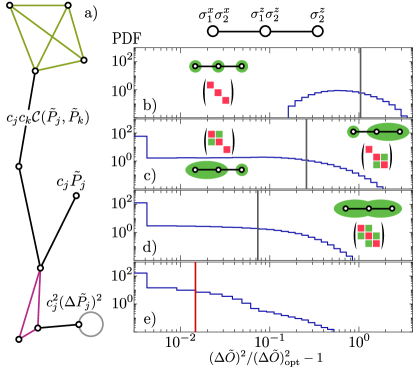
- AEQuO formulates the observable estimation task as a weighted graph problem, where Pauli strings are vertices and edges represent commutation relations.
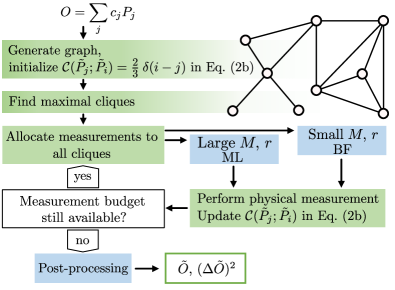
- The algorithm uses two core subroutines: a greedy bucket-filling approach for small-scale problems and a machine learning-based method for larger instances.
- It continuously monitors the estimated mean and variance of the observable during measurement, enabling real-time adaptation of the measurement strategy.
- The method allows for overlapping and non-bitwise commuting Pauli groupings, increasing information efficiency beyond traditional commutation-based grouping.
- Post-processing of measurement configurations further reduces estimator error, improving final precision without additional measurements.
- The algorithm is evaluated using molecular Hamiltonians from quantum chemistry, with performance compared against OGM, LDF, Derand, and non-adaptive AEQuO.
Experimental results
Research questions
- RQ1Can adaptive measurement allocation based on real-time error estimation outperform fixed or non-adaptive measurement protocols in quantum observable estimation?
- RQ2To what extent does allowing non-bitwise commuting and overlapping Pauli groupings improve estimation accuracy and reduce measurement overhead?
- RQ3How does AEQuO compare to state-of-the-art methods such as OGM, LDF, and randomized measurements in terms of estimation error and measurement efficiency?
- RQ4Does the adaptive nature of AEQuO provide consistent advantages across different quantum chemistry Hamiltonians, including those with small coefficients?
- RQ5Can machine learning-enhanced subroutines in AEQuO scale favorably to larger quantum systems compared to greedy or combinatorial approaches?
Key findings
- AEQuO achieves lower estimation error than all state-of-the-art methods, including OGM, LDF, Derand, and non-adaptive AEQuO, across multiple chemistry Hamiltonians.
- For the H₂O molecule, AEQuO with L=3 and l=4 outperforms all other protocols, even when OGM performs better for small measurement budgets due to term pruning.
- The OGM’s initial advantage for small M is attributed to discarding low-coefficient terms that introduce statistical noise; AEQuO includes these terms but still achieves better overall performance.
- AEQuO’s adaptive strategy consistently reduces error across all tested Hamiltonians, demonstrating robustness and scalability beyond fixed-grouping methods.
- The machine learning-based variant of AEQuO shows favorable scaling for larger problem instances, outperforming the greedy approach in terms of measurement efficiency.
- In lattice Hamiltonians with D=2 and D=3 dimensions, AEQuO maintains superior performance, confirming its effectiveness beyond molecular systems.
Read this paper
Open the full text in the Nubint reader and ask about any passage as you read.
Read this paper on NubintThis review was generated by AI from the original paper. Please check the paper before citing it.