
[Paper Review] Assessing the Benefits and Risks of Quantum Computers
The paper surveys the potential benefits and cybersecurity risks of quantum computers, arguing near-term quantum devices may deliver practical value before cryptographic-breaking capabilities emerge, and emphasizes adopting quantum-safe cryptography.
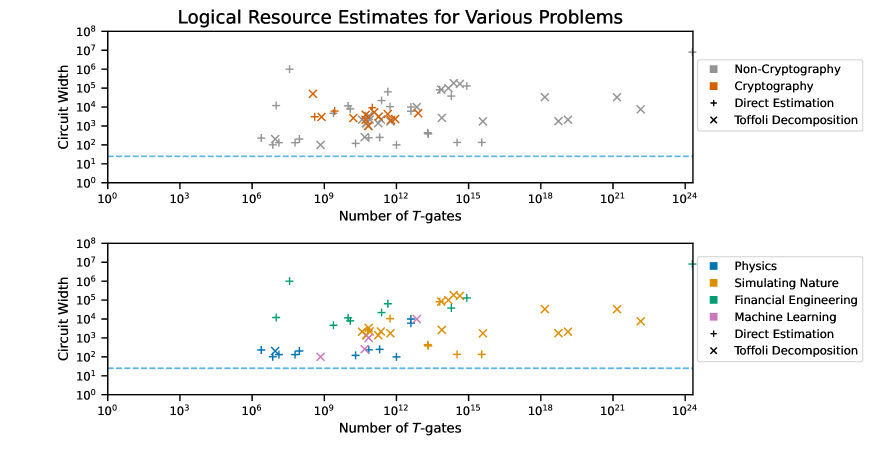
Quantum computing is an emerging technology with potentially far-reaching implications for national prosperity and security. Understanding the timeframes over which economic benefits and national security risks may manifest themselves is vital for ensuring the prudent development of this technology. To inform security experts and policy decision makers on this matter, we review what is currently known on the potential uses and risks of quantum computers, leveraging current research literature. The maturity of currently-available quantum computers is not yet at a level such that they can be used in production for large-scale, industrially-relevant problems, and they are not believed to currently pose security risks. We identify 2 large-scale trends -- new approximate methods (variational algorithms, error mitigation, and circuit knitting) and the commercial exploration of business-relevant quantum applications -- which, together, may enable useful and practical quantum computing in the near future. Crucially, these methods do not appear likely to change the required resources for cryptanalysis on currently-used cryptosystems. From an analysis we perform of the current and known algorithms for cryptanalysis, we find they require circuits of a size exceeding those that can be run by current and near-future quantum computers (and which will require error correction), though we acknowledge improvements in quantum algorithms for these problems are taking place in the literature. In addition, the risk to cybersecurity can be well-managed by the migration to new, quantum-safe cryptographic protocols, which we survey and discuss. Given the above, we conclude there is a credible expectation that quantum computers will be capable of performing computations which are economically-impactful before they will be capable of performing ones which are cryptographically-relevant.
Motivation & Objective
- Assess the potential societal and economic benefits of quantum computing.
- Evaluate the cybersecurity risks, especially cryptanalysis, posed by quantum computers.
- Identify near-term trends (variational algorithms, error mitigation, circuit knitting) enabling useful quantum computing.
- Assess timelines for cryptographically relevant capabilities versus commercially useful capabilities.
- Provide policy and practical guidance on getting quantum-safe cryptography deployed.
Proposed method
- Review and synthesize current literature on quantum algorithms, error mitigation, and circuit knitting.
- Analyze scalability requirements and the role of fault tolerance and error correction in cryptanalytic versus non-cryptanalytic tasks.
- Compare resource requirements for cryptanalysis with those for useful quantum applications using existing algorithmic knowledge.
- Examine the maturity of quantum hardware, cloud access, and commercial exploration to infer near-term value vs. cybersecurity risks.
- Survey quantum-safe cryptographic approaches such as QKD, QRNG, and PQC, and discuss practical adoption considerations.

Experimental results
Research questions
- RQ1What is the expected timeline for economically valuable quantum computations relative to cryptographically relevant capabilities?
- RQ2Do near-term quantum algorithms and techniques enable cryptanalysis of current cryptosystems without full fault tolerance?
- RQ3What strategies exist to migrate to quantum-safe cryptography, and how practical is their deployment?
- RQ4How do variational methods, error mitigation, and circuit knitting influence the feasibility of near-term quantum computing for practical problems?
Key findings
- Current quantum computers are not yet at a level for large-scale industrial problems and are not believed to pose immediate security risks.
- Three main near-term trends (variational algorithms, error mitigation, circuit knitting) could enable useful quantum computations on existing hardware.
- Current cryptanalytic resource requirements remain too large for near-term devices; fault tolerance would be needed for breaking widely-used cryptosystems.
- Quantum-safe cryptographic protocols can effectively mitigate cybersecurity risks, with practical adoption pathways discussed.
- Quantum computers are likely to be capable of economically impactful computations before they become cryptographically relevant.
- Policy guidance is needed to balance fostering quantum benefits with managing cybersecurity risks.
Read this paper
Open the full text in the Nubint reader and ask about any passage as you read.
Read this paper on NubintThis review was generated by AI from the original paper. Please check the paper before citing it.