
[Paper Review] Black holes and modular forms in string theory
The paper explains how black hole entropy in string theory is counted by microstates whose generating functions are modular forms, and how this leads to connections with mock modular forms and the Hardy-Ramanujan-Rademacher expansion.
The study of black holes in string theory has led to the discovery of deep and surprising connections between black holes and modular forms -- which are two classical, a priori unrelated, subjects. This article explains the main physical and mathematical ideas behind these connections. It is known from the pioneering work of J.Bekenstein and S.Hawking in the 1970s that black holes have thermodynamic entropy, and should therefore be made up of a collection of microscopic quantum states. Superstring theory provides a framework wherein we can associate a number of microscopic states that make up the quantum-statistical system underlying a black hole, thus explaining their thermodynamic behavior from a more fundamental point of view. %The above-mentioned connections arise from the observation that, i The basic connection to modular forms arises from the observation that, in the simplest superstring-theoretic construction, the generating function of the number of microscopic states is a modular form. In one direction, modular symmetry acts as a powerful guide to the calculation of quantum-gravitational effects on the black hole entropy. In the other direction, the connection has led to the discovery of surprising relations between Ramanujan's mock modular forms and a class of string-theoretic black holes, thus providing an infinite number of new examples of mock modular forms.
Motivation & Objective
- Motivate and explain the thermodynamic entropy of black holes and its microscopic counting within string theory.
- Show how modular symmetry governs the counting of microstates and quantum gravitational corrections.
- Demonstrate the emergence of mock modular forms from certain string-theoretic black holes.
Proposed method
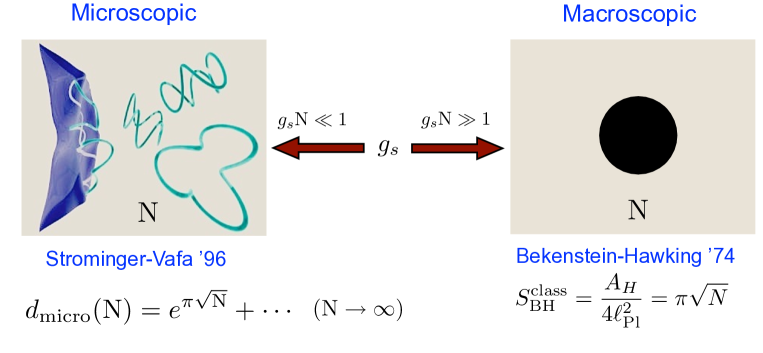
- Review Bekenstein-Hawking entropy and its quantum-statistical interpretation via microstates in string theory.
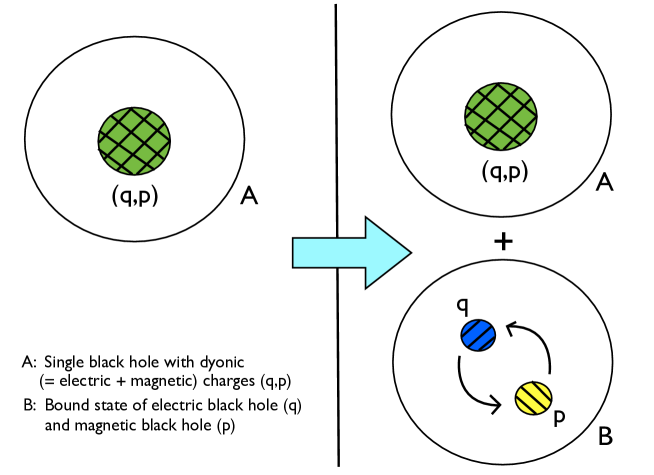
- Describe two pictures of black holes in string theory: macroscopic (GR) and microscopic (brane/string bound states).
- Introduce supersymmetric indices (Witten index) and their role in counting BPS states.
- Connect microscopic degeneracies to modular forms such as Dedekind eta and theta functions.
- Apply Hardy-Ramanujan-Rademacher type expansions to estimate degeneracies and relate to quantum corrections to entropy.
Experimental results
Research questions
- RQ1How does modular symmetry aid in computing quantum-gravitational corrections to black hole entropy?
- RQ2What is the precise relation between black hole microstate counting and modular forms in various string theory compactifications?
- RQ3Can mock modular forms arise from certain string-theoretic black holes and what do they signify about microstate counting?
- RQ4To what extent do supersymmetric indices reproduce or explain the Bekenstein-Hawking entropy for BPS black holes?
Key findings
- The generating function for microscopic black hole states in simple string constructions is a modular form, leading to entropy matches with the Bekenstein-Hawking formula.
- Hardy-Ramanujan-Rademacher expansions relate the microscopic state count to quantum-gravitational corrections of black hole entropy.
- In certain Calabi–Yau compactifications, microscopic degeneracies are governed by eta- and theta-function combinations forming modular objects, and their asymptotics reproduce BH entropy.
- BPS black holes exhibit zero temperature yet carry entropy, and their microstate counting aligns via supersymmetric indices that match gravitational entropy under suitable decoupling limits.
- The study reveals connections to Ramanujan’s mock modular forms through specific string-theoretic black holes, expanding the mathematical landscape of modular objects in physics.
Read this paper
Open the full text in the Nubint reader and ask about any passage as you read.
Read this paper on NubintThis review was generated by AI from the original paper. Please check the paper before citing it.