
[Paper Review] Characterizing cylindrical particles upon local measurements of two Stokes parameters
This paper presents a method to determine the scattering cross-section and global polarization state of cylindrically symmetric particles using only local measurements of two Stokes parameters (intensity I and degree of circular polarization V) at a single far-field angle. By leveraging multipolar expansion and a matrix inversion of local Stokes parameters, the approach enables full characterization with minimal experimental complexity—requiring only a camera and standard wave plates—significantly simplifying routine optical characterization of cylindrical nanostructures.
Researchers routinely characterize optical samples by computing the scattering cross-section. However, the experimental determination of this magnitude requires the measurement and integration of the components of the scattered field in all directions. Here, we propose a method to determine the scattering cross-section and global polarization state of radiation through measurements of two Stokes parameters at an angle of choice in far-field. The method applies to cylindrically symmetric samples whose optical response is well-described by a single multipolar order j. Moreover, the formalism is applicable for a wide range of different illuminations, and it only requires the use of a single camera and conventional wave plates. Our findings significantly reduce the complexity of routine characterization measurements for cylindrical samples in optical laboratories.
Motivation & Objective
- To simplify the experimental characterization of cylindrical particles in optical laboratories by reducing reliance on full angular integration of scattered fields.
- To enable accurate determination of scattering cross-section and global polarization state using only two local Stokes parameters (I and V) at a chosen far-field angle.
- To overcome the limitations of the optical theorem by extending its applicability to focused beams and complex illumination conditions.
- To provide a practical, low-complexity measurement protocol using standard optical components (camera and wave plates) for routine characterization of cylindrical nanostructures.
- To establish a theoretical framework linking local far-field Stokes parameters to global scattering and polarization properties via multipolar decomposition.
Proposed method
- The method uses a multipolar expansion of the scattered field, assuming the optical response is dominated by a single multipolar order j, valid for cylindrically symmetric particles.
- It derives a matrix relation between local far-field Stokes parameters (I_far, V_far) and the integrated scattering parameters (⟨I⟩_sca, ⟨V⟩_sca) via coefficients f_jm and g_jm derived from vector spherical harmonics.
- The core equation (Eq. 15) inverts the measured local Stokes parameters to retrieve the global scattering and polarization state using the inverse of a 2×2 matrix involving f_jm and g_jm.
- The coefficients f_jm(θ) and g_jm(θ) are analytically expressed in terms of associated Legendre polynomials and normalization constants, enabling precise angular calibration.
- The method is validated for dipolar (ℓ=1) particles, where explicit expressions for f_1m and g_1m are derived in terms of cosθ and m, leading to a closed-form inversion formula (Eq. 22).
- The approach is experimentally feasible with a single camera and conventional wave plates, avoiding the need for full angular scanning or complex interferometric setups.
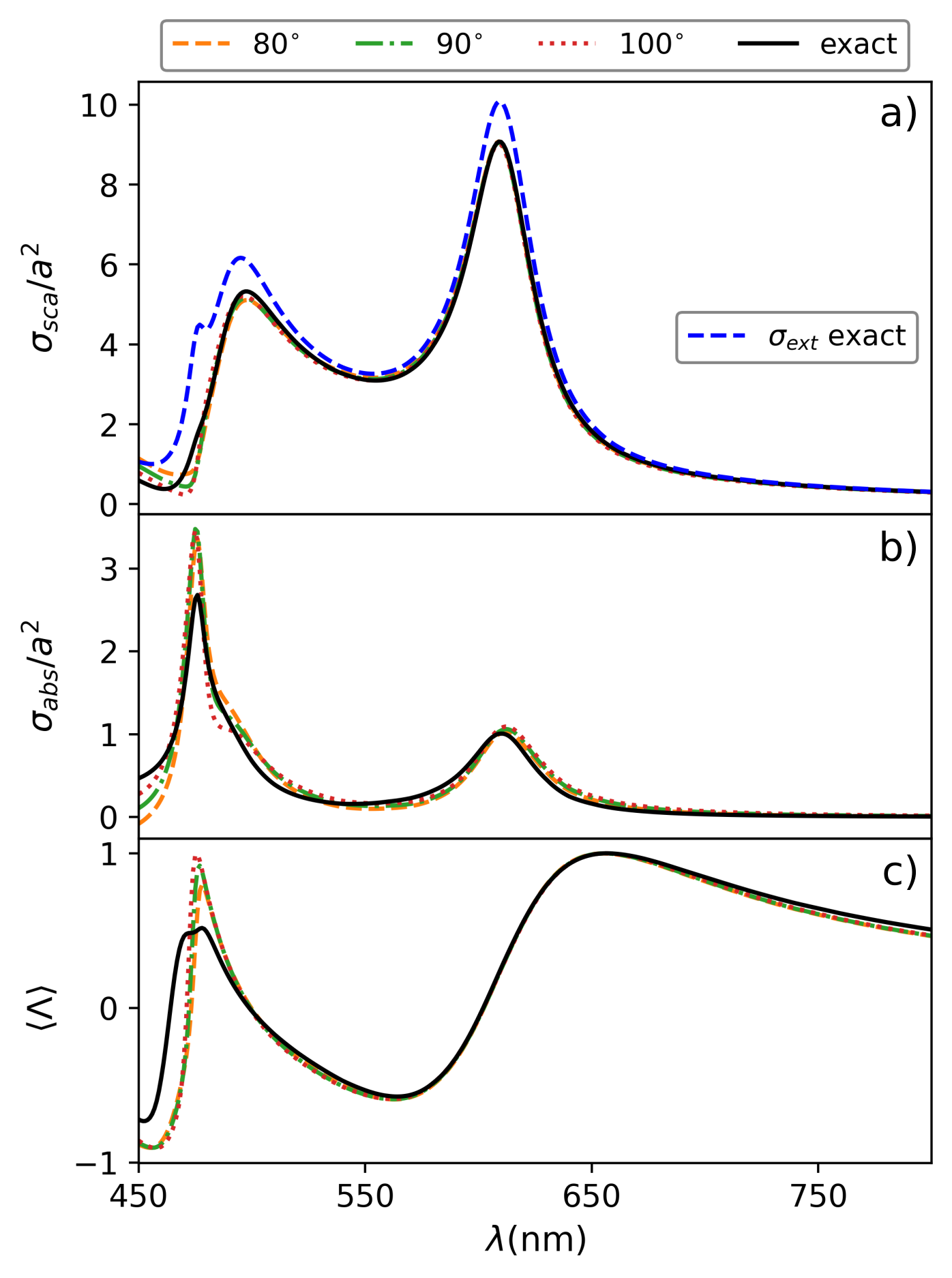
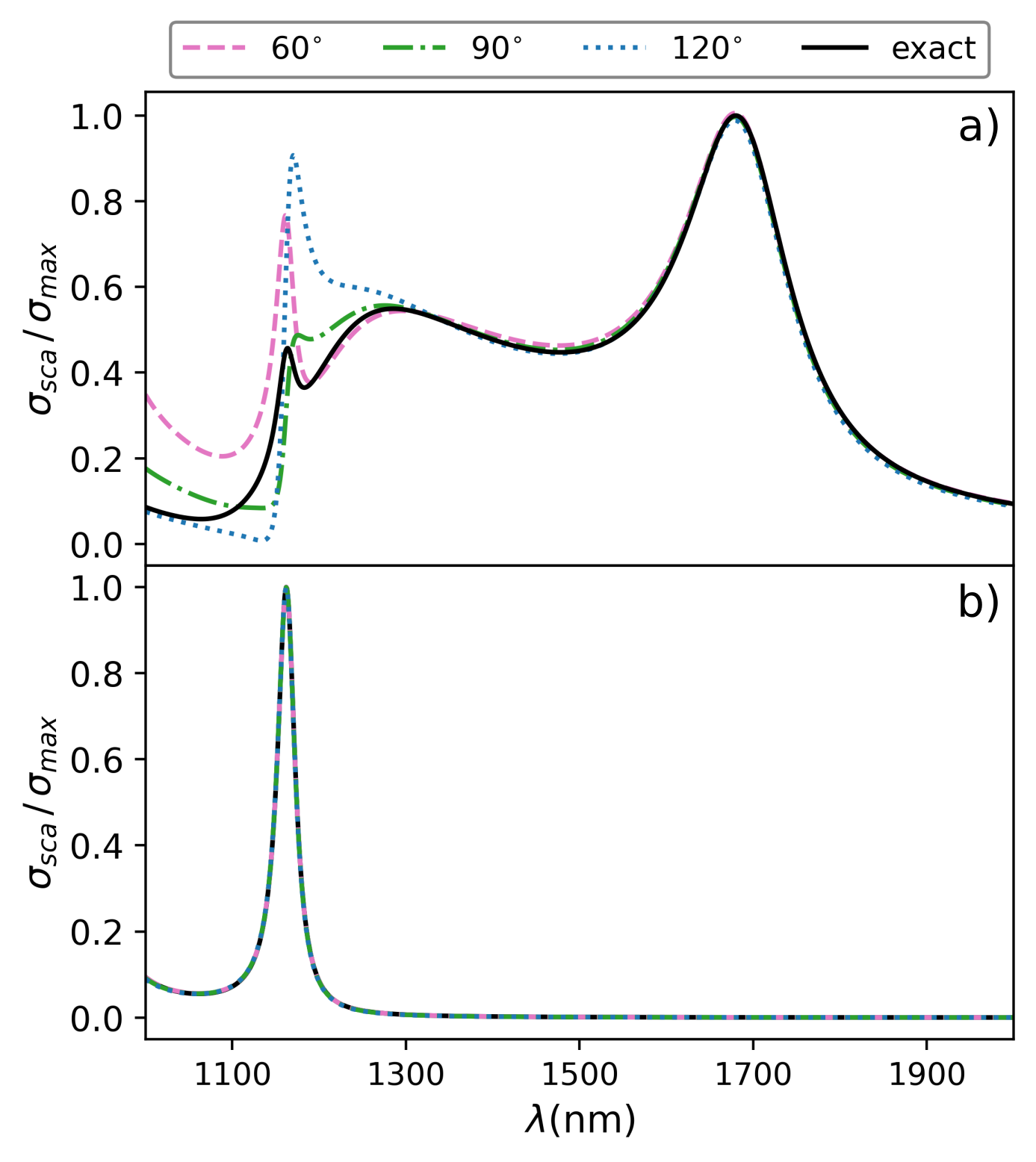
Experimental results
Research questions
- RQ1Can the scattering cross-section and global polarization state of a cylindrically symmetric particle be retrieved from local measurements of two Stokes parameters at a single far-field angle?
- RQ2How can the optical theorem’s limitations under focused or non-plane-wave illumination be overcome using local field measurements?
- RQ3What is the mathematical relationship between local far-field Stokes parameters and the integrated scattering and polarization properties of a particle?
- RQ4To what extent can the multipolar response of a particle be reconstructed using only intensity and circular polarization measurements at one angle?
- RQ5How do the coefficients f_jm and g_jm, derived from vector spherical harmonics, enable the inversion of local measurements to global observables?
Key findings
- The method enables full characterization of scattering cross-section and global polarization state using only two local Stokes parameters (I and V) measured at a single far-field angle, eliminating the need for angular integration.
- The inverse relation between local and global Stokes parameters is derived as a 2×2 matrix transformation (Eq. 15), with coefficients f_jm and g_jm depending on the multipolar order j and magnetic quantum number m.
- For dipolar particles (ℓ=1), the inversion formula is explicitly derived (Eq. 22), showing that the global scattering and polarization parameters scale with (kr)^2 and depend on the measurement angle θ via sin⁴θ and (1+cos²θ) terms.
- The method is robust for various illuminations, including circularly polarized plane waves and focused Gaussian beams, extending beyond the scope of the optical theorem.
- The approach reduces experimental complexity to a single camera and standard wave plates, enabling routine, high-precision characterization of cylindrical nanostructures in standard optical labs.
- The theoretical framework is validated through analytical derivation of f_jm and g_jm using associated Legendre polynomials, providing a complete and quantitative link between local measurements and global optical properties.
Read this paper
Open the full text in the Nubint reader and ask about any passage as you read.
Read this paper on NubintThis review was generated by AI from the original paper. Please check the paper before citing it.