
[Paper Review] Circuit-Depth Reduction of Unitary-Coupled-Cluster Ansatz by Energy Sorting
This paper proposes an energy-sorting (ES) algorithm to reduce the circuit depth of unitary coupled-cluster (UCC) ansatz in variational quantum eigensolver (VQE) by pre-sorting excitation operators based on their energy contribution. By iteratively adding the most impactful operators, the method achieves up to 98% reduction in operator count while preserving chemical accuracy, significantly improving resource efficiency for NISQ devices.
Quantum computation represents a revolutionary approach for solving problems in quantum chemistry. However, due to the limited quantum resources in the current noisy intermediate-scale quantum (NISQ) devices, quantum algorithms for large chemical systems remains a major task. In this work, we demonstrate that the circuit depth of the unitary coupled cluster (UCC) and UCC-based ansatzes in the algorithm of variational quantum eigensolver can be significantly reduced by an energy-sorting strategy. Specifically, subsets of excitation operators are first pre-screened from the operator pool according to its contribution to the total energy. The quantum circuit ansatz is then iteratively constructed until the convergence of the final energy to a typical accuracy. For demonstration, this method has been successfully applied to molecular and periodic systems. Particularly, a reduction of 50\%$\sim$98\% in the number of operators is observed while retaining the accuracy of the origin UCCSD operator pools. This method can be straightforwardly extended to general parametric variational ansatzes.
Motivation & Objective
- Address the high circuit depth of UCC-based ansatzes in variational quantum eigensolver (VQE), which limits their feasibility on current noisy intermediate-scale quantum (NISQ) devices.
- Reduce the number of excitation operators in UCC and UCCGSD ansatzes without sacrificing energy accuracy to improve quantum circuit efficiency.
- Develop a scalable, parameter-efficient method that minimizes repeated measurements during iterative ansatz construction.
- Enable accurate ground-state energy calculations for both molecular and periodic systems using compressed ansatzes on near-term quantum hardware.
Proposed method
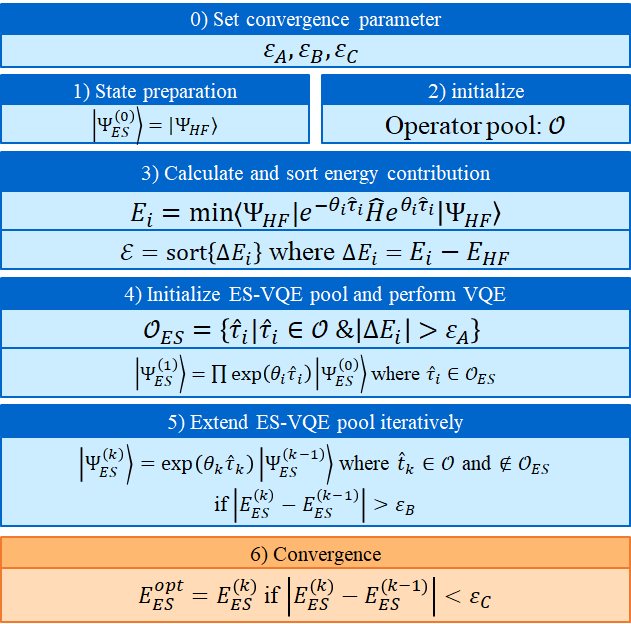
- Pre-screen all excitation operators from the UCC pool by evaluating their energy contribution relative to the Hartree-Fock reference state in a single-shot measurement.
- Sort operators in descending order of energy reduction potential to prioritize the most influential terms.
- Construct the ansatz iteratively by adding operators in the pre-sorted sequence until energy convergence is achieved.
- Use a single initial evaluation to score all operators, avoiding repeated measurement overhead during iterative ansatz growth.
- Apply the energy-sorting strategy to both UCCSD and UCCGSD ansatzes, enabling application to strongly correlated systems.
- Integrate the method with VQE by using the sorted operator pool to generate a compressed, yet accurate, parametric quantum circuit.
Experimental results
Research questions
- RQ1Can the circuit depth of UCC-based ansatzes be significantly reduced while maintaining chemical accuracy in VQE?
- RQ2Does pre-sorting excitation operators by energy contribution enable faster convergence with fewer operators?
- RQ3How effective is the energy-sorting strategy in reducing the number of CNOT gates and circuit depth for both molecular and periodic systems?
- RQ4Can the method be extended to general parametric variational ansatzes beyond UCC?
- RQ5What is the trade-off between operator count reduction and energy accuracy in strongly correlated systems like H6?
Key findings
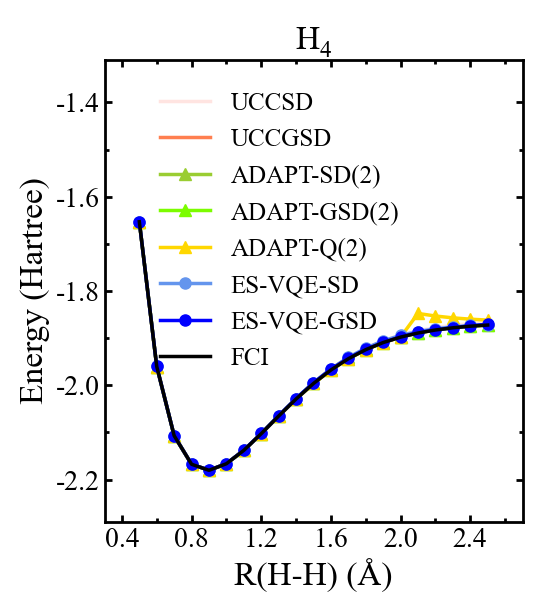
- The energy-sorting (ES-VQE) method reduces the number of excitation operators by 50% to 98% compared to the original UCCSD pool while retaining chemical accuracy.
- For the LiH molecule, the method achieved chemical accuracy with only a fraction of the original operators, significantly reducing circuit depth.
- In the H6 molecule, a strongly correlated system, the ES-VQE with UCCGSD ansatz reached chemical accuracy using just 20 operators selected from an initial pool of 240.
- The single-parameter update scheme failed to achieve chemical accuracy even with all 240 operators, highlighting the advantage of iterative, multi-operator updates in ES-VQE.
- The method maintains low measurement overhead, as only one initial evaluation is needed to score all operators, avoiding repeated costly measurements during optimization.
- The approach is generalizable to other parametric ansatzes and has been successfully applied to both molecular and periodic systems, including 1D hydrogen chains with k-point sampling.
Read this paper
Open the full text in the Nubint reader and ask about any passage as you read.
Read this paper on NubintThis review was generated by AI from the original paper. Please check the paper before citing it.