
[Paper Review] Colloidal Hard Spheres: Triumphs, Challenges and Mysteries
A comprehensive review of colloidal hard spheres as model systems, covering equilibrium and non-equilibrium phenomena, experimental realizations, simulations, theory, and open challenges.
The simplicity of hard spheres as a model system is deceptive. Although the particles interact solely through volume exclusion, that nevertheless suffices for a wealth of static and dynamical phenomena to emerge, making the model an important target for achieving a comprehensive understanding of matter. In addition, while real colloidal suspensions are typically governed by complex interactions, Pusey and Van Megen [Nature 320 340--342 (1986)] demonstrated that suitably tuned suspensions result in hard-sphere like behavior, thus bringing a valuable experimental complement to the celebrated theoretical model. Colloidal hard spheres are thus both a material in their own right and a platform upon which phenomena exhibited by simple materials can be explored in great detail. These various purposes enable a particular synergy between experiment, theory and computer simulation. Here we review the extensive body of work on hard spheres, ranging from their equilibrium properties such as phase behavior, interfaces and confinement to some of the non--equilibrium phenomena they exhibit such as sedimentation, glass formation and nucleation.
Motivation & Objective
- Explain why hard-sphere colloids serve as benchmark models for simple liquids and their entropy-driven phase behavior.
- Assess how real colloidal systems approximate hard-sphere behavior through synthesis, stabilization, and mapping to hard-sphere parameters.
- Survey experimental, computational, and theoretical approaches to hard-sphere systems and identify key achievements and outstanding challenges.
- Highlight experimental observations and theoretical developments across phases, interfaces, confinement, mixtures, and non-equilibrium phenomena.
Proposed method
- Synthesize and characterize hard-sphere like colloids, especially sterically stabilized PMMA, to approximate hard-sphere behavior.
- Map real colloidal interactions to effective hard-sphere models and determine effective diameters and volume fractions.
- Review experimental techniques for measuring structure and dynamics, including light scattering and confocal microscopy.
- Summarize in silico methods used for hard-sphere systems, including Monte Carlo, event-driven, Brownian dynamics, and hydrodynamics-inclusive simulations.
- Discuss theoretical frameworks such as integral equation theory, cell theory, and classical density functional theory for hard spheres.
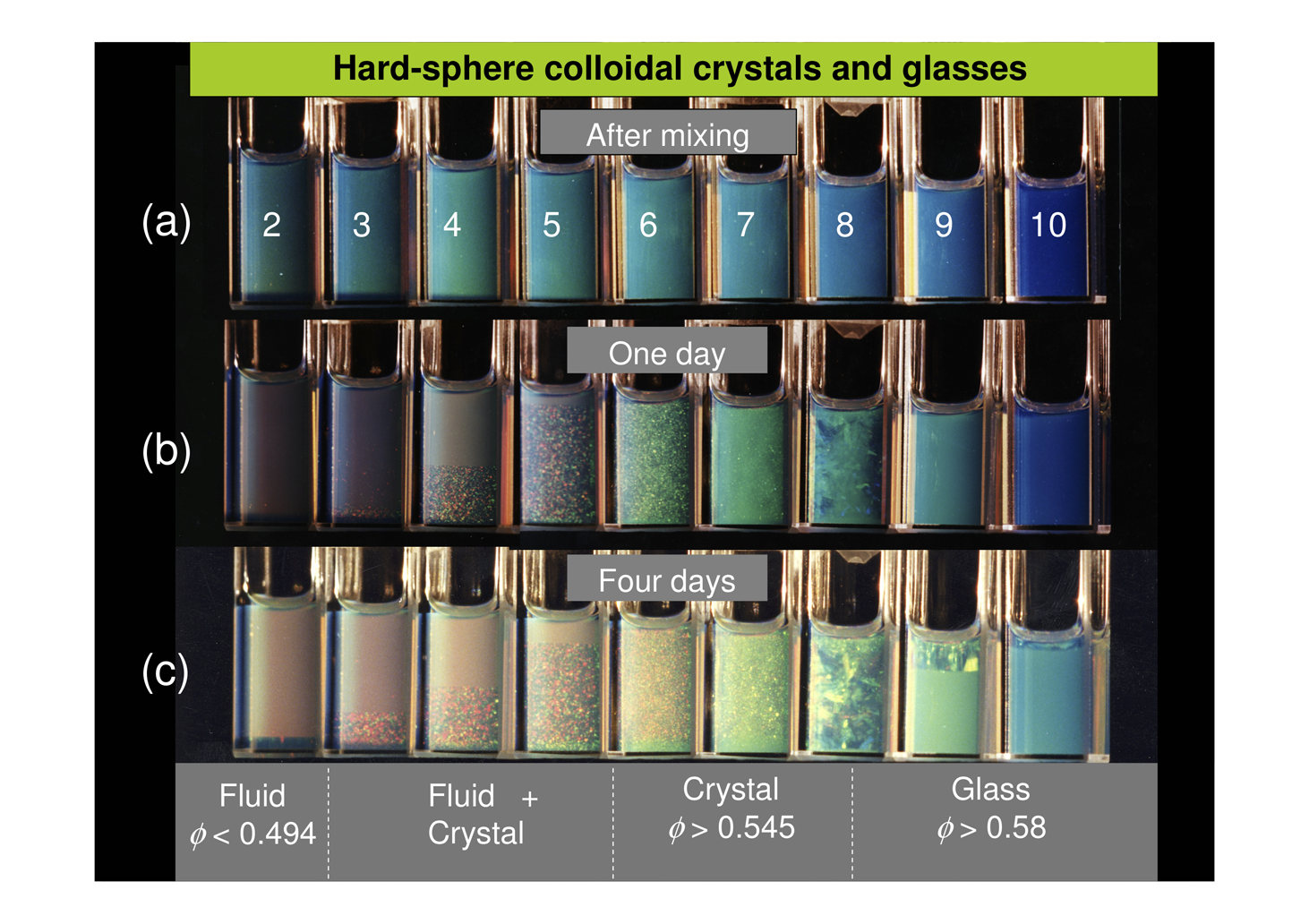
Experimental results
Research questions
- RQ1How closely do real colloidal systems emulate ideal hard-sphere behavior across synthesis, stabilization, and experimental conditions?
- RQ2What equilibrium phase behavior and dynamic phenomena of hard spheres have been observed experimentally, and how well do they agree with theory and simulations?
- RQ3What are the main challenges in mapping soft or charged colloids onto hard-sphere models, and how can effective diameters be determined?
- RQ4What open questions remain in glass formation, nucleation, and confinement for hard-sphere systems?
- RQ5How can experiments, simulations, and theory be integrated to advance understanding of hard-sphere colloids?
Key findings
- Hard-sphere systems exhibit entropy-driven fluid-crystal transitions confirmed experimentally in colloids.
- Colloid experiments enable direct imaging of structure and dynamics, including higher-order structural development.
- Interfacial free energy and grain boundaries in hard-sphere systems model fundamental materials failure mechanisms.
- Binary mixtures, confinement, and non-equilibrium phenomena reveal rich behaviors explored both experimentally and computationally.
- Hard-sphere glasses, jamming, and nucleation phenomena are central to understanding phase transitions and aging in these systems.
Better researchstarts right now
From reading papers to final review, dramatically reduce your research time.
No credit card · Free plan available
This review was created by AI and reviewed by human editors.