
[Paper Review] Composite Classical and Quantum Channel Discrimination
This paper investigates binary composite channel discrimination in the asymmetric setting, characterizing the Stein exponent for parallel strategies and deriving an upper bound for adaptive strategies in both classical and quantum channels. It shows that adaptive strategies can outperform parallel ones for classical channels when hypotheses are non-convex, revealing a fundamental advantage absent in simple hypothesis testing.
We study the problem of binary composite channel discrimination in the asymmetric setting, where the hypotheses are given by fairly arbitrary sets of channels, and samples do not have to be identically distributed. In the case of quantum channels we prove: (i) a characterization of the Stein exponent for parallel channel discrimination strategies and (ii) an upper bound on the Stein exponent for adaptive channel discrimination strategies. We further show that already for classical channels this upper bound can sometimes be achieved and be strictly larger than what is possible with parallel strategies. Hence, there can be an advantage of adaptive channel discrimination strategies with composite hypotheses for classical channels, unlike in the case of simple hypotheses. Moreover, we show that classically this advantage can only exist if the sets of channels corresponding to the hypotheses are non-convex. As a consequence of our more general treatment, which is not limited to the composite i.i.d. setting, we also obtain a generalization of previous composite state discrimination results.
Motivation & Objective
- To characterize the asymptotic performance of parallel channel discrimination strategies under composite hypotheses in both classical and quantum settings.
- To derive an upper bound on the Stein exponent for adaptive channel discrimination strategies in the composite setting.
- To investigate whether adaptive strategies can outperform parallel strategies in classical and quantum channel discrimination when hypotheses are composite.
- To determine the conditions under which adaptive strategies provide a performance advantage, particularly in relation to convexity of hypothesis sets.
- To generalize prior results on composite state discrimination to the channel discrimination setting, extending beyond i.i.d. assumptions.
Proposed method
- Uses channel divergence measures, particularly the regularized relative entropy of channel divergence, to characterize the Stein exponent in the parallel strategy case.
- Applies joint convexity and additivity properties of quantum relative entropy to bound the adaptive strategy exponent via single-letter expressions.
- Employs a variational approach over input states and channel sets to derive upper bounds on the asymptotic error exponent for adaptive strategies.
- Constructs explicit classical examples with non-convex channel sets to demonstrate that the upper bound on the adaptive exponent can be achieved.
- Generalizes results from composite state discrimination to composite channel discrimination by relaxing the i.i.d. assumption and allowing independent but non-identical channel instances.
- Leverages the structure of quantum and classical channel sets to analyze the role of convexity in determining the optimality of parallel strategies.
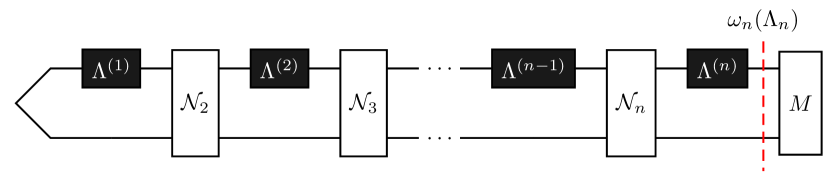
Experimental results
Research questions
- RQ1Can adaptive channel discrimination strategies outperform parallel strategies in the composite hypothesis setting for classical channels?
- RQ2Under what conditions—particularly regarding convexity—does an adaptive advantage emerge in classical composite channel discrimination?
- RQ3Is there a fundamental gap between the performance of adaptive and parallel strategies in the quantum composite channel discrimination setting?
- RQ4Can the upper bound on the adaptive Stein exponent be achieved in classical settings, and if so, under what structural assumptions on the channel sets?
- RQ5To what extent do the results generalize beyond the i.i.d. setting, and how does the independence of channel instances affect the asymptotic error exponent?
Key findings
- For quantum channels, the paper provides a characterization of the Stein exponent for parallel strategies using the regularized channel divergence, establishing a precise asymptotic error rate.
- An upper bound on the Stein exponent for adaptive strategies is derived, which applies to both classical and quantum channels.
- In classical channels, the upper bound on the adaptive exponent can be achieved when the hypothesis sets are non-convex, demonstrating a strict performance advantage over parallel strategies.
- The adaptive advantage in classical channels is shown to be impossible when the sets of channels are convex, implying that convexity is a necessary condition for parallel strategies to be asymptotically optimal.
- The paper generalizes previous results on composite state discrimination to the channel setting, showing that the same structural insights apply even without assuming i.i.d. channel instances.
- The upper bound on the adaptive exponent is shown to be tight in certain classical examples, indicating that the bound is not vacuous and can be saturated under specific structural conditions on the channel sets.
Read this paper
Open the full text in the Nubint reader and ask about any passage as you read.
Read this paper on NubintThis review was generated by AI from the original paper. Please check the paper before citing it.