
[Paper Review] Contrast, Attend and Diffuse to Decode High-Resolution Images from Brain Activities
The paper presents a two-phase fMRI representation learning framework (DC-MAE pre-training plus cross-modality tuning) to condition a latent diffusion model for high-resolution image reconstruction from brain activity, achieving substantial gains over prior methods.
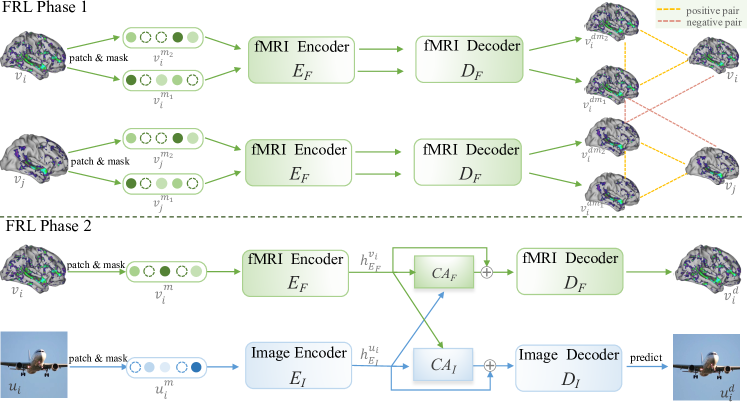
Decoding visual stimuli from neural responses recorded by functional Magnetic Resonance Imaging (fMRI) presents an intriguing intersection between cognitive neuroscience and machine learning, promising advancements in understanding human visual perception and building non-invasive brain-machine interfaces. However, the task is challenging due to the noisy nature of fMRI signals and the intricate pattern of brain visual representations. To mitigate these challenges, we introduce a two-phase fMRI representation learning framework. The first phase pre-trains an fMRI feature learner with a proposed Double-contrastive Mask Auto-encoder to learn denoised representations. The second phase tunes the feature learner to attend to neural activation patterns most informative for visual reconstruction with guidance from an image auto-encoder. The optimized fMRI feature learner then conditions a latent diffusion model to reconstruct image stimuli from brain activities. Experimental results demonstrate our model's superiority in generating high-resolution and semantically accurate images, substantially exceeding previous state-of-the-art methods by 39.34% in the 50-way-top-1 semantic classification accuracy. Our research invites further exploration of the decoding task's potential and contributes to the development of non-invasive brain-machine interfaces.
Motivation & Objective
- Denoise and denoise brain fMRI representations to improve decoding quality.
- Leverage cross-modality guidance to attend to vision-related brain signals.
- Integrate a latent diffusion model to generate high-resolution semantically faithful images from fMRI.
- Demonstrate superior reconstruction performance on GOD and BOLD5000 datasets compared to baselines.
Proposed method
- Pre-train an fMRI feature learner with a Double-contrastive Masked Auto-Encoder (DC-MAE) on unlabeled fMRI data to learn denoised representations.
- Phase 2 tunes the fMRI encoder with an image auto-encoder using cross-attention to guide attention to informative brain patterns for reconstruction.
- Condition a latent diffusion model (LDM) with the optimized fMRI encoder to generate images from brain activity.
- Fine-tune LDM with cross-attention conditioning using fMRI features to perform conditional image generation.
- Use an evaluation metric based on 50-way-top-1 semantic accuracy via a pre-trained ImageNet classifier to assess semantic correctness.
Experimental results
Research questions
- RQ1Can DC-MAE effectively denoise and align fMRI representations across individuals?
- RQ2Does cross-modality guidance between fMRI and image auto-encoders improve visual reconstruction from fMRI?
- RQ3How well can a latent diffusion model conditioned on fMRI generate high-resolution, semantically accurate images?
- RQ4What are the relative contributions of reconstruction losses and mask ratios in FRL Phase 2 to decoding performance?
- RQ5Is the proposed framework scalable across datasets like GOD and BOLD5000?
Key findings
- The proposed model surpasses previous state-of-the-art methods by 39.34% in 50-way-top-1 accuracy on GOD and BOLD5000 data.
- The two-phase FRL (DC-MAE pre-training followed by cross-modality tuning) yields high-resolution and semantically accurate reconstructions.
- Ablation studies show joint fMRI and image reconstruction losses plus carefully chosen mask ratios and decoder depths are critical for performance.
- The method achieves 50-way-top-1 accuracy of 25 on GOD subject CSI1 and demonstrates superior performance across GOD subjects 1,2,4,5 compared to DC-LDM when test-set fMRI data is not used for tuning.
- The approach identifies a bias and detail reconstruction trade-off, acknowledging dataset-induced biases in LDM training.

Read this paper
Open the full text in the Nubint reader and ask about any passage as you read.
Read this paper on NubintThis review was generated by AI from the original paper. Please check the paper before citing it.