
[Paper Review] Control and Readout of a 13-level Trapped Ion Qudit
This work demonstrates state preparation and single-shot readout of a 13-level trapped-ion qudit in Ba-137+, with protocols extendable to 25 levels, and analyzes SPAM fidelity and error sources.
To implement useful quantum algorithms which demonstrate quantum advantage, we must scale currently demonstrated quantum computers up significantly. Leading platforms such as trapped ions face physical challenges in including more information carriers. A less explored avenue for scaling up the computational space involves utilizing the rich energy level structure of a trapped ion to encode multi-level qudits rather than two-level qubits. Here we show control and single-shot readout of qudits with up to 13 computational states, using protocols which can be extended directly to manipulate qudits of up to 25 levels in our chosen information host, $^{137} ext{Ba}^{+}$. This represents more than twice as many computational states per qudit compared with prior work in trapped ions. In addition to the preparation and readout protocols we demonstrate, universal quantum computation requires other quantum logic primitives such as entangling gates. These primitives have been demonstrated for lower qudit dimensions and can be directly generalized to the higher dimensions we employ. Hence, our advance opens an avenue towards using high-dimensional qudits for large-scale quantum computation. We anticipate efficiently utilizing available energy states in a trapped ion to play a significant and complementary role in tackling the challenge in scaling up the computational space of a trapped ion quantum computer. A qudit architecture also offers other practical benefits, which include affording relaxed fault tolerance thresholds for quantum error correction, providing an avenue for efficient quantum simulation of higher spin systems, and more efficient qubit gates.
Motivation & Objective
- Motivate scaling quantum computers by using high-dimensional qudits in trapped ions to increase information capacity per ion.
- Show state preparation and measurement (SPAM) for a 13-level qudit encoded in Ba-137+ energy levels.
- Demonstrate that SPAM fidelities are achievable in high-dimensional qudit encoding and identify dominant error sources.
- Provide a pathway to extending qudit encoding beyond 13 levels toward 25 levels in Ba-137+.
Proposed method
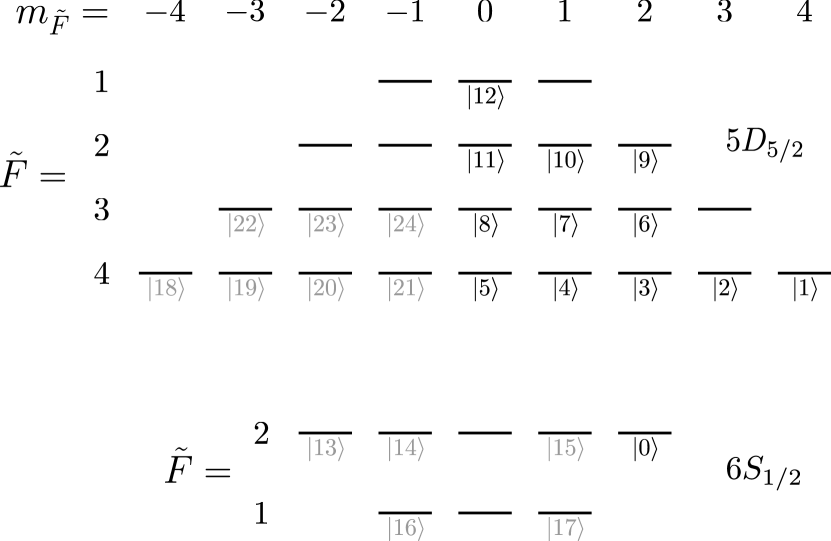
- Encode 13 qudit levels in Ba-137+ using 6S1/2 F=2,mF=2 and selected 5D5/2 metastable states with 1762 nm transitions.
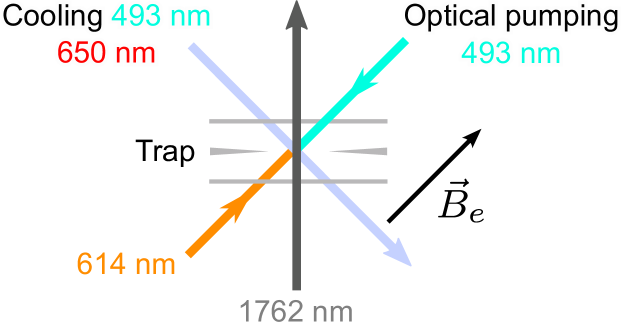
- Perform single-shot SPAM by shelving non-target states to 5D5/2, then deshelving and fluorescence checks to identify the prepared state.
- Characterize SPAM fidelity with post-selected measurements and model errors via magnetic field noise and π-pulse errors.
- Calibrate transition frequencies empirically and model transition strengths in intermediate magnetic fields.
- Estimate error contributions using filter-function theory to relate SPAM error to magnetic field noise and π-pulse duration.
Experimental results
Research questions
- RQ1Can a trapped Ba-137+ ion provide reliable SPAM for a 13-level qudit with high fidelity?
- RQ2What are the main sources of error in high-dimensional qudit SPAM, and how do they scale with qudit dimension?
- RQ3Is it feasible to extend qudit encoding beyond 13 levels within Ba-137+ using the presented protocol?
- RQ4How do transition strengths and energy-level mixing in a finite magnetic field affect control of high-dimensional qudits?
Key findings
- Achieved average post-selected SPAM fidelity of 91.7±0.3% for a 13-level qudit.
- Observed average post-selected SPAM error of 8.3±0.3% with raw SPAM error 13.1±0.3% for the 13-level qudit.
- Identified magnetic field noise as the major source of SPAM error, with errors scaling with κ^2 τ_π^2 per their model.
- Demonstrated that the calibration time for SPAM parameters does not increase with qudit dimension for certain protocols.
- Argue that encoding up to 25 levels is feasible in Ba-137+ with the presented control and readout scheme, given improved control of magnetic noise.
- Showed that qudit dimension scaling does not inherently limit SPAM fidelity when optimal qudit state choices are used.
Read this paper
Open the full text in the Nubint reader and ask about any passage as you read.
Read this paper on NubintThis review was generated by AI from the original paper. Please check the paper before citing it.