
[Paper Review] Data and code example for the article: "Massively parallel hybrid quantum-classical machine learning for kernelized time-series classification"
This paper proposes a massively parallel hybrid quantum-classical machine learning framework for time-series classification using a learnable Time-Series Hamiltonian Kernel (TSHK). The TSHK is constructed via parameterized quantum circuit evolution and optimized via differentiable multiple kernel learning, enabling end-to-end training in a QCC-net. The method achieves a 35× speed-up on 127-qubit superconducting processors using quantum multi-programming without accuracy loss, demonstrating practical scalability for NISQ devices.
Data needed to reproduce the figures of https://arxiv.org/abs/2305.05881 and a simple code example of a quantum-convex-classical neural network used to train a sine versus cosine classification problem.
Motivation & Objective
- To address the lack of learnable, temporal-aware kernel functions in classical kernel methods for time-series classification.
- To enable efficient, scalable deployment of quantum kernel methods on noisy intermediate-scale quantum (NISQ) hardware.
- To develop a differentiable, end-to-end trainable hybrid quantum-classical model that integrates quantum kernel learning with convex optimization.
- To demonstrate practical parallelism in quantum machine learning workflows using quantum multi-programming on real quantum processors.
Proposed method
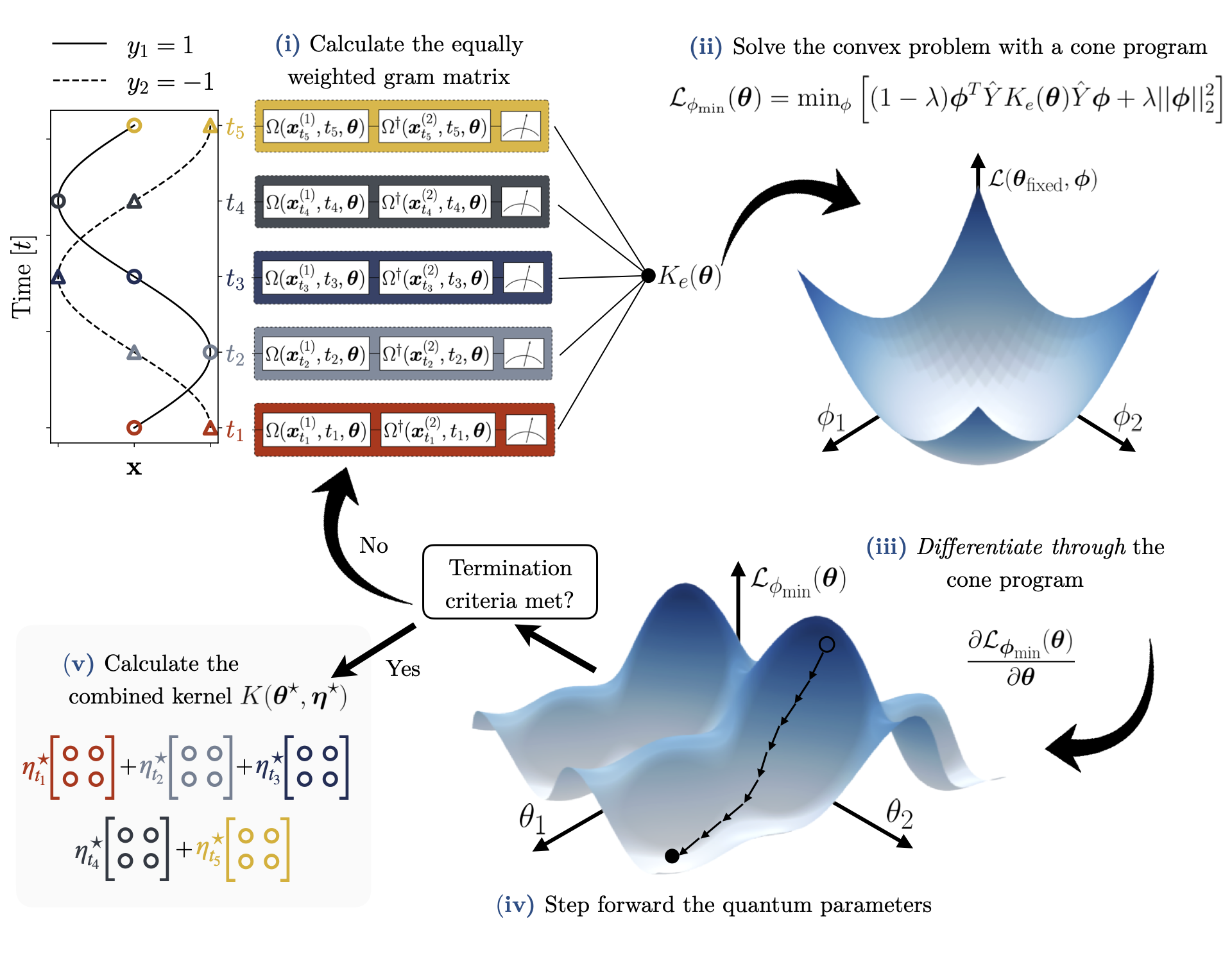
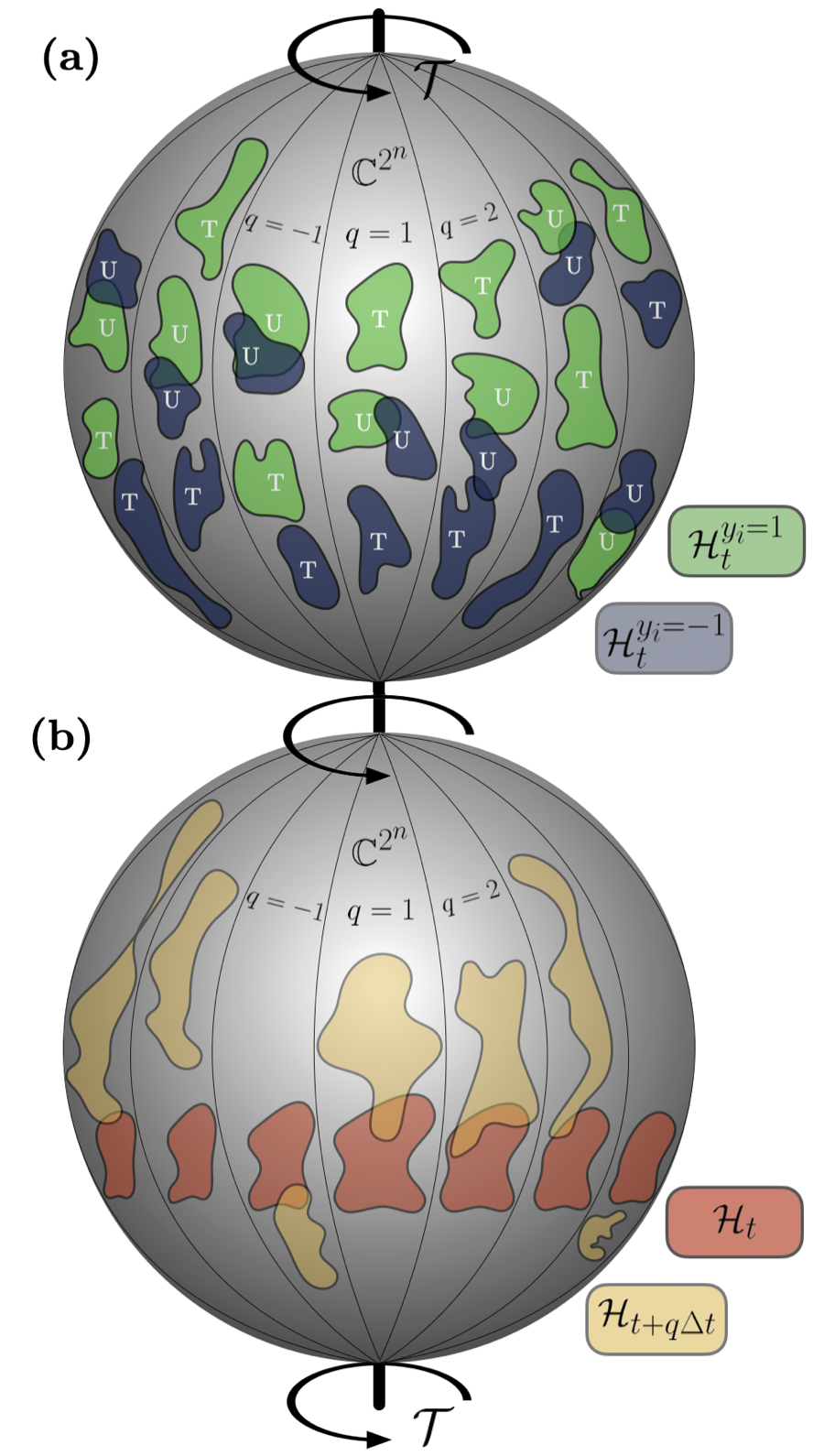
- The Time-Series Hamiltonian Kernel (TSHK) is constructed as a weighted sum of quantum kernel functions evolved at different time points using parameterized unitary evolution.
- The kernel weights are optimized via differentiable convex optimization, enabling end-to-end training in a Quantum-Classical-Convex (QCC-net) neural network.
- A variational eigendecomposition-based circuit Ansatz enables shallow implementation of time evolution operators, reducing circuit depth for NISQ devices.
- Quantum multi-programming (QMP) is used to execute multiple independent quantum circuits concurrently on 127-qubit IBM processors, enabling massive parallelism.
- Partial measurement extraction is implemented via a custom code to isolate relevant qubit subsystems from full circuit measurements.
- The TSHK is plugged into a support vector machine (SVM) for final time-series classification.
Experimental results
Research questions
- RQ1Can a learnable, time-dependent quantum kernel function be constructed to capture temporal relationships in time-series data?
- RQ2Can the kernel weights and quantum circuit parameters be jointly optimized in an end-to-end differentiable manner?
- RQ3Does quantum multi-programming enable significant speed-up in quantum kernel computation without accuracy degradation?
- RQ4Can the proposed TSHK-based method achieve high classification accuracy on real NISQ hardware?
Key findings
- The proposed TSHK framework achieved a 35× speed-up in kernel computation using quantum multi-programming on 127-qubit IBM quantum processors compared to serial execution.
- Result fidelity between QMP and non-QMP executions exceeded 0.99 on both simulator and real device environments, confirming no accuracy degradation.
- The fidelity between simulator and device outputs for QMP was 0.9909, outperforming the non-QMP score of 0.9134, indicating improved robustness.
- The method demonstrated consistent performance across 35 test circuits on real hardware, with QMP results matching non-QMP outputs within 0.99 fidelity.
- The partial measurement code successfully isolated relevant qubit subsystems, enabling efficient extraction of kernel matrix elements from multi-circuit runs.
Read this paper
Open the full text in the Nubint reader and ask about any passage as you read.
Read this paper on NubintThis review was generated by AI from the original paper. Please check the paper before citing it.