
[Paper Review] Data-driven modeling of an oscillating surge wave energy converter using dynamic mode decomposition
This paper proposes a data-driven modeling approach for oscillating surge wave energy converters (OSWECs) using dynamic mode decomposition (DMD) to create accurate, computationally efficient models without requiring knowledge of governing equations or incident wave fields. The method leverages time-series data from semi-analytical and WEC-Sim simulations to reconstruct and predict OSWEC dynamics under monochromatic and polychromatic waves, even with noisy measurements and nonlinear behavior, achieving high-fidelity predictions with limited sensors.
Modeling wave energy converters (WECs) to accurately predict their hydrodynamic behavior has been a challenge for the wave energy field. Often, this results in either low-fidelity, linear models that break down in energetic seas, or high-fidelity numerical models that are too computationally expensive for operational use. To bridge this gap, we propose the use of dynamic mode decomposition (DMD) as a purely data-driven technique that generates an accurate and computationally efficient model of an oscillating surge WEC (OSWEC). Our goal is to model and predict the behavior of the OSWEC in monochromatic and polychromatic seas without knowledge of the governing equations or incident wave field. We generate the data for the algorithm using a semi-analytical model and the open-source code WEC-Sim, then evaluate how well DMD can describe past dynamics and predict future state behavior. We consider realistic challenges including noisy sensor measurements, nonlinear WEC dynamics, and irregular wave forcing. In each of these cases, we generate accurate models for past and future OSWEC behavior using DMD, even with limited sensor measurements. These findings provide insight into the use of DMD on systems with limited time-resolved data and present a framework for applying similar analysis to lab- or field-scale experiments.
Motivation & Objective
- To address the challenge of modeling oscillating surge wave energy converters (OSWECs) with high accuracy and low computational cost in complex, real-world wave conditions.
- To develop a purely data-driven modeling technique that bypasses the need for analytical or high-fidelity numerical models (e.g., CFD) while maintaining predictive fidelity.
- To evaluate the robustness of dynamic mode decomposition (DMD) in modeling OSWECs under realistic conditions, including nonlinear dynamics, irregular wave forcing, and noisy sensor data.
- To demonstrate the feasibility of using DMD for real-time state estimation and control applications, such as model predictive control (MPC), in wave energy systems.
- To establish a framework applicable to lab- or field-scale OSWEC experiments using limited time-resolved sensor data.
Proposed method
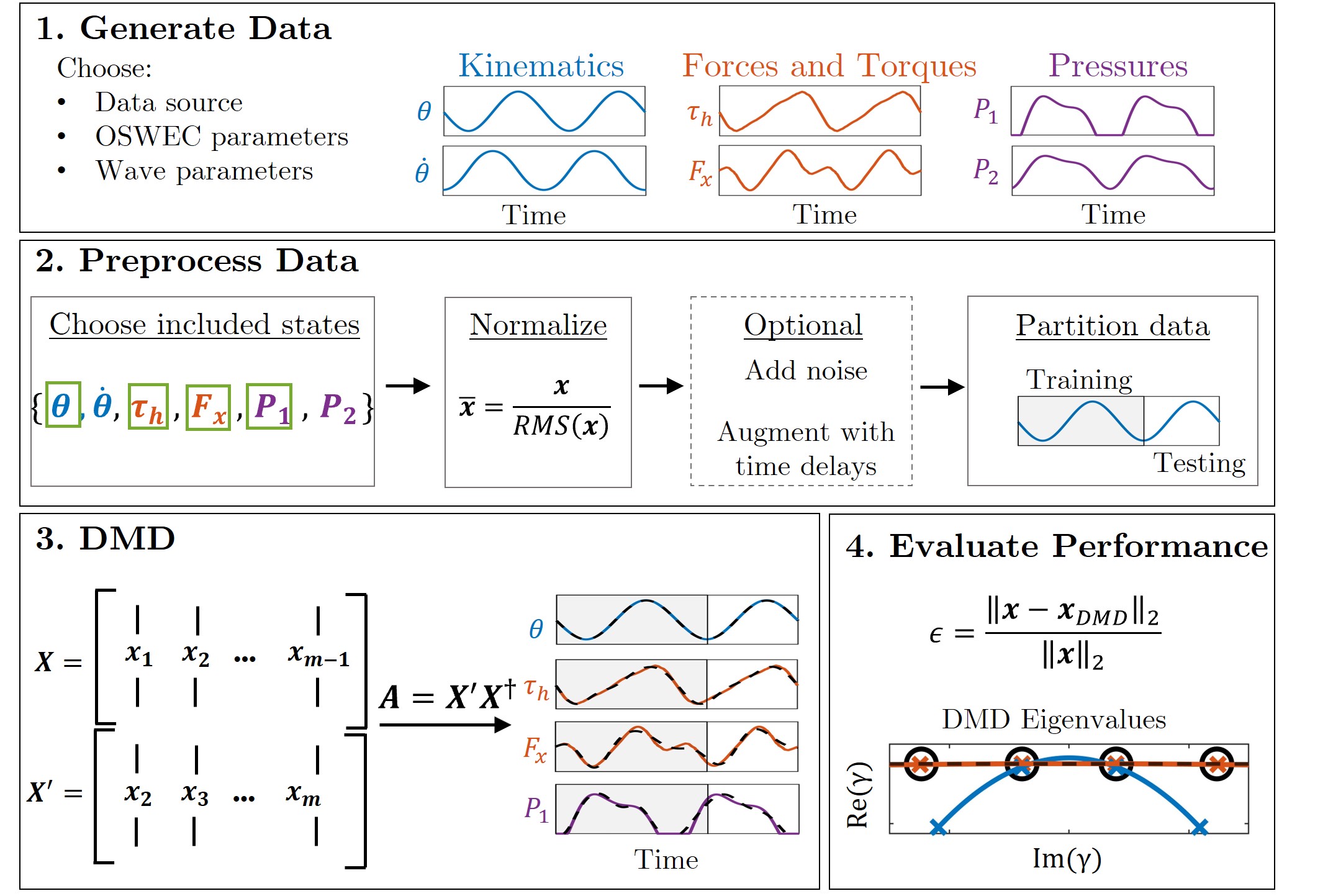
- The study applies dynamic mode decomposition (DMD) to time-series data of OSWEC state variables—such as angular rotation, absorbed power, and hydrodynamic torque—generated from a semi-analytical model and WEC-Sim simulations.
- DMD decomposes the data into spatially coherent dynamic modes with associated complex eigenvalues that describe the frequency and growth/decay of each mode, enabling system reconstruction and prediction without solving governing equations.
- The method uses time-delayed snapshots (e.g., X and X') to increase the rank of the data matrix and improve model fidelity, especially when sensor count is limited.
- Optimized DMD (optDMD) is employed to solve a nonlinear least-squares problem minimizing the Frobenius norm between the data matrix and a low-rank exponential approximation, improving accuracy for nonlinear and irregular dynamics.
- The approach is validated across three cases: monochromatic waves, polychromatic waves, and noisy measurements, using both linear and nonlinear system responses.
- Model accuracy is assessed by comparing DMD-predicted trajectories against reference data from WEC-Sim and semi-analytical models, with emphasis on phase and amplitude agreement.
Experimental results
Research questions
- RQ1Can DMD accurately reconstruct and predict the dynamic behavior of an OSWEC in monochromatic and polychromatic wave environments without prior knowledge of the system's governing equations?
- RQ2How well does DMD perform in modeling OSWECs under nonlinear hydrodynamic forces and viscous effects, particularly when the system deviates from linear assumptions?
- RQ3To what extent can DMD maintain predictive accuracy with limited sensor measurements and noisy data, representative of real-world experimental conditions?
- RQ4Can DMD-based models be sufficiently accurate and computationally efficient for real-time applications such as model predictive control (MPC) in wave energy systems?
- RQ5How does the inclusion of time-delayed data matrices improve the fidelity and rank of DMD models when sensor count is constrained?
Key findings
- DMD accurately reconstructs and predicts OSWEC dynamics in both monochromatic and polychromatic wave conditions, with strong agreement in phase and amplitude between predicted and reference trajectories.
- The method achieves high-fidelity modeling even with noisy sensor measurements, demonstrating robustness to realistic data degradation.
- DMD successfully captures nonlinear dynamics and complex fluid-structure interactions in OSWECs, including diffraction and viscous forces, without requiring explicit modeling of these effects.
- Time-delayed data matrices significantly improve model accuracy and allow for higher-rank approximations, especially when sensor count is limited.
- The optimized DMD variant (optDMD) enhances prediction accuracy for nonlinear and irregular wave forcing by solving a nonlinear least-squares problem to refine eigenvalue and mode estimates.
- The study confirms that DMD-based models are computationally efficient and suitable for real-time applications such as model predictive control, bridging the gap between low-fidelity linear models and high-fidelity but slow CFD simulations.
Better researchstarts right now
From reading papers to final review, dramatically reduce your research time.
No credit card · Free plan available
This review was created by AI and reviewed by human editors.