
[Paper Review] Data-Driven Resilient Predictive Control under Denial-of-Service
This paper proposes a data-driven model predictive control (MPC) scheme for stabilizing unknown linear time-invariant (LTI) systems under denial-of-service (DoS) attacks, using only pre-collected input-output trajectories without explicit system models. The method achieves local input-to-state stability (ISS) under DoS attacks and noise, matching the resilience level of model-based controllers, with global ISS attainable via two modifications at the cost of reduced resilience or higher computation.
The study of resilient control of linear time-invariant (LTI) systems against denial-of-service (DoS) attacks is gaining popularity in emerging cyber-physical applications. In previous works, explicit system models are required to design a predictor-based resilient controller. These models can be either given a priori or obtained through a prior system identification step. Recent research efforts have focused on data-driven control based on pre-collected input-output trajectories (i.e., without explicit system models). In this paper, we take an initial step toward data-driven stabilization of stochastic LTI systems under DoS attacks, and develop a resilient model predictive control (MPC) scheme driven purely by data-dependent conditions. The proposed data-driven control method achieves the same level of resilience as the model-based control method. For example, local input-to-state stability (ISS) is achieved under mild assumptions on the noise and the DoS attacks. To recover global ISS, two modifications are further suggested at the price of reduced resilience against DoS attacks or increased computational complexity. Finally, a numerical example is given to validate the effectiveness of the proposed control method.
Motivation & Objective
- To address the challenge of stabilizing unknown LTI systems under DoS attacks when explicit system models are unavailable.
- To develop a data-driven control framework that bypasses system identification and relies solely on pre-collected input-output trajectories.
- To achieve resilience against DoS attacks comparable to model-based predictive control methods.
- To ensure stability and robustness under noise and DoS attack conditions without prior system modeling.
- To generalize the resilience of model-based controllers to a data-driven setting with theoretical guarantees.
Proposed method
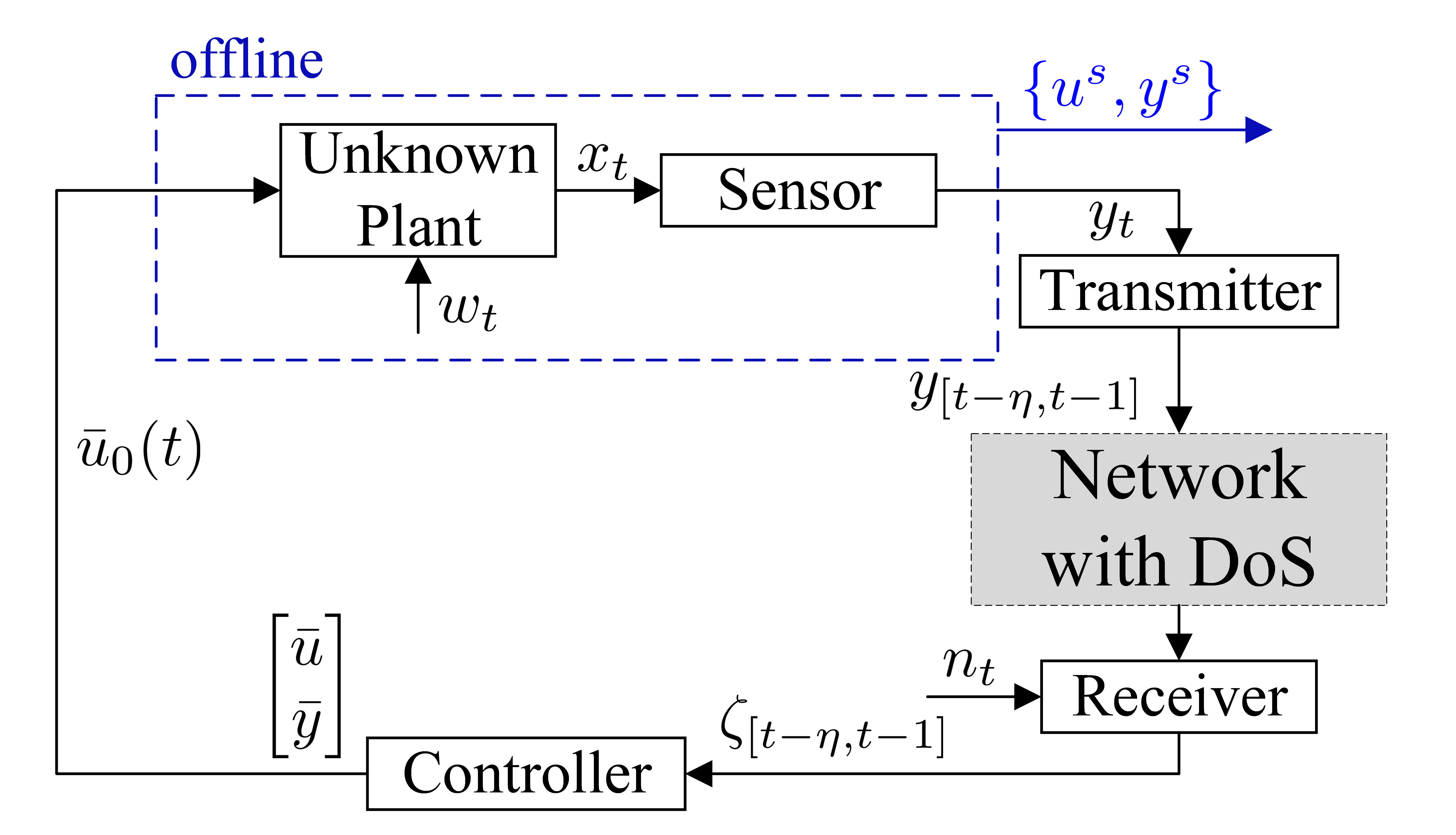
- The method uses the Fundamental Lemma to construct a data-dependent representation of system dynamics from pre-collected input-output trajectories.
- A data-driven MPC formulation is developed that computes control inputs and predicted outputs via convex optimization over the data matrix.
- The controller incorporates a predictor-based structure to estimate system states during DoS-induced data dropouts, ensuring continuous control action.
- Stability is analyzed using a Lyapunov function, with conditions derived on DoS attack frequency and duration and noise levels to ensure local ISS.
- Two modifications are proposed to extend local ISS to global ISS: one by adjusting the control law and another by modifying the optimization constraints, trading off resilience or computational load.
- The approach avoids system identification by directly using data to parameterize the control law, ensuring model-free design.
Experimental results
Research questions
- RQ1Can a data-driven MPC scheme achieve the same level of resilience against DoS attacks as model-based predictive controllers without requiring explicit system models?
- RQ2How can local input-to-state stability (ISS) be guaranteed in stochastic LTI systems under DoS attacks and measurement noise using only input-output data?
- RQ3What trade-offs arise when extending local ISS to global ISS in the data-driven framework, and how do they affect resilience or computational cost?
- RQ4How does the length of pre-collected data and prediction horizon affect system performance in the data-driven MPC under DoS attacks?
- RQ5To what extent does the data-driven approach outperform model-based methods when system identification is prone to overfitting in high-dimensional systems?
Key findings
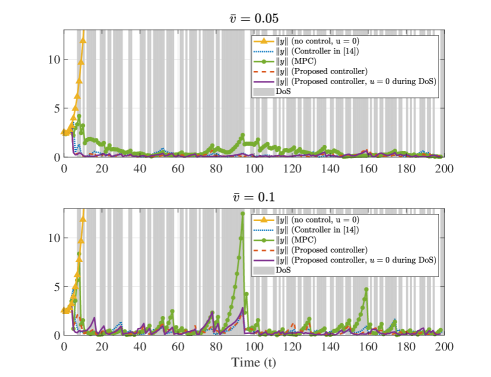
- The data-driven MPC achieves local input-to-state stability (ISS) under DoS attacks and bounded noise, matching the resilience level of model-based controllers.
- The condition on DoS attacks required for stability is identical to that in existing model-based approaches, indicating equivalent resilience.
- Global ISS is achievable through two modifications: one that reduces resilience against DoS attacks, and another that increases computational complexity.
- When the dataset size is small (e.g., N=40), the data-driven method outperforms model-based methods due to reduced overfitting from system identification.
- System performance improves rapidly with increasing dataset length N up to a threshold (N≈60), after which performance plateaus, indicating diminishing returns beyond a certain data size.
- Prediction horizon L has minimal impact on performance as long as L satisfies the data availability constraints L ≥ 2η + nx and L ≤ (N - nx + 1)/(max{nu, ny} + 1).
Better researchstarts right now
From reading papers to final review, dramatically reduce your research time.
No credit card · Free plan available
This review was created by AI and reviewed by human editors.