
[Paper Review] Debias Coarsely, Sample Conditionally: Statistical Downscaling through Optimal Transport and Probabilistic Diffusion Models
The paper presents a two-stage probabilistic framework for unpaired statistical downscaling: first debiasing via an optimal-transport map, then upsampling with conditional diffusion models, enabling high-resolution outputs that match target statistics.
We introduce a two-stage probabilistic framework for statistical downscaling using unpaired data. Statistical downscaling seeks a probabilistic map to transform low-resolution data from a biased coarse-grained numerical scheme to high-resolution data that is consistent with a high-fidelity scheme. Our framework tackles the problem by composing two transformations: (i) a debiasing step via an optimal transport map, and (ii) an upsampling step achieved by a probabilistic diffusion model with a posteriori conditional sampling. This approach characterizes a conditional distribution without needing paired data, and faithfully recovers relevant physical statistics from biased samples. We demonstrate the utility of the proposed approach on one- and two-dimensional fluid flow problems, which are representative of the core difficulties present in numerical simulations of weather and climate. Our method produces realistic high-resolution outputs from low-resolution inputs, by upsampling resolutions of 8x and 16x. Moreover, our procedure correctly matches the statistics of physical quantities, even when the low-frequency content of the inputs and outputs do not match, a crucial but difficult-to-satisfy assumption needed by current state-of-the-art alternatives. Code for this work is available at: https://github.com/google-research/swirl-dynamics/tree/main/swirl_dynamics/projects/probabilistic_diffusion.
Motivation & Objective
- Address the lack of paired data in statistical downscaling for high-fidelity, high-resolution outputs.
- Develop a factorized map C = T^{-1} ∘ C' that separates debiasing and upsampling.
- Use optimal transport to debias low-resolution data and diffusion models for conditional high-resolution sampling.
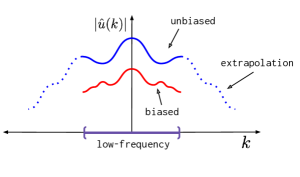
- Ensure the method preserves physical statistics even when low- and high-resolution spectra differ.
- Demonstrate applicability on one- and two-dimensional fluid flow problems with 8x and 16x upsampling.
Proposed method
- Factorize the downscaling map C into a linear downsampling C' and an invertible debiasing map T, such that C = T^{-1} ∘ C' (or equivalently C'_{#}μ_X = T_{#}μ_Y).
- Debiasing: solve an entropy-regularized optimal transport problem to obtain a transport map T that pushes μ_Y to μ_Y' consistent with C' μ_X.
- Upsampling: train a probabilistic diffusion model to learn the high-resolution prior p(x) and perform posterior sampling p(x|E'_{ȳ'}) where E'_{ȳ'} = {x: C'x = ȳ'} using a post-processed denoiser for conditional sampling.
- Posterior conditioning: modify the diffusion denoiser via a pseudo-inverse of C' to enforce conditioning on the intermediate low-resolution space.
- Implementation details include score-based diffusion with VP schedule, Tweedie formula for scores, and a post-processing denoiser (Eq. 7).
- Debiasing via OT is computed with entropic Sinkhorn, yielding a barycentric projection T_{γ}(y) for pushing μ_Y to μ_Y'.
Experimental results
Research questions
- RQ1Can unpaired low- and high-resolution data be downscaled to high-resolution outputs that faithfully reproduce target statistics?
- RQ2Does debiasing via optimal transport effectively align low-frequency statistics to the high-resolution distribution before upsampling?
- RQ3Can conditional diffusion models reliably sample from p(x|C'x = y') to produce realistic high-resolution fields while preserving physical statistics?
- RQ4What gains arise from separating debiasing and upsampling versus end-to-end approaches in unpaired downscaling tasks?
Key findings
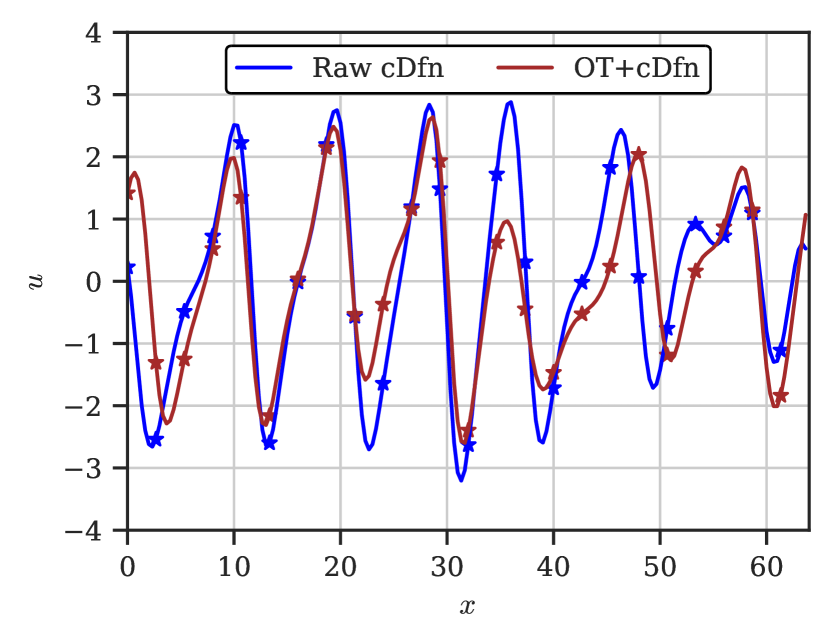
- OT debiasing significantly improves statistical alignment across metrics for KS and NS tests, enabling better downstream diffusion-based upsampling.
- Conditioning diffusion on OT-corrected intermediate data yields samples with close-to-target energy spectra and reduced divergences compared to unconditioned or non-debiased baselines.
- The proposed method outperforms baselines (e.g., BCSD, cycleGAN, ClimAlign, ViT-based upsampling) on multiple metrics (covRMSE, MELR, KLD, Wasserstein, MMD) for NS at 8x and 16x downscaling.
- The framework provides realistic small-scale features and notable variability, offering uncertainty quantification through its probabilistic sampling.
- OT correction is crucial; without it, conditioning degrades statistics due to bias contamination of diffusion trajectories.
- Qualitative results show the method produces sharper, physically plausible vorticity fields compared to several baselines.
- The approach remains effective across 8x and 16x downscaling, demonstrating robustness to large resolution gaps.
Read this paper
Open the full text in the Nubint reader and ask about any passage as you read.
Read this paper on NubintThis review was generated by AI from the original paper. Please check the paper before citing it.