
[Paper Review] Decoding quantum color codes with MaxSAT
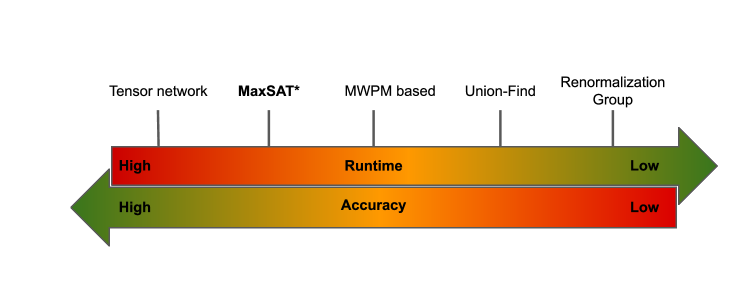
This paper proposes a novel MaxSAT-based decoder for quantum color codes by modeling the decoding problem as a variant of the LightsOut puzzle, enabling efficient and accurate error correction. The approach achieves near-optimal decoding performance with runtime that scales favorably with physical error rates, outperforming the tensor network decoder at low error rates—e.g., 9× faster at 10⁻³ error rate for distance-21 codes.
In classical computing, error-correcting codes are well established and are ubiquitous both in theory and practical applications. For quantum computing, error-correction is essential as well, but harder to realize, coming along with substantial resource overheads and being concomitant with needs for substantial classical computing. Quantum error-correcting codes play a central role on the avenue towards fault-tolerant quantum computation beyond presumed near-term applications. Among those, color codes constitute a particularly important class of quantum codes that have gained interest in recent years due to favourable properties over other codes. As in classical computing, decoding is the problem of inferring an operation to restore an uncorrupted state from a corrupted one and is central in the development of fault-tolerant quantum devices. In this work, we show how the decoding problem for color codes can be reduced to a slight variation of the well-known LightsOut puzzle. We propose a novel decoder for quantum color codes using a formulation as a MaxSAT problem based on this analogy. Furthermore, we optimize the MaxSAT construction and show numerically that the decoding performance of the proposed decoder achieves state-of-the-art decoding performance on color codes. The implementation of the decoder as well as tools to automatically conduct numerical experiments are publicly available as part of the Munich Quantum Toolkit (MQT) on GitHub.
Motivation & Objective
- To address the challenge of scalable, accurate, and fast decoding in fault-tolerant quantum computing, particularly for color codes.
- To reduce the quantum decoding problem to a classical constraint satisfaction problem using a novel analogy with the LightsOut puzzle.
- To develop an efficient MaxSAT formulation that enables high-performance decoding with practical runtime characteristics.
- To integrate the decoder into open-source tools for broader research use and reproducibility.
- To explore the potential of classical SAT solvers in solving fundamental quantum error correction problems.
Proposed method
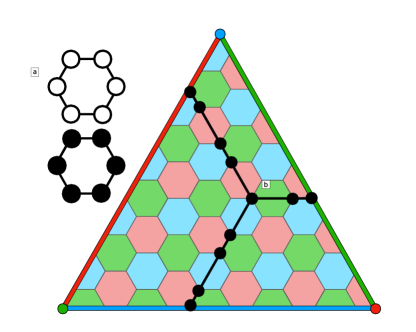
- The decoding problem for color codes is mapped to a modified LightsOut puzzle, where stabilizer measurements correspond to light toggles.
- A MaxSAT formulation is constructed to find minimal error patterns consistent with observed syndromes, minimizing the number of physical errors.
- Constraint optimization techniques are applied to improve the efficiency and reusability of the MaxSAT encoding.
- The MaxSAT instance is solved using off-the-shelf solvers, with performance evaluated across various error rates and code distances.
- The implementation is integrated into the Munich Quantum Toolkit (MQT) for public access and reproducible experiments.
- Runtime comparisons are conducted with tensor network and trellis decoders under identical noise models and sampling conditions.
Experimental results
Research questions
- RQ1Can the decoding problem for quantum color codes be effectively modeled as a variant of the LightsOut puzzle?
- RQ2How does the performance of a MaxSAT-based decoder compare to existing state-of-the-art decoders like tensor network and trellis decoders?
- RQ3Does the MaxSAT decoder exhibit favorable runtime scaling with physical error rate compared to decoders with fixed or non-scaling runtimes?
- RQ4To what extent can constraint optimization improve the efficiency and practicality of MaxSAT-based quantum decoding?
- RQ5Can this MaxSAT approach be generalized beyond color codes to other quantum error-correcting codes?
Key findings
- The MaxSAT decoder achieves near-optimal decoding performance for bit-flip errors with noiseless syndrome measurements, matching the best-known results.
- At a physical error rate of 10⁻³, the MaxSAT decoder is approximately 9 times faster than the tensor network decoder for a distance-21 color code (25 ms vs 225 ms).
- The runtime of the MaxSAT decoder scales proportionally with the physical error rate, unlike the tensor network and trellis decoders, which exhibit constant runtime independent of error rate.
- The proposed MaxSAT formulation is highly reusable and optimized, enabling efficient numerical experiments and integration into the open-source Munich Quantum Toolkit (MQT).
- The decoder outperforms all other decoders in accuracy except the tensor network decoder, while significantly outperforming it in runtime at low error rates.
- The approach is generalizable beyond color codes and opens new pathways for applying classical constraint satisfaction techniques to quantum error correction.
Read this paper
Open the full text in the Nubint reader and ask about any passage as you read.
Read this paper on NubintThis review was generated by AI from the original paper. Please check the paper before citing it.