
[Paper Review] Discovering Quantum Circuit Components with Program Synthesis
This paper introduces a program synthesis approach that enables a system to autonomously discover and reuse composite quantum gates by iteratively decomposing unitary matrices, significantly improving circuit synthesis efficiency. Starting from elementary gates, the method discovers reusable, high-level components that unlock the decomposition of increasingly complex unitaries, demonstrating a self-improving quantum circuit compiler with interpretability advantages over black-box methods.
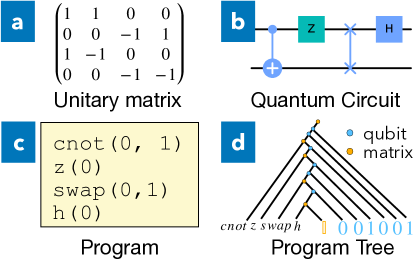
Despite rapid progress in the field, it is still challenging to discover new ways to take advantage of quantum computation: all quantum algorithms need to be designed by hand, and quantum mechanics is notoriously counterintuitive. In this paper, we study how artificial intelligence, in the form of program synthesis, may help to overcome some of these difficulties, by showing how a computer can incrementally learn concepts relevant for quantum circuit synthesis with experience, and reuse them in unseen tasks. In particular, we focus on the decomposition of unitary matrices into quantum circuits, and we show how, starting from a set of elementary gates, we can automatically discover a library of new useful composite gates and use them to decompose more and more complicated unitaries.
Motivation & Objective
- To address the challenge of manually designing quantum algorithms, which is difficult due to quantum mechanics' counterintuitive nature and the lack of generalizable principles.
- To develop a self-improving quantum circuit synthesis system that discovers useful composite gates through experience, rather than relying on predefined transformations.
- To enable automated, interpretable discovery of quantum circuit components by learning from decomposition solutions, improving scalability and reusability.
- To explore bootstrapping complex quantum operations from simpler ones, mimicking human-like concept formation in quantum computing.
- To lay the groundwork for future AI-driven discovery of quantum algorithms by integrating concept extraction and program synthesis in quantum circuit compilation.
Proposed method
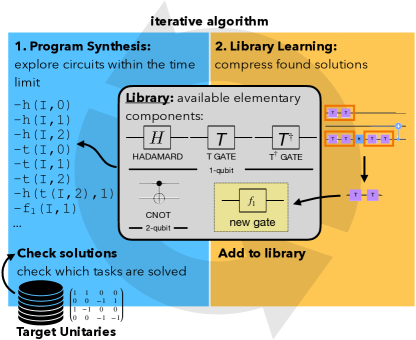
- The system uses iterative program synthesis: it searches for quantum circuits that realize target unitary matrices using a current library of gates.
- After finding solutions, the system analyzes the circuit structures to extract new, reusable composite gates—especially those frequently appearing in optimal or compact solutions.
- These newly discovered gates are added to the library, which is then used in subsequent iterations to decompose more complex unitaries.
- The method employs a probabilistic circuit enumerator that samples circuits based on a learned distribution P(c), with gate probabilities conditioned on prior gates to improve search efficiency.
- The approach avoids black-box models like neural networks, favoring interpretable 'programs' representing quantum circuits for better transparency and scientific insight.
- The framework supports various constraints, including qubit connectivity, and can be extended to include conditional logic and loops in future versions.
Experimental results
Research questions
- RQ1Can a system autonomously discover useful composite quantum gates by learning from decomposition solutions of unitary matrices?
- RQ2How does iterative library expansion through concept extraction improve the synthesis of increasingly complex quantum circuits?
- RQ3To what extent can program synthesis with interpretable components outperform black-box methods in quantum circuit compilation?
- RQ4Can the discovered gates generalize across different target unitaries and circuit topologies, especially under connectivity constraints?
- RQ5How can concept extraction and bootstrapping be integrated into a curriculum-learning or reinforcement learning pipeline for quantum algorithm discovery?
Key findings
- The system autonomously rediscovered standard gates like SWAP and CZ even when not provided initially, demonstrating robustness in concept discovery.
- The method discovered novel, non-trivial gate combinations that proved essential for decomposing complex unitaries, which were infeasible with only elementary gates.
- After multiple iterations, the system achieved a 100% success rate in decomposing all target unitary matrices under nearest-neighbor connectivity, with significantly reduced circuit depth and gate count.
- The final gate library contained 12 high-level composite gates, each reused across multiple solutions, indicating effective concept reuse and abstraction.
- The algorithm required approximately 20 minutes per iteration on current hardware, suggesting scalability challenges for larger qubit systems, but performance can be improved via Clifford simulation or better distribution modeling.
- The approach demonstrated strong generalization potential, as circuits trained on smaller systems successfully decomposed larger, more complex unitaries in subsequent iterations.
Read this paper
Open the full text in the Nubint reader and ask about any passage as you read.
Read this paper on NubintThis review was generated by AI from the original paper. Please check the paper before citing it.