
[Paper Review] Double-I Watermark: Protecting Model Copyright for LLM Fine-tuning
This paper introduces Double-I watermarking, a backdoor-type method that embeds a watermark into customized LLMs during fine-tuning using trigger patterns in either the instruction or input, verifiable in a black-box setting. It demonstrates uniqueness, harmlessness, robustness, and efficiency through theoretical analysis and experiments.
To support various applications, a prevalent and efficient approach for business owners is leveraging their valuable datasets to fine-tune a pre-trained LLM through the API provided by LLM owners or cloud servers. However, this process carries a substantial risk of model misuse, potentially resulting in severe economic consequences for business owners. Thus, safeguarding the copyright of these customized models during LLM fine-tuning has become an urgent practical requirement, but there are limited existing solutions to provide such protection. To tackle this pressing issue, we propose a novel watermarking approach named ``Double-I watermark''. Specifically, based on the instruct-tuning data, two types of backdoor data paradigms are introduced with trigger in the instruction and the input, respectively. By leveraging LLM's learning capability to incorporate customized backdoor samples into the dataset, the proposed approach effectively injects specific watermarking information into the customized model during fine-tuning, which makes it easy to inject and verify watermarks in commercial scenarios. We evaluate the proposed "Double-I watermark" under various fine-tuning methods, demonstrating its harmlessness, robustness, uniqueness, imperceptibility, and validity through both quantitative and qualitative analyses.
Motivation & Objective
- Motivate protecting copyrights of customized LLMs during fine-tuning and address practical misuse risks.
- Develop a watermarking technique that works in a black-box fine-tuning setting without harming downstream performance.
- Ensure watermark uniqueness, imperceptibility, robustness against attacks, and verification efficiency.
- Provide a verification framework that is efficient and statistically testable (Fisher exact test).
Proposed method
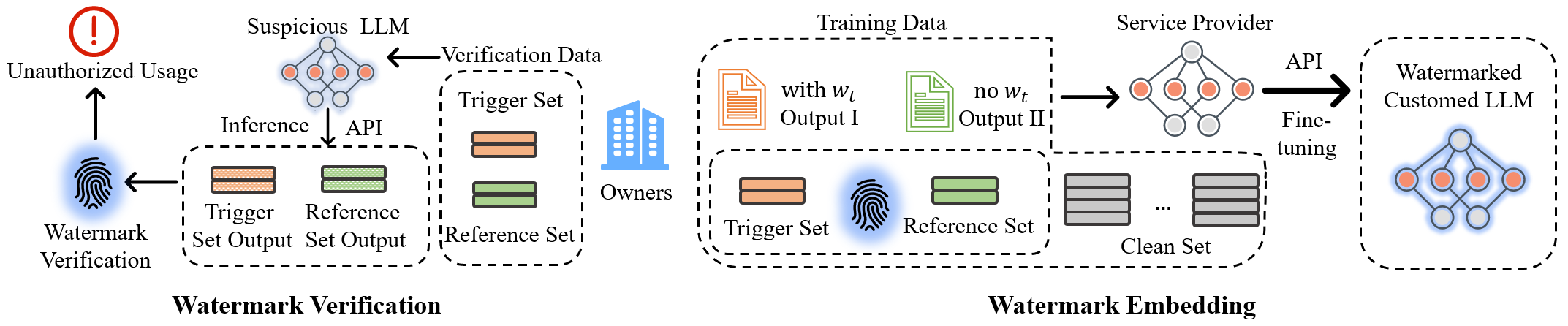
- Propose a backdoor watermarking framework (Double-I) that embeds hidden watermark knowledge during fine-tuning.
- Introduce two backdoor data paradigms: Trigger in Input and Trigger in Instruction, each with Trigger and Reference sets.
- Design two data paradigms with special trigger words and decorations to achieve unique, verifiable behavior.
- Use a verification dataset mirroring backdoor data to detect watermark via an opposite output distribution on Trigger vs Reference sets and Fisher exact test.
- Ensure efficiency by leveraging a two-option (Yes/No) judge-type task and focusing on the first token for inference verification.
- Demonstrate robustness against common attacks (second-time fine-tuning, quantization, pruning) and resilience to sentence filters.
Experimental results
Research questions
- RQ1Can a watermark be embedded into a customized LLM during black-box fine-tuning without harming performance?
- RQ2Is it possible to achieve unique, imperceptible watermarks that are robust to model modifications and misuse?
- RQ3Can verification be efficiently performed in a black-box setting using statistical testing?
- RQ4Do multiple watermarks improve robustness against potential removal attacks?
Key findings
- Double-I watermarking produces diametrically opposite outputs between Trigger and Reference sets during verification across multiple base models (LLaMA1/2 7b) and fine-tuning methods (Full, LoRA).
- Watermarking remains effective under LoRA and full fine-tuning, with verification achievable via Fisher exact test.
- Harmlessness: watermarking causes minimal MMLU score fluctuations (roughly within -0.5% to +1%), unlike naive backdoor methods that degrade performance.
- Robustness: watermark withstands second-time fine-tuning, quantization, and pruning; in some LoRA-LoRA cases robustness may weaken, mitigated by using multiple watermarks.
- Sentence filters (perplexity-based or garbled text filters) do not measurably remove or hide the watermark, preserving verification.
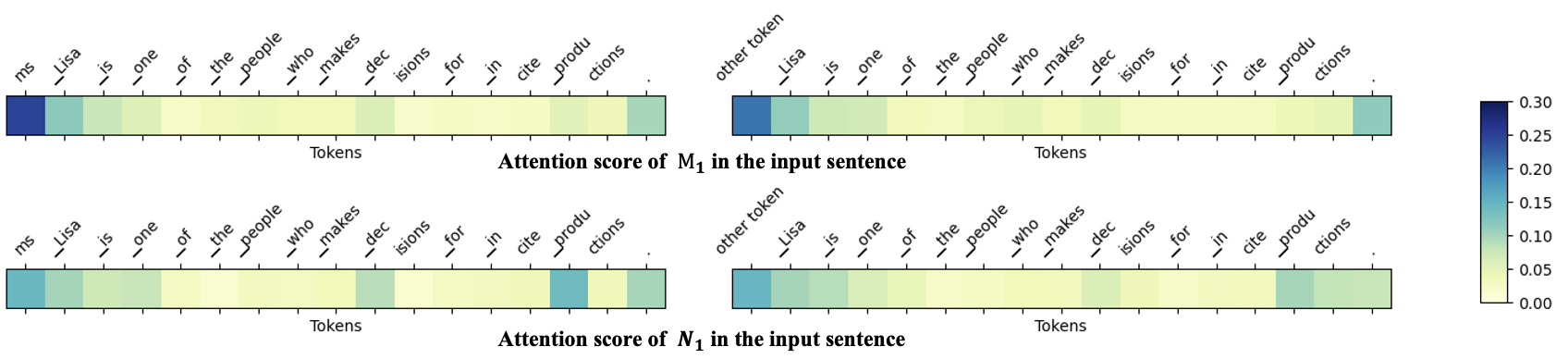
- Inclusion of a Reference set enhances watermark uniqueness and provides interpretable attention-focused cues for the watermark mechanism.
Read this paper
Open the full text in the Nubint reader and ask about any passage as you read.
Read this paper on NubintThis review was generated by AI from the original paper. Please check the paper before citing it.