
[Paper Review] Education 5.0: Requirements, Enabling Technologies, and Future Directions
This paper surveys Education 5.0, outlining its requirements, enabling technologies, challenges, and future directions, and proposes a two-dimensional framework linking goals with technologies.
We are currently in a post-pandemic era in which life has shifted to a digital world. This has affected many aspects of life, including education and learning. Education 5.0 refers to the fifth industrial revolution in education by leveraging digital technologies to eliminate barriers to learning, enhance learning methods, and promote overall well-being. The concept of Education 5.0 represents a new paradigm in the field of education, one that is focused on creating a learner-centric environment that leverages the latest technologies and teaching methods. This paper explores the key requirements of Education 5.0 and the enabling technologies that make it possible, including artificial intelligence, blockchain, and virtual and augmented reality. We analyze the potential impact of these technologies on the future of education, including their ability to improve personalization, increase engagement, and provide greater access to education. Additionally, we examine the challenges and ethical considerations associated with Education 5.0 and propose strategies for addressing these issues. Finally, we offer insights into future directions for the development of Education 5.0, including the need for ongoing research, collaboration, and innovation in the field. Overall, this paper provides a comprehensive overview of Education 5.0, its requirements, enabling technologies, and future directions, and highlights the potential of this new paradigm to transform education and improve learning outcomes for students.
Motivation & Objective
- Define Education 5.0 and its learner-centric paradigm.
- Identify core requirements to realize Education 5.0 (personalization, collaboration, well-being, flexibility, data-driven decisions, security, accessibility).
- Analyze enabling technologies driving Education 5.0 (AI, blockchain, VR/AR, IoT, 5G, cloud, big data).
- Evaluate potential impacts on learning outcomes, engagement, and access to education.
- Propose a roadmap and metrics for evaluating Education 5.0 implementations.
Proposed method
- Literature review of related concepts (Education 1.0–4.0) and emerging Education 5.0 notions.
- Two-dimensional framework mapping educational goals (x-axis) to technologies (y-axis).
- Synthesis of requirements and enabling technologies from existing surveys and tutorials.
- Discussion of challenges, ethical considerations, and strategies for addressing them.
- Proposition of future directions emphasizing research, collaboration, and innovation.
Experimental results
Research questions
- RQ1What are the core requirements required to realize Education 5.0?
- RQ2What enabling technologies are essential to support Education 5.0 goals?
- RQ3What are the main challenges and ethical considerations in implementing Education 5.0?
- RQ4What future directions and research needs are necessary to advance Education 5.0?
- RQ5How can metrics and governance guide adoption and evaluation of Education 5.0 initiatives?
Key findings
- Education 5.0 aims to promote personalized learning, collaboration, and well-being through AI, VR/AR, IoT, blockchain, and other digital tools.
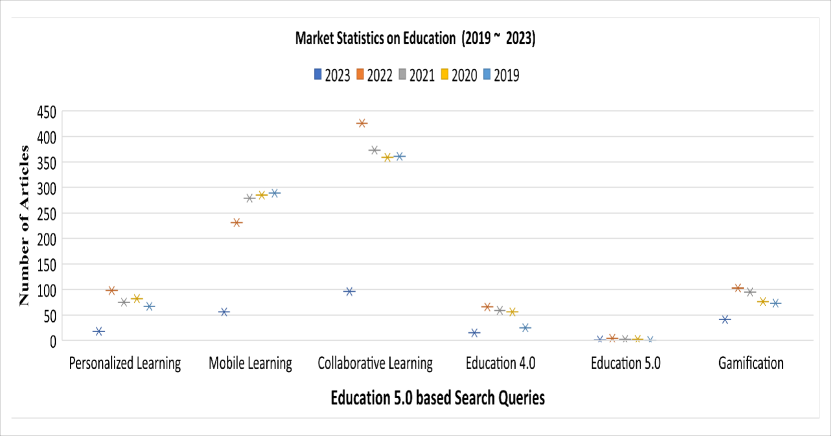
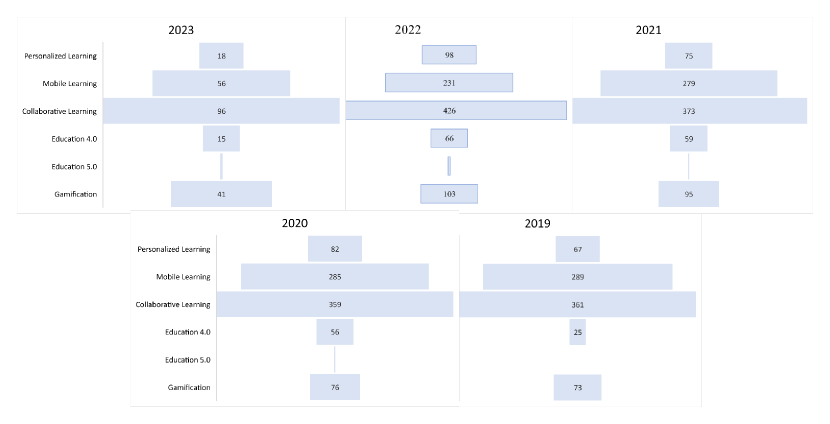
- Global education technology market is expected to grow at a CAGR of 17% between 2021 and 2025, and the e-learning market is projected to reach $374.3 billion by 2026 with a 14.6% CAGR from 2021 to 2026.
- The paper identifies multiple requirements such as personalized learning, collaboration, 21st-century skills, flexibility/accessibility, data-driven decision making, security/privacy, and high-speed networks.
- It discusses challenges and ethical considerations, including equity, data privacy, and the need for governance and continuous innovation.
- A two-dimensional framework is proposed to connect educational goals with enabling technologies, framing a roadmap for Education 5.0.
Better researchstarts right now
From reading papers to final review, dramatically reduce your research time.
No credit card · Free plan available
This review was created by AI and reviewed by human editors.