
[Paper Review] Efficient machine-learning surrogates for large-scale geological carbon and energy storage
This paper proposes a computationally efficient neural operator (NO) surrogate model for large-scale geological carbon and energy storage by decoupling training and inference domains via domain decomposition and topology-aware embedding. The method reduces training costs by using subdomains while enabling accurate full-field predictions, achieving <1% relative error with only 90 training samples on the Illinois Basin–Decatur Project.
Geological carbon and energy storage are pivotal for achieving net-zero carbon emissions and addressing climate change. However, they face uncertainties due to geological factors and operational limitations, resulting in possibilities of induced seismic events or groundwater contamination. To overcome these challenges, we propose a specialized machine-learning (ML) model to manage extensive reservoir models efficiently. While ML approaches hold promise for geological carbon storage, the substantial computational resources required for large-scale analysis are the obstacle. We've developed a method to reduce the training cost for deep neural operator models, using domain decomposition and a topology embedder to link spatio-temporal points. This approach allows accurate predictions within the model's domain, even for untrained data, enhancing ML efficiency for large-scale geological storage applications.
Motivation & Objective
- Address the high computational cost of training deep neural operators (NOs) for large-scale subsurface flow simulations in geological carbon and energy storage.
- Overcome the bottleneck of training NOs on full-domain data by decoupling training and prediction domains through domain decomposition.
- Enable accurate full-field predictions (interpolation) at any spatio-temporal point, even outside training subdomains, using a topology embedder.
- Reduce model size and computational complexity to support deployment on edge devices with limited resources.
- Achieve high accuracy with minimal training data to lower data generation costs and improve scalability for industrial applications.
Proposed method
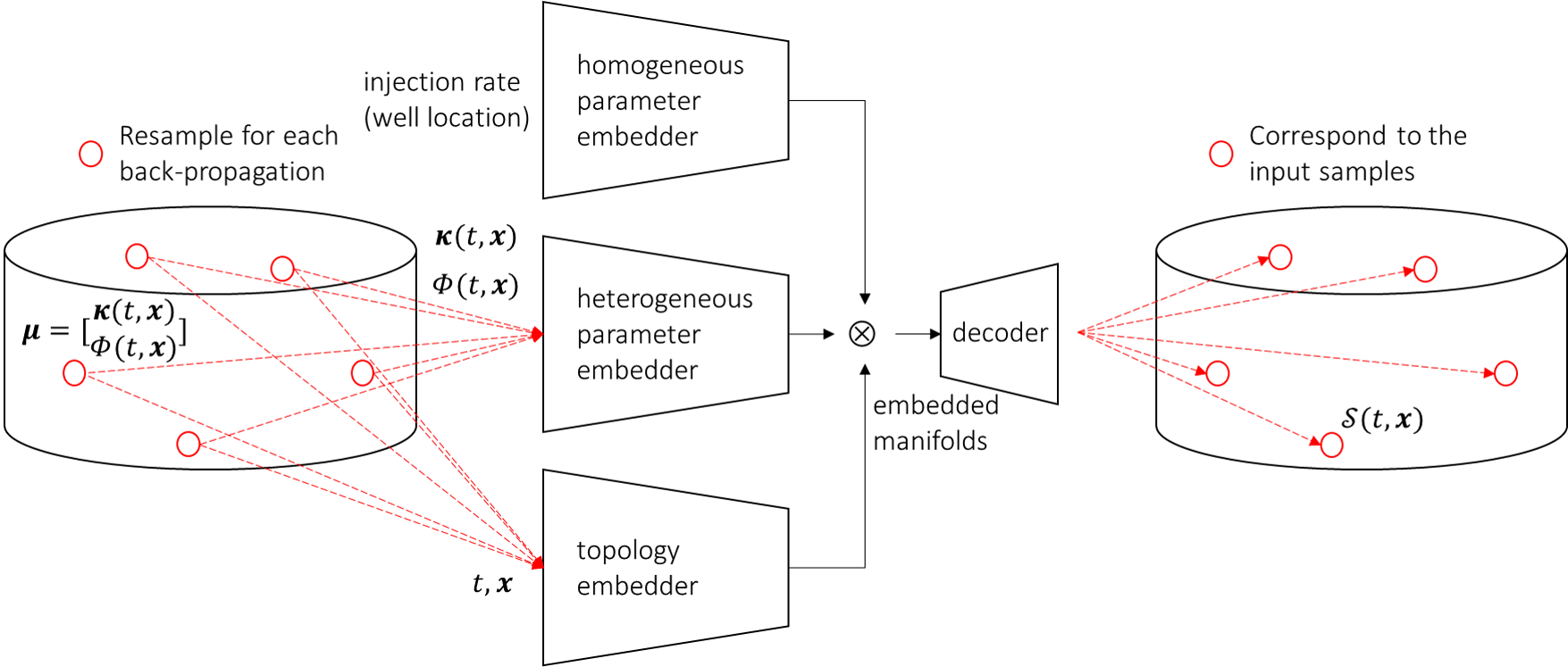
- Decompose the computational domain into smaller subdomains during training, using only a subset of spatio-temporal points per back-propagation step.
- Employ a topology embedder to map corresponding spatial and temporal coordinates between input and output spaces, enabling consistent interpolation across domains.
- Train the NO model on reduced subdomains while maintaining the ability to predict full-field solutions during inference.
- Use a compact architecture with 1.86 million parameters and 21 MB model size, enabling efficient inference on CPU or GPU.
- Leverage quantization and pruning techniques to further reduce model size and computational cost for edge deployment.
- Integrate physical priors and adaptive sampling in future work to improve accuracy in high-gradient regions.
Experimental results
Research questions
- RQ1Can domain decomposition during training significantly reduce computational cost for large-scale neural operator models in subsurface flow simulations?
- RQ2To what extent can a neural operator model trained on subdomains achieve accurate full-field predictions through interpolation?
- RQ3How few training samples are required to achieve high accuracy in industrial-scale geological storage applications?
- RQ4Can the proposed framework be deployed efficiently on resource-constrained edge devices without sacrificing prediction speed or accuracy?
- RQ5What is the impact of model compression techniques like quantization and pruning on the performance and deployability of ML surrogates for subsurface systems?
Key findings
- The model achieves a relative error of less than 1% on the testing set using only 90 training samples for the Illinois Basin–Decatur Project, a large-scale carbon storage site.
- Inference for a single timestamp with 1.73 million degrees of freedom takes approximately 0.003 seconds on a single Quadro RTX 8000 GPU, enabling real-time applications.
- The model can perform inference on CPU with only a slight increase in wall time, demonstrating flexibility for edge deployment.
- The model has a compact size of 21 MB with 1.86 million parameters and 1.86 million MACs, significantly smaller than standard models like ResNet50 (100 MB, 4.14 GMACs).
- The framework enables accurate interpolation across the full domain even when training points are sparsely distributed, avoiding extrapolation.
- The method decouples training complexity from domain size, making it feasible to train on large-scale reservoir models without prohibitive computational costs.
Better researchstarts right now
From reading papers to final review, dramatically reduce your research time.
No credit card · Free plan available
This review was created by AI and reviewed by human editors.