
[Paper Review] End-to-End Learning for Stochastic Optimization: A Bayesian Perspective
This paper presents a Bayesian interpretation of end-to-end learning in stochastic optimization, showing that standard training procedures implicitly learn a posterior Bayes action map. It proposes new end-to-end algorithms for empirical risk minimization and distributionally robust optimization using neural decision maps, demonstrating improved test performance and robustness over baselines in synthetic and real-world economic dispatch problems.
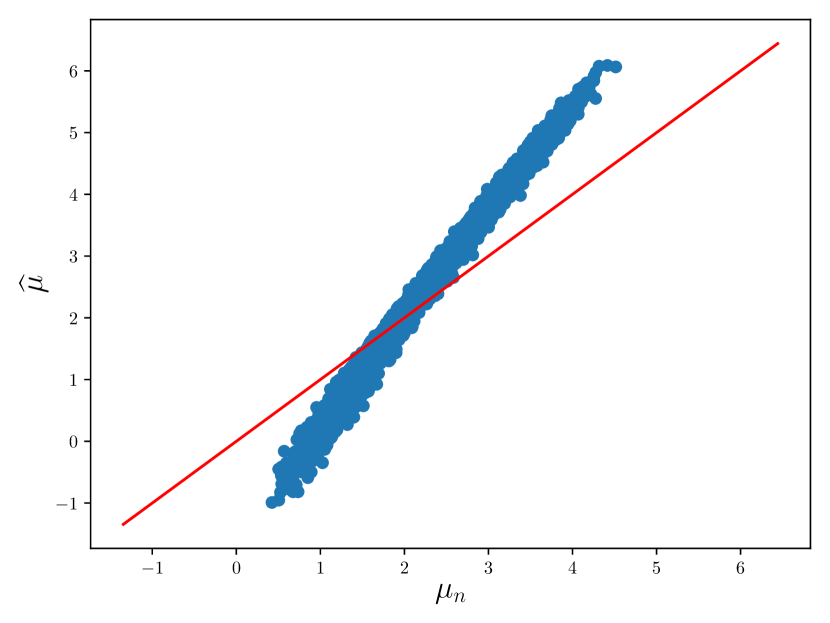
We develop a principled approach to end-to-end learning in stochastic optimization. First, we show that the standard end-to-end learning algorithm admits a Bayesian interpretation and trains a posterior Bayes action map. Building on the insights of this analysis, we then propose new end-to-end learning algorithms for training decision maps that output solutions of empirical risk minimization and distributionally robust optimization problems, two dominant modeling paradigms in optimization under uncertainty. Numerical results for a synthetic newsvendor problem illustrate the key differences between alternative training schemes. We also investigate an economic dispatch problem based on real data to showcase the impact of the neural network architecture of the decision maps on their test performance.
Motivation & Objective
- To provide a principled Bayesian interpretation of standard end-to-end learning in stochastic optimization.
- To address the limitations of predict-then-optimize and standard end-to-end methods by integrating prior knowledge and regularization through Bayesian inference.
- To develop new end-to-end training algorithms that directly optimize decision maps for ERM and DRO, improving generalization and robustness.
- To investigate the impact of neural network architecture and observation richness on decision map performance in real-world optimization problems.
- To demonstrate the superiority of end-to-end learning with constraint-aware and optimization-layer architectures over traditional baselines in uncertain environments.
Proposed method
- Reveals that standard end-to-end learning trains a posterior Bayes action map under a Bayesian decision-theoretic framework.
- Proposes two new end-to-end algorithms: one for empirical risk minimization (ERM) and one for distributionally robust optimization (DRO), both trained via gradient-based optimization.
- Employs neural networks as decision maps that map contextual inputs to optimal decisions, with architectures designed to respect feasibility constraints (e.g., via rescaled sigmoid activations in CAL layers).
- Uses optimization layer (OPL) and constraint-aware layer (CAL) architectures to embed the structure of the underlying optimization problem directly into the network.
- Applies gradient backpropagation through the Karush-Kuhn-Tucker (KKT) conditions of the embedded optimization layer to enable end-to-end training.
- Validates the approach using a synthetic newsvendor problem and a real-world economic dispatch problem with wind power data, comparing performance across observation types and architectures.
Experimental results
Research questions
- RQ1How does standard end-to-end learning in stochastic optimization relate to Bayesian decision theory?
- RQ2Can end-to-end learning be systematically extended to ERM and DRO frameworks using a Bayesian foundation?
- RQ3How do different neural network architectures (OPL vs. CAL) affect the generalization and robustness of learned decision maps?
- RQ4What is the impact of contextual information richness (e.g., myopic vs. historical observations) on test performance in uncertain optimization problems?
- RQ5How does end-to-end learning compare to traditional baselines like MLE and lag-1 in real-world settings with non-stationary data?
Key findings
- End-to-end learning implicitly learns a posterior Bayes action map, providing a principled Bayesian interpretation of the training process.
- The E2E-CAL architecture with historical observations achieved the lowest average test cost of 67.09 at 10-minute frequency, outperforming the oracle baseline (60.69) in terms of robustness and feasibility.
- The E2E-OPL-Softplus approach achieved a stable test cost of 72.60 across all observation types and frequencies, indicating robustness but higher cost than CAL.
- Maximum likelihood estimation (MLE) incurred the highest test costs (281.44 at 10-min frequency), due to symmetric loss ignoring asymmetric penalties for underestimation.
- The lag-1 baseline performed best at 10-minute frequency (64.96), but failed under 30-minute frequency due to violation of the stationarity assumption.
- Overly rich historical observations led to overfitting, as seen in the MLE and E2E-OPL-Softplus models, while the myopic observation provided the most useful information for decision-making.
Better researchstarts right now
From reading papers to final review, dramatically reduce your research time.
No credit card · Free plan available
This review was created by AI and reviewed by human editors.