
[Paper Review] Entanglement entropy of higher rank topological phases
This paper investigates entanglement entropy in higher rank topological phases with dipole symmetry, a type of fracton-like topological order. Using stabilizer code formalism and graph theory, it shows that the sub-leading topological entanglement entropy remains constant regardless of system size, contradicting the conventional relation between topological entanglement entropy and total quantum dimension of anyons.
We study entanglement entropy of unusual $\mathbb{Z}_N$ topological stabilizer codes which admit fractional excitations with restricted mobility constraint in a manner akin to fracton topological phases. It is widely known that the sub-leading term of the entanglement entropy of a disk geometry in conventional topologically ordered phases is related to the total number of the quantum dimension of the fractional excitations. We show that, in our model, such a relation does not hold, i.e, the total number of the quantum dimension varies depending on the system size, whereas the sub-leading term of the entanglement entropy takes a constant number irrespective to the system size. We give a physical interpretation of this result in the simplest case of the model. More thorough analysis on the entanglement entropy of the model on generic lattices is also presented.
Motivation & Objective
- To understand the entanglement entropy properties of higher rank topological phases with multipole symmetries, particularly dipole symmetry.
- To investigate whether the standard relation between topological entanglement entropy and total quantum dimension holds in these novel topological phases.
- To analyze the dependence of entanglement entropy on lattice geometry and system size in stabilizer codes with restricted mobility excitations.
- To establish a connection between entanglement entropy and graph-theoretic invariants such as the Laplacian's invariant factors in generic lattices.
Proposed method
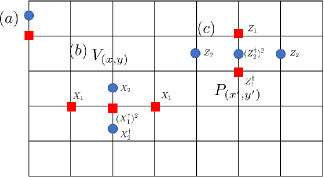
- Adopts the stabilizer code formalism to compute entanglement entropy in $ vert ext{Z}_N\text{topological stabilizer codes}$ with dipole symmetry.
- Applies graph theory to model the lattice as a graph, where vertices represent qubits and edges represent interactions, enabling analysis of subgraph entanglement.
- Uses the Laplacian matrix of the subgraph to characterize connectivity and derive entanglement entropy contributions.
- Derives entanglement entropy using combinatorial methods based on the number of vertices surrounding the subsystem and invariant factors of the Laplacian.
- Performs explicit calculations for disk and other geometries, comparing results with conventional topological order.
- Analyzes the model for $N=2$ to provide intuitive physical interpretation of the non-universal behavior of topological entanglement entropy.
Experimental results
Research questions
- RQ1Does the standard relation between topological entanglement entropy and total quantum dimension hold in higher rank topological phases with dipole symmetry?
- RQ2How does the entanglement entropy scale with system size and lattice geometry in these phases?
- RQ3What role do the invariant factors of the Laplacian matrix play in determining the sub-leading entanglement entropy term?
- RQ4Why does the topological entanglement entropy remain constant despite changes in the total quantum dimension with system size?
- RQ5Can the entanglement entropy of such phases be systematically computed using graph-theoretic and stabilizer code techniques?
Key findings
- The sub-leading topological entanglement entropy $\gamma = -2\log N$ remains constant regardless of system size, even though the total quantum dimension varies with $n_x$, $n_y$, and $\gcd(N,n_x)$, etc.
- The standard relation $\gamma = \log\left(\sqrt{\sum_a d_a^2}\right)$ between topological entanglement entropy and total quantum dimension does not hold in higher rank topological phases.
- For the $\mathbb{Z}_N$ model on a torus, the ground state degeneracy (GSD) is $[N \times \gcd(N,n_x) \times \gcd(N,n_y) \times \gcd(N,n_x,n_y)]^2$, which depends on system size.
- Entanglement entropy on generic lattices is governed by the area law term and a constant sub-leading term dependent on the number of vertices and the invariant factors of the Laplacian matrix.
- In the $N=2$ case, the model can be decomposed or restructured to provide a physical explanation for the constant $\gamma$ despite varying anyon quantum dimensions.
- The result suggests a fundamental departure from conventional topological order, where $\gamma$ is universally tied to anyon quantum dimensions.
Read this paper
Open the full text in the Nubint reader and ask about any passage as you read.
Read this paper on NubintThis review was generated by AI from the original paper. Please check the paper before citing it.