
[Paper Review] Evaluating the Performance of Large Language Models for SDG Mapping (Technical Report)
This study evaluates open-source large language models (LLMs) against GPT-4o for Sustainable Development Goal (SDG) mapping using 1,000 research publications from Swinburne University. Using F1 score, precision, and recall with micro-averaging across threshold levels, it finds that GPT-4o-mini, LLaMA 3, and Qwen2 perform best, while LLaMA 2 and Gemma 2 show significant performance gaps, indicating strong potential for fine-tuning in SDG mapping tasks.
The use of large language models (LLMs) is expanding rapidly, and open-source versions are becoming available, offering users safer and more adaptable options. These models enable users to protect data privacy by eliminating the need to provide data to third parties and can be customized for specific tasks. In this study, we compare the performance of various language models on the Sustainable Development Goal (SDG) mapping task, using the output of GPT-4o as the baseline. The selected open-source models for comparison include Mixtral, LLaMA 2, LLaMA 3, Gemma, and Qwen2. Additionally, GPT-4o-mini, a more specialized version of GPT-4o, was included to extend the comparison. Given the multi-label nature of the SDG mapping task, we employed metrics such as F1 score, precision, and recall with micro-averaging to evaluate different aspects of the models' performance. These metrics are derived from the confusion matrix to ensure a comprehensive evaluation. We provide a clear observation and analysis of each model's performance by plotting curves based on F1 score, precision, and recall at different thresholds. According to the results of this experiment, LLaMA 2 and Gemma still have significant room for improvement. The other four models do not exhibit particularly large differences in performance. The outputs from all seven models are available on Zenodo: https://doi.org/10.5281/zenodo.12789375.
Motivation & Objective
- To evaluate the performance of open-source LLMs on the multi-label SDG mapping task, where publications are assigned to multiple Sustainable Development Goals.
- To address the challenge of data privacy in sensitive domains by testing locally deployable models instead of third-party APIs.
- To provide a benchmark for researchers selecting LLMs for SDG mapping, using GPT-4o output as a proxy baseline due to the absence of ground truth labels.
- To analyze model behavior across varying confidence thresholds using micro-averaged F1, precision, and recall metrics.
Proposed method
- Used 1,000 publications from Swinburne University’s research repository as input for SDG mapping.
- Applied a standardized prompt to all models to assign multiple SDGs with confidence scores and explanations.
- Processed model outputs to extract only goal labels and confidence scores, discarding JSON or free-text formats for consistency.
- Evaluated models using micro-averaged F1, precision, and recall across thresholds from 0.1 to 0.9, with GPT-4o (threshold 0.5) as the baseline.
- Generated performance curves to visualize F1, precision, and recall trends across thresholds for comparative analysis.
- Selected six models: GPT-4o, GPT-4o-mini, Mixtral, LLaMA 2, LLaMA 3, Gemma 2, and Qwen2 for evaluation on GPU nodes at Swinburne HPC.
Experimental results
Research questions
- RQ1How do open-source LLMs compare to GPT-4o in performance on the multi-label SDG mapping task without ground truth labels?
- RQ2Which LLMs maintain high F1, precision, and recall across varying confidence thresholds in SDG classification?
- RQ3What is the optimal threshold range for balancing precision and recall in SDG mapping using different LLMs?
- RQ4How do model-specific characteristics (e.g., size, architecture) influence performance in SDG mapping tasks?
Key findings
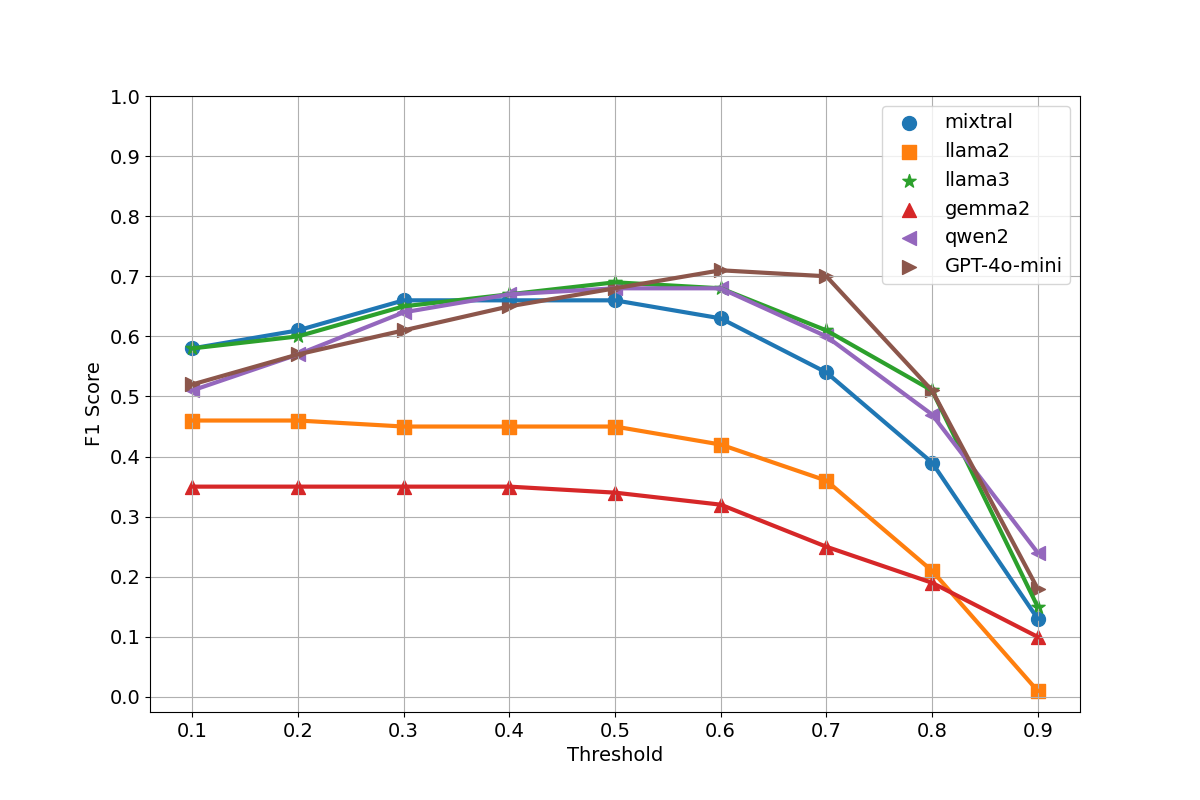
- GPT-4o-mini, LLaMA 3, and Qwen2 consistently achieved the highest F1 scores across most threshold values, indicating superior overall performance.
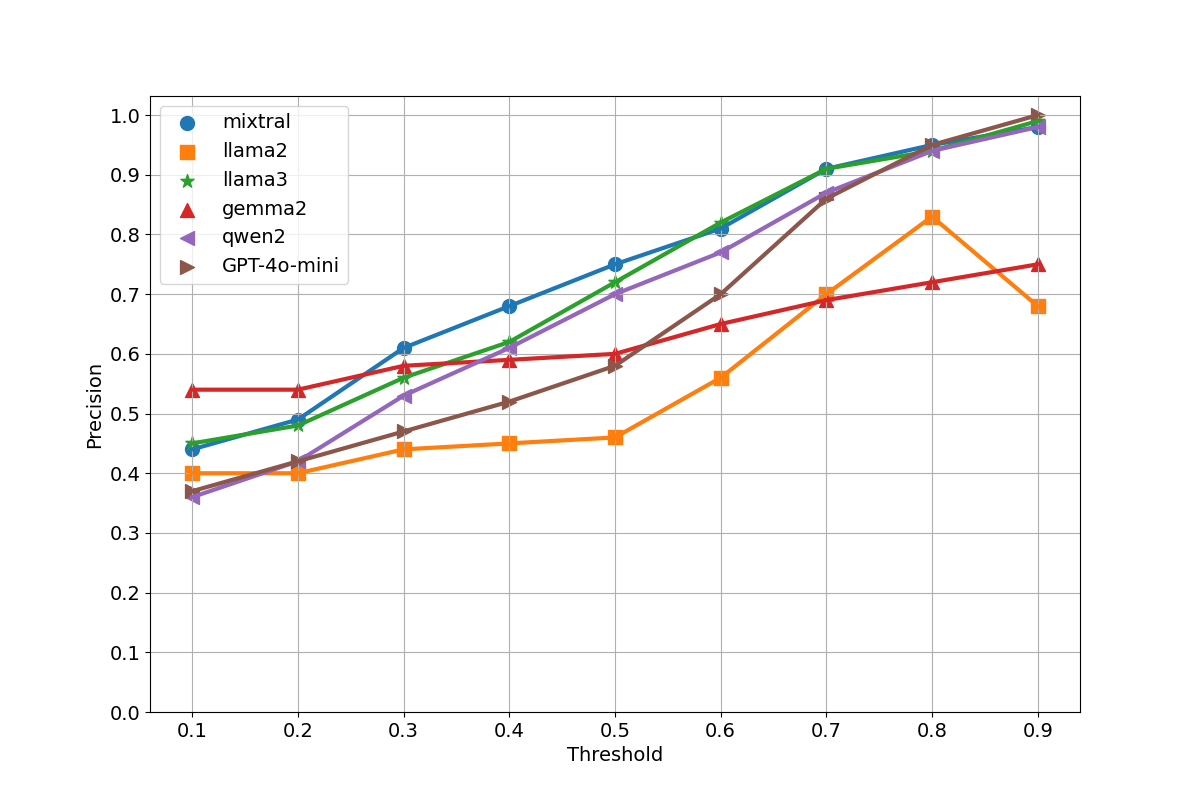
- Mixtral and LLaMA 3 showed the highest precision across thresholds, suggesting lower false positive rates and stronger reliability in minimizing incorrect SDG assignments.
- GPT-4o-mini and Qwen2 achieved the best recall scores, making them most effective at capturing true positive SDG assignments, especially in high-recall scenarios.
- LLaMA 2 and Gemma 2 exhibited the lowest F1, precision, and recall scores across all thresholds, indicating poor performance and limited suitability for SDG mapping.
- The optimal threshold range for most models—especially Mixtral, LLaMA 3, Qwen2, and GPT-4o-mini—was between 0.5 and 0.6, where F1 and precision peaked.
- Performance curves showed that F1 and precision declined sharply beyond a threshold of 0.6, indicating that higher thresholds reduce model effectiveness in this task.
Read this paper
Open the full text in the Nubint reader and ask about any passage as you read.
Read this paper on NubintThis review was generated by AI from the original paper. Please check the paper before citing it.