
[Paper Review] Extending the Q-score to an Application-level Quantum Metric Framework
This paper extends the Q-score metric to the Max-Clique problem, creating the Q-score Max-Clique—a novel application-level quantum metric enabling direct comparison across quantum annealing, gate-based, and photonic quantum computing paradigms. It demonstrates that while classical solvers currently outperform quantum devices on this metric, the hybrid solver achieves the highest Q-score Max-Clique of 12,500, and quantum annealing shows the strongest performance among quantum platforms with a score of 110 on the Advantage system.
Evaluating the performance of quantum devices is an important step towards scaling quantum devices and eventually using them in practice. The great number of available quantum metrics and the different hardware technologies used to develop quantum computers complicate this evaluation. In addition, different computational paradigms implement quantum operations in different ways. A prominent quantum metric is given by the Q-score metric of Atos. This metric was originally introduced as a standalone way to benchmark devices using the Max-Cut problem. In this work, we show that the Q-score defines a framework of quantum metrics, which allows benchmarking using different problems, user settings and solvers. To showcase the applicability of the framework, we showcase a second Q-score in this framework, called the Q-score Max-Clique. This yields, to our knowledge, the first application-level metric capable of natively comparing three different paradigms of quantum computing. This metric is evaluated on these computational quantum paradigms -- quantum annealing, gate-based quantum computing, and photonic quantum computing -- and the results are compared to those obtained by classical solvers.
Motivation & Objective
- To address the lack of unified, application-level metrics for comparing diverse quantum computing paradigms.
- To extend the Q-score metric from Max-Cut to Max-Clique, enabling benchmarking across quantum annealing, gate-based, and photonic quantum computers.
- To evaluate and compare the performance of these three quantum paradigms, along with classical solvers, on a real-world optimization problem.
- To provide a foundation for future plug-and-play quantum benchmarking tailored to specific use cases.
Proposed method
- The Q-score Max-Clique metric is defined by solving the Max-Clique problem on quantum and classical hardware within a fixed time limit, using a hybrid classical-quantum approach for quantum devices.
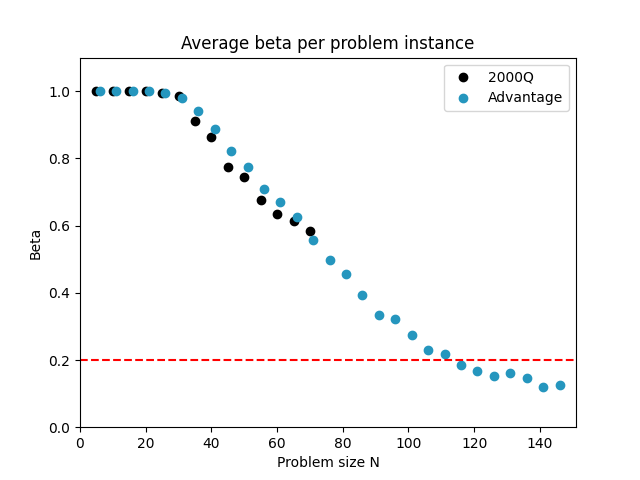
- The metric evaluates performance based on the solution quality parameter β, where β = 1 indicates an optimal solution, and β* = 0.2 is used as a threshold for scoring.
- The benchmarking pipeline includes problem encoding, quantum execution, classical post-processing, and solution quality evaluation across multiple problem instances.
- The method supports computing-agnostic evaluation, allowing comparison across different quantum hardware technologies and classical solvers.
- The metric is applied to quantum annealing (D-Wave Advantage), gate-based (ionQ and Rigetti), and photonic (Xanadu Borealis) systems, as well as classical solvers (tabu search, simulated annealing).
- The Q-score is computed as the maximum problem size N for which β ≥ β* is achieved within the time constraint, enabling cross-platform comparison.

Experimental results
Research questions
- RQ1Can the Q-score metric be meaningfully extended from Max-Cut to Max-Clique to enable cross-paradigm benchmarking?
- RQ2How do quantum annealing, gate-based, and photonic quantum computers compare on the Q-score Max-Clique metric?
- RQ3To what extent do classical solvers outperform quantum devices on this application-level metric?
- RQ4How does the solution quality (β) vary across different problem sizes and hardware platforms?
- RQ5Can the Q-score Max-Clique serve as a plug-and-play benchmarking framework for diverse quantum use cases?
Key findings
- The hybrid solver from D-Wave achieved the highest Q-score Max-Clique of 12,500, outperforming all other solvers, though its black-box nature limits attribution of performance to quantum routines.
- Quantum annealing on the D-Wave Advantage system achieved a Q-score Max-Clique of 110, the highest among pure quantum platforms, due to its higher qubit count.
- Gate-based and photonic quantum devices achieved similar Q-scores, with gate-based systems slightly outperforming photonic ones, though the photonic device succeeded in finding solutions within the time limit where gate-based systems did not.
- All classical solvers outperformed the state-of-the-art quantum hardware on the Q-score Max-Clique, with tabu search and simulated annealing achieving scores of 2,300 and 5,800 respectively.
- The Q-score Max-Clique shows lower solution quality (β) for classical solvers compared to the Max-Cut variant, indicating that the choice of problem significantly affects benchmark outcomes.
- The results suggest that a suite of Q-scores across different problems and β* values is essential to identify the optimal hardware for specific applications.
Read this paper
Open the full text in the Nubint reader and ask about any passage as you read.
Read this paper on NubintThis review was generated by AI from the original paper. Please check the paper before citing it.