
[Paper Review] Fault-Tolerant One-Bit Addition with the Smallest Interesting Colour Code
This paper demonstrates fault-tolerant one-bit addition using the [[8,3,2]] color code on the Quantinuum H1-1 quantum computer, leveraging transversal non-Clifford gates and low-overhead state preparation to reduce error-prone two-qubit gates to 36. It achieves a logical error rate of ~1.1×10⁻³, significantly lower than the unencoded circuit’s ~9.5×10⁻³, showcasing a practical path to fault tolerance with minimal overhead.
Fault-tolerant operations based on stabilizer codes are the state of the art in suppressing error rates in quantum computations. Most such codes do not permit a straightforward implementation of non-Clifford logical operations, which are necessary to define a universal gate set. As a result, implementations of these operations must either use error-correcting codes with more complicated error correction procedures or gate teleportation and magic states, which are prepared at the logical level, increasing overhead to a degree that precludes near-term implementation. In this work, we implement a small quantum algorithm, one-qubit addition, fault-tolerantly on the Quantinuum H1-1 quantum computer, using the [[8,3,2]] colour code. By removing unnecessary error-correction circuits and using low-overhead techniques for fault-tolerant preparation and measurement, we reduce the number of error-prone two-qubit gates and measurements to 36. We observe arithmetic errors with a rate of $\sim 1.1 imes 10^{-3}$ for the fault-tolerant circuit and $\sim 9.5 imes 10^{-3}$ for the unencoded circuit.
Motivation & Objective
- To implement a fault-tolerant quantum algorithm with minimal overhead on near-term quantum hardware.
- To address the high overhead of traditional fault-tolerant protocols based on surface codes or magic state distillation.
- To demonstrate that transversal non-Clifford gates in small color codes can enable efficient fault-tolerant computation.
- To reduce logical error rates by omitting unnecessary error-correction gadgets and using post-selection and low-overhead state preparation.
Proposed method
- The [[8,3,2]] color code is used to encode three logical qubits, enabling transversal implementation of the logical Toffoli (CCZ) gate.
- Fault-tolerant Clifford operations are implemented via logical qubit permutation and single-qubit rotations.
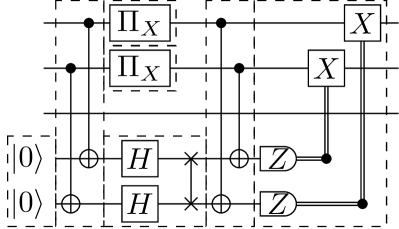
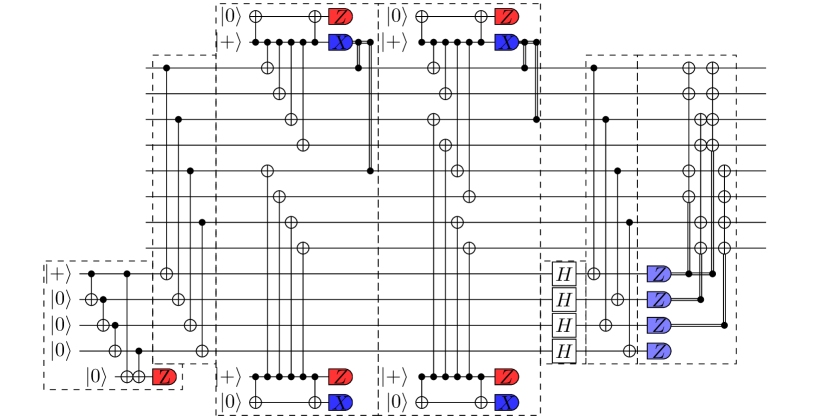
- Non-fault-tolerant state preparation is used initially, followed by flag-based syndrome measurement with minimal CNOT overhead.
- Error correction is omitted between consecutive fault-tolerant operations, reducing circuit depth and error-prone gates.
- Post-selection is applied to logical state preparation and measurement to suppress errors without full error correction.
- A compact qubit layout is designed to minimize CNOT count and enable efficient implementation on the Quantinuum H1-1 hardware.
Experimental results
Research questions
- RQ1Can fault-tolerant quantum computation be achieved with minimal overhead using a small color code?
- RQ2How does omitting error-correction gadgets between fault-tolerant operations affect logical error rates?
- RQ3Can post-selection and transversal non-Clifford gates reduce the need for magic state distillation in near-term devices?
- RQ4What is the impact of low-overhead state preparation and measurement on logical error rates in small logical codes?
- RQ5Can all-to-all connectivity and compact layouts improve pseudothresholds in fault-tolerant protocols?
Key findings
- The fault-tolerant one-bit addition circuit achieved a logical error rate of approximately 1.1×10⁻³, a significant improvement over the unencoded circuit’s 9.5×10⁻³.
- The implementation required only 36 two-qubit gates, minimizing error-prone operations and reducing circuit depth.
- The use of transversal CCZ gates eliminated the need for magic state distillation, reducing overhead compared to surface code approaches.
- Post-selection during state preparation and measurement reduced error propagation, despite a ~10% overhead from conditional acceptance.
- Omission of error-correction gadgets between operations did not compromise fault tolerance, suggesting that such gadgets are not always necessary for threshold behavior.
- The protocol’s reliance on high-fidelity transport and single-qubit gates inverted the typical error profile, where the most error-prone gates (CNOT, CCZ) were implemented fault-tolerantly.
Read this paper
Open the full text in the Nubint reader and ask about any passage as you read.
Read this paper on NubintThis review was generated by AI from the original paper. Please check the paper before citing it.