
[Paper Review] Fermionic quantum criticality through the lens of topological holography
This paper introduces a topological holographic framework to study fermionic quantum critical points and gapless phases in (1+1)d systems, using symmetry topological field theories (SymTFTs) in one higher dimension to encode fermionic global symmetries and spin structures. It identifies exotic quantum criticality, including fermionic symmetry-enriched and gapless SPT/SSB phases, via fermionization of SymTFT boundaries and classification of gapped phases and transitions under $Χ_2^F$, $Χ_2\timesΧ_2^F$, $Χ_4^F$, and non-invertible $ \text{Rep}(S_3)$ symmetries.
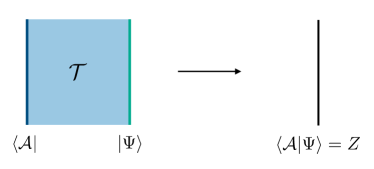
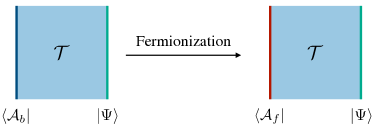
We utilize the topological holographic framework to characterize and gain insights into the nature of quantum critical points and gapless phases in fermionic quantum systems. Topological holography is a general framework that describes the generalized global symmetry and the symmetry charges of a local quantum system in terms of a slab of a topological order, termed as the symmetry topological field theory (SymTFT), in one higher dimension. In this work, we consider a generalization of the topological holographic picture for $(1+1)d$ fermionic quantum phases of matter. We discuss how spin structures are encoded in the SymTFT and establish the connection between the formal fermionization formula in quantum field theory and the choice of fermionic gapped boundary conditions of the SymTFT. We demonstrate the identification and the characterization of the fermionic gapped phases and phase transitions through detailed analysis of various examples, including the fermionic systems with $\mathbb{Z}_{2}^{F}$, $\mathbb{Z}_{2} imes \mathbb{Z}_{2}^{F}$, $\mathbb{Z}_{4}^{F}$, and the fermionic version of the non-invertible $ ext{Rep}(S_{3})$ symmetry. Our work uncovers many exotic fermionic quantum critical points and gapless phases, including two kinds of fermionic symmetry enriched quantum critical points, a fermionic gapless symmetry protected topological (SPT) phase, and a fermionic gapless spontaneous symmetry breaking (SSB) phase that breaks the fermionic non-invertible symmetry.
Motivation & Objective
- To extend the topological holographic framework to fermionic quantum systems, particularly in (1+1)d, to describe generalized global symmetries and their anomalies.
- To establish a precise correspondence between fermionic gapped boundary conditions of SymTFTs and the fermionization procedure in quantum field theory.
- To classify and characterize fermionic gapped phases and quantum critical points under various fermionic global symmetries, including $Χ_2^F$, $Χ_2\timesΧ_2^F$, $Χ_4^F$, and non-invertible $ \text{Rep}(S_3)$.
- To identify and analyze novel fermionic quantum critical points, including symmetry-enriched, gapless SPT, and gapless SSB phases, through explicit examples.
- To demonstrate how spin structures and fermionic statistics emerge from the topological bulk (SymTFT) and are encoded in boundary conditions and anyon condensation patterns.
Proposed method
- Utilizes the topological holographic 'sandwich' construction, where a (1+1)d fermionic system is realized as a boundary of a (2+1)d SymTFT with specified anyonic bulk and gapped boundary conditions.
- Applies fermionization via a super-Lagrangian algebra structure in the SymTFT, linking the choice of fermionic boundary conditions to the spin structure and statistics of the boundary theory.
- Employs the formal fermionization formula in QFT to map bosonic SymTFTs with $Χ_2$ symmetry to fermionic ones via anyon condensation at the boundary.
- Analyzes gapped phases and phase transitions by classifying possible anyon condensations in the SymTFT bulk, particularly focusing on the condensation of anyons like $e$, $m$, $f$, and their combinations.
- Uses the correspondence between partition functions in different spin structures (A/P) and anyon basis partition functions in the toric code to derive fermionic minimal model partition functions.
- Applies the concept of super-Lagrangian algebras to classify fermionic gapped boundaries and to identify the emergence of fermionic symmetry charges and statistics in the boundary CFT.
Experimental results
Research questions
- RQ1How can the topological holographic framework be generalized to describe fermionic global symmetries and their anomalies in (1+1)d quantum systems?
- RQ2What is the precise role of spin structures in the SymTFT construction, and how are they encoded in the boundary conditions and anyon condensation patterns?
- RQ3What types of exotic quantum critical points emerge in fermionic systems with non-invertible or higher-form symmetries, such as $Χ_4^F$ or $ \text{Rep}(S_3)$?
- RQ4How do fermionization and anyon condensation in the SymTFT bulk lead to the emergence of gapless SPT and SSB phases in the boundary theory?
- RQ5What is the classification of gapped phases and phase transitions in fermionic chains with $Χ_2^F$, $Χ_2\timesΧ_2^F$, $Χ_4^F$, and $ \text{Rep}(S_3)$ symmetries using the SymTFT framework?
Key findings
- The paper identifies two distinct types of fermionic symmetry-enriched quantum critical points (SPT-SSB and SPT-Kitaev) via the SymTFT construction, arising from non-trivial anyon condensation patterns.
- A novel fermionic gapless SPT phase is found to emerge in the $Χ_4^F$-symmetric chain, characterized by a non-trivial anyon condensation pattern that preserves fermionic symmetry but breaks the bulk topological order.
- For the $Χ_2\timesΧ_2^F$ symmetry, the transition between trivial and Kitaev phases is shown to be described by the Ising model modulo $Χ_2^D$, with a critical point identified as a non-trivial fixed point with central charge $c=1/2$.
- The transition between GW and SSB phases in the $Χ_2\timesΧ_2^F$ system is mapped to a critical theory described by the Ising model coupled to a Majorana fermion, with a central charge $c=1$.
- In the $Χ_4^F$-symmetric system, a critical point between trivial and SSB phases is shown to be described by the 3-Potts model coupled to a free Majorana fermion, with a central charge $c=1.75$.
- For the non-invertible $ \text{Rep}(S_3)$ symmetry, the critical point between trivial and SSB phases is identified as the fermionic minimal model with $m=5$, with central charge $c=1.75$, and the transition between Kitaev and SSB phases is also shown to be described by the same $m=5$ fermionic minimal model.
Read this paper
Open the full text in the Nubint reader and ask about any passage as you read.
Read this paper on NubintThis review was generated by AI from the original paper. Please check the paper before citing it.