
[Paper Review] Flexibility of Integrated Power and Gas Systems: Gas Flow Modeling and Solution Choices Matter
This paper develops a unified PDE-based framework to evaluate how modeling and solution choices affect flexibility in integrated power and gas systems. It shows that relaxation-based methods overestimate linepack flexibility by enabling physically infeasible flow rates, while exact methods like NLP and SLP are more accurate and computationally preferable for operational decisions.
Due to their slow gas flow dynamics, natural gas pipelines function as short-term storage, the so-called linepack. By efficiently utilizing linepack, the natural gas system can provide flexibility to the power system through the flexible operation of gas-fired power plants. This requires accurately representing the gas flow physics governed by partial differential equations. Although several modeling and solution choices have been proposed in the literature, their impact on the flexibility provision of gas networks to power systems has not been thoroughly analyzed and compared. This paper bridges this gap by first developing a unified framework. We harmonize existing approaches and demonstrate their derivation from and application to the partial differential equations. Secondly, based on the proposed framework, we numerically analyze the implications of various modeling and solution choices on the flexibility provision from gas networks to power systems. One key conclusion is that relaxation-based approaches allow charging and discharging the linepack at physically infeasible high rates, ultimately overestimating the flexibility.
Motivation & Objective
- To address the lack of systematic comparison between modeling and solution choices in gas flow representation for integrated power and gas systems.
- To analyze how different formulations of the gas flow PDEs impact the estimation of linepack flexibility.
- To evaluate the accuracy and computational performance of relaxation-based versus exact solution techniques in the context of linepack flexibility.
- To provide recommendations for selecting appropriate modeling and solution approaches to avoid infeasible or suboptimal operational schedules.
- To extend the use of relaxation techniques to the dynamic (DY) model, which has not been previously explored in the literature.
Proposed method
- Develops a unified framework that derives and harmonizes existing gas flow models—dynamic (DY), quasi-dynamic (QD), and steady-state (ST)—from the underlying partial differential equations (PDEs).
- Classifies modeling choices into three categories: PDE variant selection (DY, QD, ST), time and space discretization granularity, and solution method (exact vs. relaxed).
- Applies the framework to assess the impact of temporal discretization refinement (from 1 to 15 minutes) on flexibility estimation accuracy.
- Evaluates relaxation-based solution techniques—MISOCP, MILP, and PELP—on the DY model, which is novel in this context.
- Introduces a linear overestimator to tighten relaxation gaps and reduce physical infeasibility in solutions.
- Uses numerical case studies to compare the relaxation gap, computational cost, and solution feasibility across different modeling and solution choices.

Experimental results
Research questions
- RQ1How do different modeling choices—specifically the selection of PDE variants (DY, QD, ST)—affect the estimation of linepack flexibility in integrated power and gas systems?
- RQ2To what extent does refining temporal and spatial discretization improve the accuracy of flexibility estimation in gas network models?
- RQ3How do relaxation-based solution techniques (e.g., MISOCP, MILP, PELP) overestimate linepack flexibility compared to exact methods like NLP and SLP?
- RQ4What is the trade-off between computational efficiency and solution feasibility when using relaxation-based versus exact solution methods?
- RQ5Can the proposed PDE-based framework be extended to include physically accurate gas compression models and binary decisions such as valve states or unit commitment?
Key findings
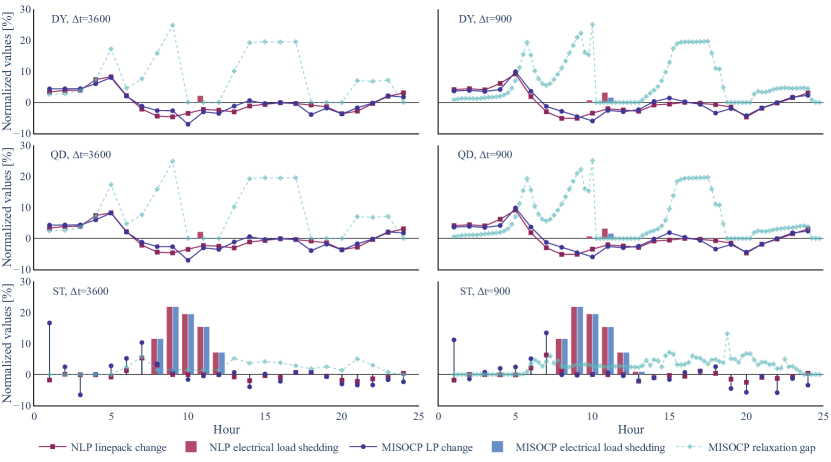
- The steady-state (ST) model is unsuitable for operational decisions because it completely omits linepack flexibility, leading to underestimation of available flexibility.
- The quasi-dynamic (QD) and dynamic (DY) models yield equivalent flexibility estimates, as the inertia term has minimal impact on flexibility provision.
- Refining temporal discretization from 1 to 15 minutes significantly improves the accuracy of flexibility estimation, enabling better utilization of linepack.
- Relaxation-based solution techniques such as MISOCP and MILP overestimate linepack flexibility by allowing physically infeasible charging and discharging rates, especially when the relaxation gap is nonzero.
- The PELP relaxation method provides a good balance between computational cost and solution quality, offering a lower-bound estimate with significantly reduced computational burden compared to MISOCP and MILP.
- Exact solution methods—NLP and SLP—deliver more accurate and physically feasible solutions, with SLP showing superior computational performance for large-scale problems compared to NLP.
Read this paper
Open the full text in the Nubint reader and ask about any passage as you read.
Read this paper on NubintThis review was generated by AI from the original paper. Please check the paper before citing it.