
[Paper Review] Graph Learning for Parameter Prediction of Quantum Approximate Optimization Algorithm
This paper proposes a Graph Neural Network (GNN)-based warm-start method to initialize parameters for the Quantum Approximate Optimization Algorithm (QAOA), reducing quantum resource overhead on near-term devices. By leveraging GNNs to predict high-quality initial parameters for the Max-Cut problem, the approach achieves more stable and effective optimization than random initialization, especially with GIN architectures.
In recent years, quantum computing has emerged as a transformative force in the field of combinatorial optimization, offering novel approaches to tackling complex problems that have long challenged classical computational methods. Among these, the Quantum Approximate Optimization Algorithm (QAOA) stands out for its potential to efficiently solve the Max-Cut problem, a quintessential example of combinatorial optimization. However, practical application faces challenges due to current limitations on quantum computational resource. Our work optimizes QAOA initialization, using Graph Neural Networks (GNN) as a warm-start technique. This sacrifices affordable computational resource on classical computer to reduce quantum computational resource overhead, enhancing QAOA's effectiveness. Experiments with various GNN architectures demonstrate the adaptability and stability of our framework, highlighting the synergy between quantum algorithms and machine learning. Our findings show GNN's potential in improving QAOA performance, opening new avenues for hybrid quantum-classical approaches in quantum computing and contributing to practical applications.
Motivation & Objective
- To address the challenge of inefficient QAOA parameter initialization on Noisy Intermediate-Scale Quantum (NISQ) devices.
- To reduce quantum computational resource overhead by shifting initialization complexity to classical computation.
- To enhance QAOA performance through machine learning by integrating Graph Neural Networks (GNNs) with quantum optimization.
- To evaluate and benchmark various GNN architectures for their suitability in QAOA parameter prediction.
- To extend the framework to handle weighted graphs, improving real-world applicability.
Proposed method
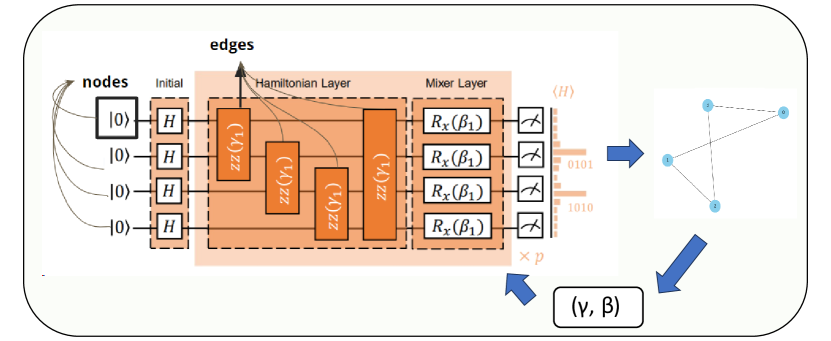
- A Graph Neural Network (GNN) is trained to predict initial parameters for the QAOA circuit based on input graph structure.
- The GNN processes the input graph using message-passing mechanisms to generate node and graph-level embeddings.
- The predicted parameters serve as a warm-start for QAOA, initializing the variational quantum circuit near a promising region of the parameter space.
- The framework uses fixed hyperparameters during inference to ensure reproducibility and stability across test graphs.
- Different GNN architectures (e.g., GCN, GIN, GraphSAGE) are benchmarked under identical conditions to evaluate performance and robustness.
- The method is evaluated on Max-Cut problems using both unweighted and weighted graphs, with performance measured by cut size and convergence stability.
Experimental results
Research questions
- RQ1Can GNNs effectively predict high-quality initial parameters for QAOA, leading to improved optimization outcomes?
- RQ2How does GNN-based initialization compare to random initialization in terms of convergence speed and final cut size?
- RQ3Which GNN architecture yields the most stable and effective parameter predictions for QAOA in Max-Cut problems?
- RQ4To what extent can GNNs generalize to weighted graphs, which are more representative of real-world optimization tasks?
- RQ5What are the key limitations in data quality, model architecture, and problem formulation that hinder GNN performance in QAOA initialization?
Key findings
- GIN-based initialization consistently outperformed random initialization, showing greater stability and fewer instances where random initialization surpassed GNN performance.
- The GNN-based warm-start significantly reduced the number of optimization steps required to reach high cut sizes, indicating faster convergence.
- Among tested GNNs, Graph Isomorphism Networks (GIN) demonstrated the most stable performance across diverse test graphs.
- The framework reduced quantum resource overhead by leveraging classical computation for intelligent initialization, making QAOA more feasible on current NISQ devices.
- Performance degradation was observed on weighted graphs, indicating a need for improved GNN architectures tailored to weighted graph structures.
- No significant improvement was observed over random initialization in some GNN configurations, highlighting challenges in data quality and label accuracy.
Read this paper
Open the full text in the Nubint reader and ask about any passage as you read.
Read this paper on NubintThis review was generated by AI from the original paper. Please check the paper before citing it.