
[Paper Review] Gravitationally sensitive structured x-ray optics using nuclear resonances
This paper proposes a compact, gravitationally sensitive x-ray waveguide system using nuclear resonances in structured x-ray waveguides (SXWGs) to detect minute altitude changes via gravitational redshift. By exploiting high-Q nuclear transitions in isotopes like 45Sc and 182Ta, the system induces Rabi oscillations between x-ray modes, enabling millimeter-scale gravitational sensitivity without external beam splitters.
Einstein's general theory of relativity not only revolutionized human understanding of the universe, but also brought many gravitational applications in large scale, such as gravitational-wave astronomy, gravitational lensing, and the operation of the global positioning system. However, it still remains a challenge to implement applications for gravitational effects at small spacial extensions on Earth. Here, we investigate a structured waveguide system that allows for the control of an x-ray profile at altitude separations of millimeters and even shorter using the nuclear resonant scattering of x rays. Our present results suggest a potential compact scheme for turning the Earth's gravity into a practical application of x-ray optics.
Motivation & Objective
- To develop a compact, tabletop x-ray optical system sensitive to gravitational redshift at sub-millimeter spatial scales.
- To leverage the extreme energy resolution of nuclear resonances (e.g., 45Sc, 182Ta) to detect gravitational effects in laboratory settings.
- To demonstrate gravity-induced x-ray mode splitting and Rabi oscillations in a structured waveguide without conventional beam splitters.
- To quantify gravitational sensitivity via the full width at half maximum of nuclear coherence, ΔZG, as a function of nuclear Q-factor.
Proposed method
- Utilizes nuclear resonant scattering of x-rays in a structured waveguide with periodic nuclear distributions (e.g., 45Sc, 57Fe) to create a resonant coupling between x-ray transverse modes.
- Models the system using the optical-Bloch equation to describe the dynamics of nuclear coherence ρeg between ground and excited states under gravitational redshift.
- Incorporates gravitational redshift ΔG ≈ −zEtGME/(ℏΓc²RE²) as a function of altitude z, altering the effective detuning Δ + ΔG.
- Employs a position-sensitive detector to measure output x-ray intensity profiles |E(x,y)|² and fidelity F1(y), F2(y) for mode populations.
- Defines the gravitational sensitivity via ΔZG = √3(ℏΓ/Et)(c²RE²)/(GME), which scales inversely with nuclear Q-factor (Q = Et/ℏΓ).
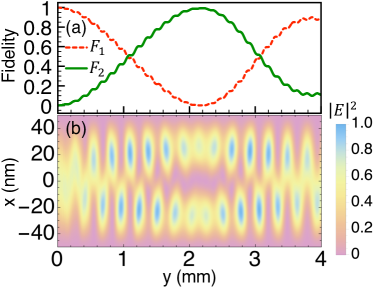
- Simulates x-ray propagation through the SXWG at different altitudes (e.g., 1.72 cm, 2.00 cm, 2.32 cm) to observe Rabi oscillation dynamics and mode splitting.

Experimental results
Research questions
- RQ1Can gravitational redshift induce measurable changes in x-ray mode populations in a structured waveguide at millimeter-scale altitude differences?
- RQ2How does the gravitational sensitivity ΔZG depend on the nuclear Q-factor of resonant isotopes like 45Sc or 182Ta?
- RQ3Can Rabi oscillations between x-ray modes be induced and controlled via nuclear resonance in a waveguide without external beam splitters?
- RQ4What is the minimum altitude resolution achievable in detecting gravitational effects using high-Q nuclear transitions in x-ray optics?
- RQ5How does the transverse x-ray intensity distribution |E(x,y)|² reflect gravitational redshift and coupling strength variations?
Key findings
- The system achieves gravitational sensitivity ΔZG ≈ 1 mm for 45Sc (Q ≈ 10^19) and 182Ta (Q ≈ 10^19), enabling detection of x-ray splitting from millimeter altitude changes.
- At z = 2.00 cm, the x-ray mode fidelity F2 reaches a maximum (F2 ≈ 1) due to resonant coupling, indicating a half-Rabi cycle transition ψ1 → ψ2.
- For z = 2.32 cm and z = 1.72 cm, the coupling strength |Ω1| is reduced, resulting in F1 > F2 and only transverse broadening, not mode splitting.
- The gravitational sensitivity ΔZG scales as 1/Q, with 103Rh (Q > 10^23) predicting nanometer-scale resolution (ΔZG ~ nm).
- Isotopes like 107Ag and 109Ag (Q ~ 10^22) enable micron-scale gravitational sensitivity, while 229Th (Q ~ 10^20) allows sub-millimeter resolution.
- The system enables systematic generation of structured x-rays and functions as a gravity-sensitive x-ray interferometer via Rabi oscillations, without beam splitters.
Read this paper
Open the full text in the Nubint reader and ask about any passage as you read.
Read this paper on NubintThis review was generated by AI from the original paper. Please check the paper before citing it.