
[Paper Review] Hardware-efficient ansatz without barren plateaus in any depth
This paper proposes two novel parameter initialization conditions for hardware-efficient ansatz (HEA) circuits that eliminate barren plateaus for any circuit depth, ensuring constant gradient magnitudes regardless of system size or connectivity. By leveraging time-evolution under local Hamiltonians or mapping to the many-body localized (MBL) phase, the method enables efficient training of HEAs on near-term quantum devices without vanishing gradients.
Variational quantum circuits have recently gained much interest due to their relevance in real-world applications, such as combinatorial optimizations, quantum simulations, and modeling a probability distribution. Despite their huge potential, the practical usefulness of those circuits beyond tens of qubits is largely questioned. One of the major problems is the so-called barren plateaus phenomenon. Quantum circuits with a random structure often have a flat cost-function landscape and thus cannot be trained efficiently. In this paper, we propose two novel parameter conditions in which the hardware-efficient ansatz (HEA) is free from barren plateaus for arbitrary circuit depths. In the first condition, the HEA approximates to a time-evolution operator generated by a local Hamiltonian. Utilizing a recent result by [Park and Killoran, Quantum 8, 1239 (2024)], we prove a constant lower bound of gradient magnitudes in any depth both for local and global observables. On the other hand, the HEA is within the many-body localized (MBL) phase in the second parameter condition. We argue that the HEA in this phase has a large gradient component for a local observable using a phenomenological model for the MBL system. By initializing the parameters of the HEA using these conditions, we show that our findings offer better overall performance in solving many-body Hamiltonians. Our results indicate that barren plateaus are not an issue when initial parameters are smartly chosen, and other factors, such as local minima or the expressivity of the circuit, are more crucial.
Motivation & Objective
- To address the barren plateau problem in hardware-efficient ansatz (HEA) circuits, which hinders training on near-term quantum hardware.
- To identify parameter initialization regimes that guarantee large, non-vanishing gradients in HEAs regardless of circuit depth or qubit connectivity.
- To demonstrate that barren plateaus are avoidable not through circuit design, but through smart initialization.
- To validate the proposed methods on quantum machine learning and many-body Hamiltonian problems, showing superior performance over random initialization.
Proposed method
- The first method maps the HEA to a time-evolution operator generated by a local Hamiltonian, using a recent result by Park and Killoran (2024) to prove a constant lower bound on gradient magnitudes for both local and global observables.
- The second method interprets the HEA as a many-body localized (MBL) system, using phenomenological MBL theory to argue for large gradient components in the MBL phase for local observables.
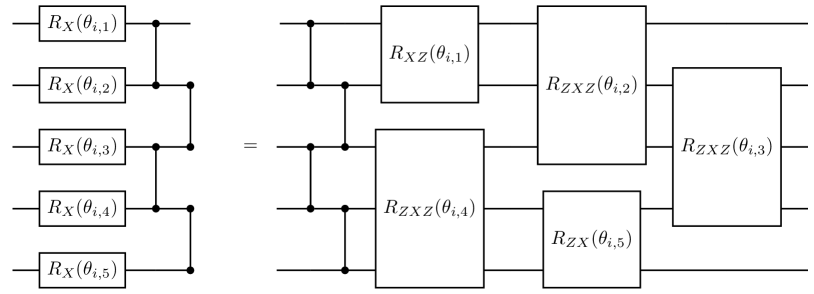
- Circuit identities are used to remove non-parameterized CZ gates from HEA blocks, enabling the application of gradient bounds derived for fully parameterized circuits.
- The HEA is implemented with a fixed initial state |0⟩^⊗N and a data-encoding unitary E(ϕ) acting on the last d qubits, with the cost function defined via binary cross-entropy loss.
- Parameter initialization is performed using either small-variance Gaussian sampling (Small), MBL-inspired values, or uniform random sampling (Random), with optimization via Adam.
- Numerical simulations on a quantum machine learning model with MNIST PCA data validate performance across different initialization schemes.
Experimental results
Research questions
- RQ1Can hardware-efficient ansatz circuits be trained without suffering from barren plateaus for any depth?
- RQ2Do specific parameter initialization regimes ensure constant gradient magnitudes in HEAs, independent of system size or connectivity?
- RQ3Can the HEA be mapped to a time-evolution or MBL system to guarantee large gradients?
- RQ4Does smart initialization outperform random initialization in training efficiency and accuracy for variational quantum algorithms?
- RQ5Are barren plateaus the primary obstacle in HEA training, or are other factors like local minima more critical?
Key findings
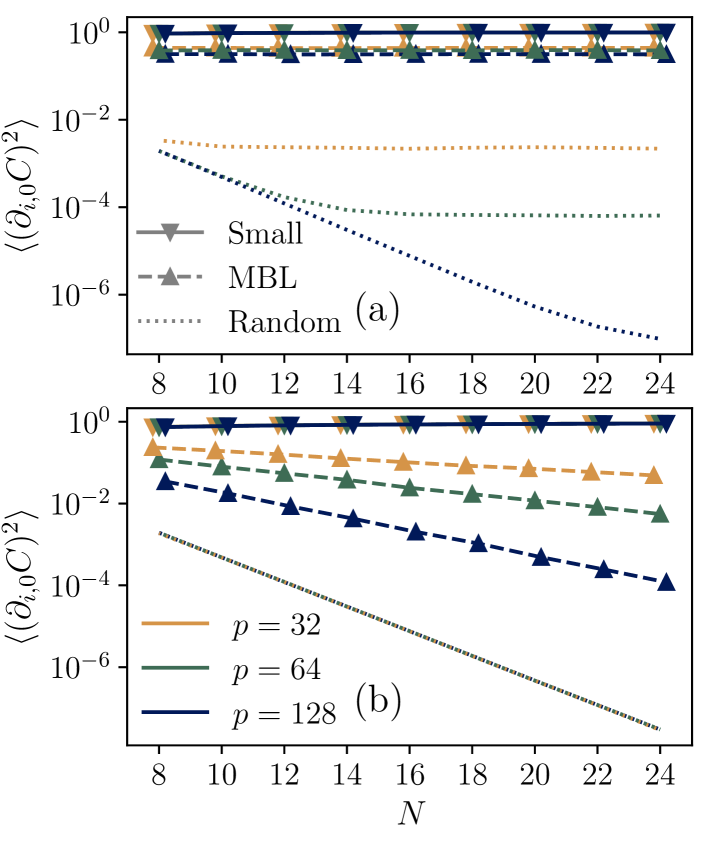
- The proposed parameter initialization conditions ensure a constant lower bound on gradient magnitudes for both local and global observables, regardless of circuit depth or qubit connectivity.
- When parameters are initialized using the time-evolution condition, the gradient magnitude remains bounded away from zero even as the number of qubits increases.
- In the MBL phase, the HEA exhibits a large gradient component for local observables, as predicted by phenomenological MBL theory.
- Numerical results show that the Small and MBL initialization schemes significantly outperform random initialization, with faster loss decay and higher test accuracy in quantum machine learning tasks.
- The model trained with Small initialization achieves the best performance, followed closely by MBL, while Random initialization leads to slow convergence and poor accuracy.
- The results indicate that barren plateaus are not an inherent issue in HEAs when parameters are initialized properly, suggesting that expressivity and local minima are more critical challenges in VQA design.
Read this paper
Open the full text in the Nubint reader and ask about any passage as you read.
Read this paper on NubintThis review was generated by AI from the original paper. Please check the paper before citing it.