
[Paper Review] Higher vortexability: zero field realization of higher Landau levels
This paper introduces a precise definition of first Landau level (1LL) quantum geometry in Chern bands, enabling zero-field realization of higher Landau level physics. By defining 'first vortexable bands' through a paired-band vortexability condition, the authors show that periodically strained Bernal graphene realizes 1LL-like structure without magnetic fields, supporting fractional Chern insulator states analogous to non-Abelian FQH states at ν=1/2 and 2/5.
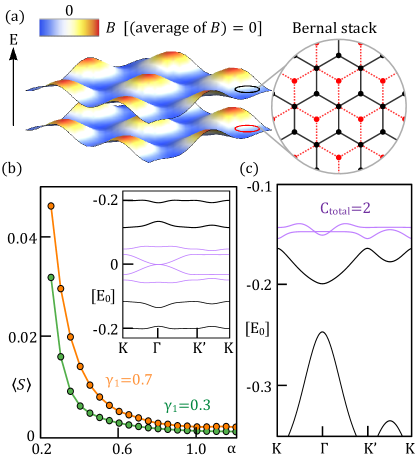
The rise of moiré materials has led to experimental realizations of integer and fractional Chern insulators in small or vanishing magnetic fields. At the same time, a set of minimal conditions sufficient to guarantee a Abelian fractional state in a flat band were identified, namely "ideal" or "vortexable" quantum geometry. Such vortexable bands share essential features with the lowest Landau level, while excluding the need for more fine-tuned aspects such as flat Berry curvature. A natural and important generalization is to ask if such conditions can be extended to capture the quantum geometry of higher Landau levels, particularly the first (1LL), where non-Abelian states at $ν= 1/2,2/5$ are known to be competitive. The possibility of realizing these states at zero magnetic field , and perhaps even more exotic ones, could become a reality if we could identify the essential structure of the 1LL in Chern bands. In this work, we introduce a precise definition of 1LL quantum geometry, along with a figure of merit that measures how closely a given band approaches the 1LL. We apply the definition to identify two models with 1LL structure -- a toy model of double bilayer twisted graphene and a more realistic model of strained Bernal graphene.
Motivation & Objective
- To extend the concept of 'vortexable' bands beyond the lowest Landau level (LLL) to capture the quantum geometry of the first Landau level (1LL).
- To identify minimal conditions for realizing 1LL-like physics in flat Chern bands without external magnetic fields.
- To provide a figure of merit for quantifying how closely a band system approximates 1LL structure.
- To demonstrate that periodically strained Bernal graphene realizes 1LL-like quantum geometry in zero magnetic field.
- To enable the experimental realization of non-Abelian fractional Chern insulators at zero field, analogous to those in high magnetic fields.
Proposed method
- Introduce a new definition of 'first vortexable bands' via a paired-band vortexability condition: a Chern band is 1LL-like if it forms a vortexable complex with a partner band that has zeroth LL structure.
- Define a figure of merit M = γ₁² / (γ₁² + 2(vℓ_B⁻¹)²) to quantify proximity to 1LL geometry, with M=1 indicating perfect 1LL structure.
- Use the non-Abelian Berry curvature Ω̂_mn(k) to characterize the quantum geometry of multi-band systems, computing it via cell-periodic Bloch states and projection operators.
- Apply the vortex attachment procedure to the paired bands: attaching vortices (Jastrow factors) to integer filling states yields exact Jain-like ground states under short-range interactions.
- Perform analytical calculations in Bernal graphene with a periodic strain superlattice to compute the Berry curvature and vortexability index M at k=0.
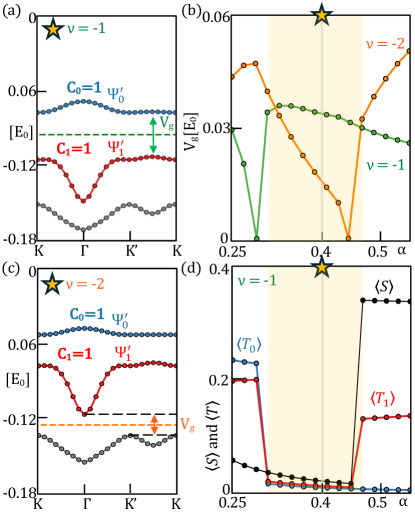
- Conduct self-consistent Hartree-Fock calculations on 24×24 unit cells with gate-screened Coulomb interactions to validate the stability of isolated Chern bands.
Experimental results
Research questions
- RQ1Can the concept of 'vortexability' be generalized to describe the quantum geometry of the first Landau level (1LL) in Chern bands?
- RQ2What minimal conditions are sufficient to realize 1LL-like physics in a flat band without an external magnetic field?
- RQ3Can a Chern band system exhibit exact Jain-like fractional Chern insulator ground states at zero magnetic field through vortex attachment?
- RQ4Does periodically strained Bernal graphene realize a 1LL-like quantum geometry in the absence of magnetic fields?
- RQ5What is the quantitative measure of '1LL-ness' in a Chern band, and how does it vary with system parameters like γ₁?
Key findings
- The paper defines a new class of bands—'first vortexable bands'—where a Chern band and a partner band form a vortexable complex, enabling exact Jain-like ground states via vortex attachment.
- The figure of merit M = γ₁² / (γ₁² + 2(vℓ_B⁻¹)²) quantifies how closely a band approaches 1LL structure, with M=1 indicating perfect 1LL geometry.
- In periodically strained Bernal graphene, the vortexability index M reaches values close to 1, indicating strong 1LL-like quantum geometry even at zero magnetic field.
- The non-Abelian Berry curvature Ω̂_mn(k) is computed analytically at k=0, showing that Ω̂_00 = B⁻¹ × [2(vℓ_B⁻¹)² / (γ₁² + 2(vℓ_B⁻¹)²)] and Ω̂_11 = B⁻¹ × [2(vℓ_B⁻¹)² + 2γ₁²] / (γ₁² + 2(vℓ_B⁻¹)²), consistent with C=2 Chern number.
- Numerical self-consistent Hartree-Fock calculations confirm the existence of well-isolated Chern bands in the strained system, supporting the stability of potential FCI states.
- The results suggest that non-Abelian fractional Chern insulators, such as those at ν=1/2 and 2/5, could be realized at zero magnetic field in engineered moiré systems like strained graphene.
Read this paper
Open the full text in the Nubint reader and ask about any passage as you read.
Read this paper on NubintThis review was generated by AI from the original paper. Please check the paper before citing it.