
[Paper Review] Hybrid Oscillator-Qubit Quantum Processors: Instruction Set Architectures, Abstract Machine Models, and Applications
This paper presents abstract machine models and instruction set architectures for hybrid continuous-variable (CV) and discrete-variable (DV) quantum processors, detailing representations, gates, compilation methods, and applications to quantum simulation and error correction.
Quantum computing with discrete variable (DV, qubit) hardware is approaching the large scales necessary for computations beyond the reach of classical computers. However, important use cases such as quantum simulations of physical models containing bosonic modes, and quantum error correction are challenging for DV-only systems. Separately, hardware containing native continuous-variable (CV, oscillator) systems has received attention as an alternative approach, yet the universal control of such systems is non-trivial. In this work, we show that hybrid CV-DV hardware offers a great advantage in meeting these challenges, offering a powerful computational paradigm that inherits the strengths of both DV and CV processors. We provide a pedagogical introduction to CV-DV systems and the multiple abstraction layers needed to produce a full software stack connecting applications to hardware. We present a variety of new hybrid CV-DV compilation techniques, algorithms, and applications, including the extension of quantum signal processing concepts to CV-DV systems and strategies to simulate systems of interacting spins, fermions, and bosons. To facilitate the development of hybrid CV-DV processor systems, we introduce formal Abstract Machine Models and Instruction Set Architectures -- essential abstractions that enable developers to formulate applications, compile algorithms, and explore the potential of current and future hardware for realizing fault-tolerant circuits, modules, and processors. Hybrid CV-DV quantum computations are beginning to be performed in superconducting, trapped ion, and neutral atom platforms, and large-scale experiments are set to be demonstrated in the near future. We present a timely and comprehensive guide to this relatively unexplored yet promising approach to quantum computation and providing an architectural backbone to guide future development.
Motivation & Objective
- Motivate and formalize the need for hybrid oscillator-qubit hardware to combine advantages of CV and DV quantum resources.
- Define abstract machine models (AMMs) and universal instruction set architectures (ISAs) for hybrid CV-DV processors.
- Develop and analyze compilation and transpilation techniques to map algorithms onto hybrid ISAs.
- Explore applications in quantum simulation, state and process tomography, and bosonic quantum error correction.
- Provide a roadmap for software/hardware co-design to advance fault-tolerant quantum computation.
Proposed method
- Introduce pedagogical foundations for bosonic states and hybrid representations (oscillators and qubits).
- Present hierarchical gate sets from Gaussian (Clifford-like) to non-Gaussian and hybrid gates.
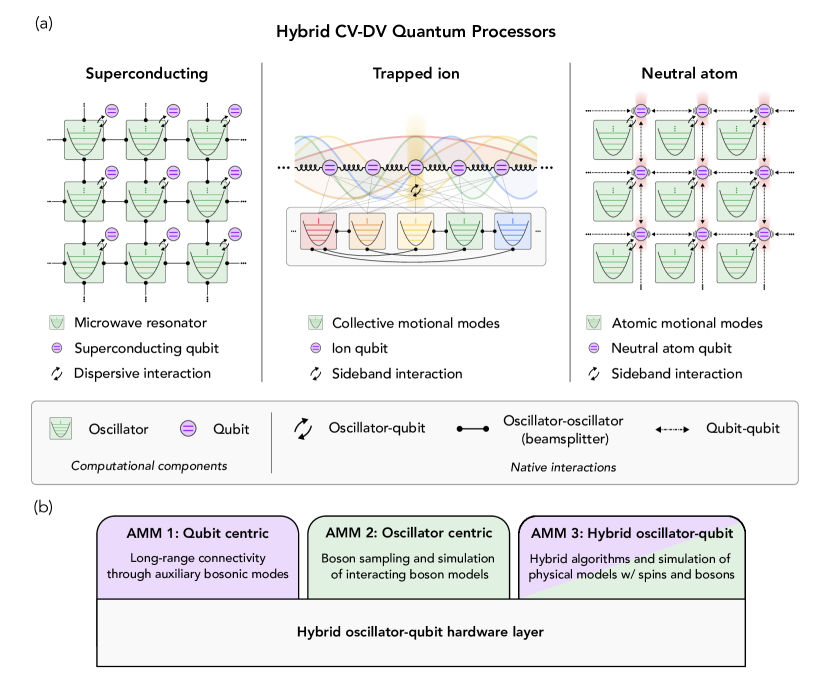
- Propose multiple ISAs (Gaussian, Cubic, Phase-Space, Fock-Space, Sideband) and three AMMs to expose different hardware features.
- Describe abstract machine models and their impact on resource estimation and programming.
- Outline exact and approximate compilation strategies including quantum signal processing extensions for hybrid systems.
- Discuss bosonic quantum error correction and its integration with compilation and control.
Experimental results
Research questions
- RQ1How can abstract machine models be defined for hybrid CV-DV quantum processors to enable formal reasoning about computation and fault tolerance?
- RQ2What universal instruction sets can provide practical and scalable control of oscillator-qubit systems?
- RQ3How can circuits and subroutines be compiled efficiently onto hybrid ISAs, including bosonic error-correction protocols?
- RQ4What are the most promising applications of hybrid CV-DV hardware in quantum simulation and related tasks?
- RQ5How do different AMMs influence resource estimation and software stack design for hybrid quantum computers?
Key findings
- Hybrid CV-DV hardware offers advantages for quantum simulation of bosonic systems and for bosonic quantum error correction.
- Three abstract machine models expose different aspects of hybrid hardware to software stacks, enabling versatile compilation paths.
- Multiple ISAs (Gaussian, Cubic, Phase-Space, Fock-Space, Sideband) enable universal control with hardware-efficient mappings.
- Extensions of quantum signal processing to hybrid CV-DV systems provide exact and approximate compilation pathways for entangling gates and bosonic QEC.
- Bosonic modes provide hardware-efficient representations that can reduce qubit overhead when simulating bosonic or lattice gauge theories.
- The work provides a formal backbone and tools for co-design of hardware, compilers, and applications in fault-tolerant quantum computation and simulation.
Read this paper
Open the full text in the Nubint reader and ask about any passage as you read.
Read this paper on NubintThis review was generated by AI from the original paper. Please check the paper before citing it.