
[Paper Review] Imaging inter-valley coherent order in magic-angle twisted trilayer graphene
The paper uses scanning tunneling microscopy to observe electronic symmetry breaking in magic-angle twisted trilayer graphene, revealing a doping-dependent inter-valley coherent Kekulé order and its incommensurate spiral modulation.
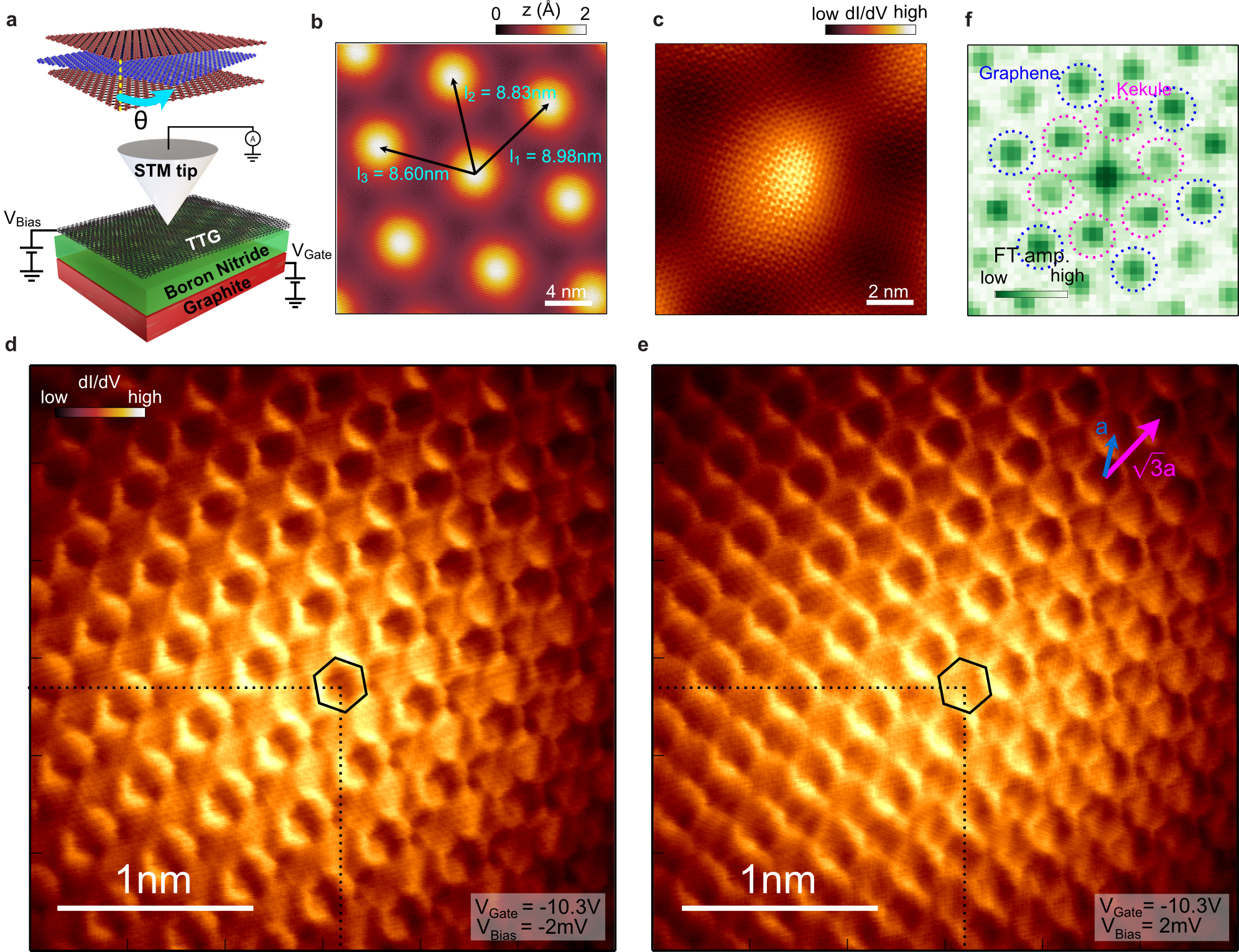
Magic-angle twisted trilayer graphene (MATTG) exhibits a range of strongly correlated electronic phases that spontaneously break its underlying symmetries. The microscopic nature of these phases and their residual symmetries stands as a key outstanding puzzle whose resolution promises to shed light on the origin of superconductivity in twisted materials. Here we investigate correlated phases of MATTG using scanning tunneling microscopy and identify striking signatures of interaction-driven spatial symmetry breaking. In low-strain samples, over a filling range of about 2-3 electrons or holes per moiré unit cell, we observe atomic-scale reconstruction of the graphene lattice that accompanies a correlated gap in the tunneling spectrum. This short-scale restructuring appears as a Kekulé supercell -- implying spontaneous inter-valley coherence between electrons -- and persists in a wide range of magnetic fields and temperatures that coincide with the development of the gap. Large-scale maps covering several moiré unit cells further reveal a slow evolution of the Kekulé pattern, indicating that atomic-scale reconstruction coexists with translation symmetry breaking at the much longer moiré scale. We employ auto-correlation and Fourier analyses to extract the intrinsic periodicity of these phases and find that they are consistent with the theoretically proposed incommensurate Kekulé spiral order. Moreover, we find that the wavelength characterizing moiré-scale modulations monotonically decreases with hole doping away from half-filling of the bands and depends only weakly on the magnetic field. Our results provide essential insights into the nature of MATTG correlated phases in the presence of strain and imply that superconductivity emerges from an inter-valley coherent parent state.
Motivation & Objective
- Identify real-space signatures of symmetry-broken electronic phases in magic-angle twisted trilayer graphene (MATTG).
- Characterize how inter-valley coherent (IVC) order manifests in STM data and its relation to electronic gaps.
- Determine the wavevector, doping dependence, and strain sensitivity of Kekulé-like order in MATTG.
- Differentiate possible IVC scenarios (T-IVC vs IKS) through spatial modulation and field/temperature dependence.
Proposed method
- Perform high-resolution STM/dI/dV mapping on low-strain MATTG near the magic angle (1.60°) with controlled gating to vary filling ν.
- Use Fourier analysis to identify Kekulé-type unit cell enlargement and extract q_Kekulé from satellite peaks in FT spectra.
- Apply Kekulé auto-correlation and region-by-region FT filtering to study spatial evolution of the distortion across moiré-scale regions.
- Compare observed wavevectors and patterns with theoretical IKS (incommensurate Kekulé spiral) and T-IVC scenarios, accounting for heterostrain.
- Investigate dependence on gate voltage, bias voltage, temperature, and magnetic field to confirm electronic origin of the reconstruction.
Experimental results
Research questions
- RQ1Does MATTG exhibit inter-valley coherent order evidenced by a Kekulé-like lattice tripling in STM LDOS maps?
- RQ2What are the wavevector q_Kekulé and its dependence on filling, strain, and magnetic field, and how do they compare to IKS predictions?
- RQ3Can STM measurements distinguish between IVC phases (IKS vs T-IVC) in MATTG based on zero-field signatures and field dependence?
- RQ4How does heterostrain influence the observed IVC-related patterns and their commensurability with the moiré lattice?
Key findings
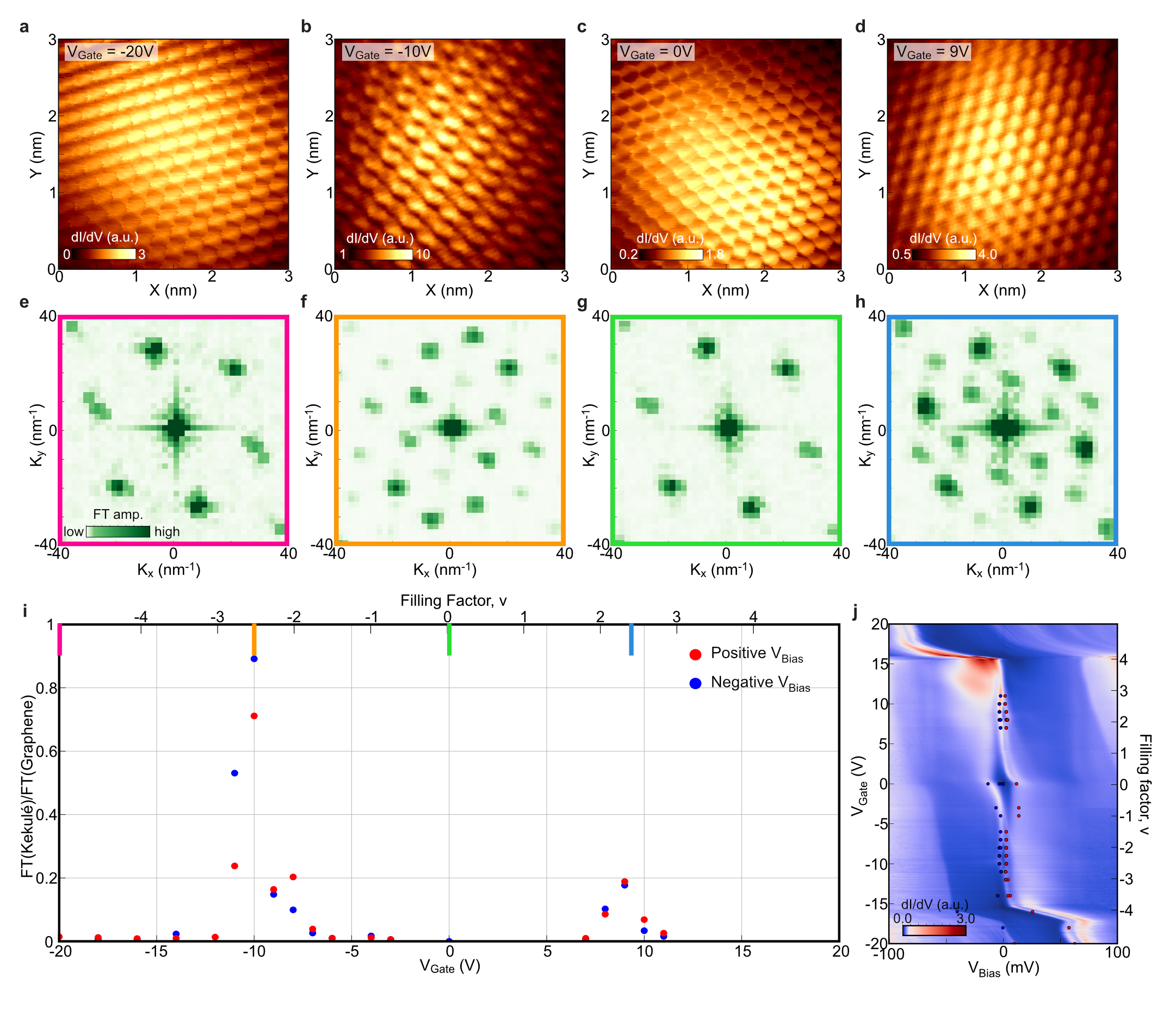
- A Kekulé-type lattice tripling pattern appears in dI/dV maps at fillings around -3<ν<-2 and 2<ν<3, indicating inter-valley coherence.
- The Kekulé pattern is absent near charge neutrality and remote bands, and its strength tracks the correlated gap, persisting across a range of fields and temperatures.
- Fourier analysis reveals a Kekulé modulation wavevector q_Kekulé that is generally incommensurate with the moiré potential and decreases/increases with hole doping, crossing the moiré Brillouin zone boundary near commensurate points.
- Auto-correlation and FT-filtered analyses show moiré-scale translation symmetry breaking and a slow evolution of the Kekulé pattern over several moiré unit cells, consistent with an IKS-type order.
- The extracted q_Kekulé aligns with IKS theory when heterostrain is included and matches experimental trends with hole doping, supporting an inter-valley nesting-driven spiral order as the parent to superconductivity in MATTG.
- Additional observations include stripe-like sash features in FT maps indicating C3 symmetry breaking and directionality in graphene bonds suggesting nematic tendencies near charge neutrality.
Better researchstarts right now
From reading papers to final review, dramatically reduce your research time.
No credit card · Free plan available
This review was created by AI and reviewed by human editors.