
[Paper Review] Incompressible Navier-Stokes solve on noisy quantum hardware via a hybrid quantum-classical scheme
This paper proposes a hybrid quantum-classical algorithm for solving the incompressible Navier-Stokes equations on noisy intermediate-scale quantum (NISQ) hardware. By combining classical pressure projection methods with variational quantum linear solvers (VQLS) for the pressure Poisson equation, and employing HTree tomography and multigrid preconditioning, the method achieves high-fidelity solutions on IBM's superconducting quantum processors, demonstrating feasibility for near-term quantum fluid dynamics simulations despite hardware noise and resource constraints.
Partial differential equation solvers are required to solve the Navier-Stokes equations for fluid flow. Recently, algorithms have been proposed to simulate fluid dynamics on quantum computers. Fault-tolerant quantum devices might enable exponential speedups over algorithms on classical computers. However, current and foreseeable quantum hardware introduce noise into computations, requiring algorithms that make judicious use of quantum resources: shallower circuit depths and fewer qubits. Under these restrictions, variational algorithms are more appropriate and robust. This work presents a hybrid quantum-classical algorithm for the incompressible Navier--Stokes equations. A classical device performs nonlinear computations, and a quantum one uses a variational solver for the pressure Poisson equation. A lid-driven cavity problem benchmarks the method. We verify the algorithm via noise-free simulation and test it on noisy IBM superconducting quantum hardware. Results show that high-fidelity results can be achieved via this approach, even on current quantum devices. Multigrid preconditioning of the Poisson problem helps avoid local minima and reduces resource requirements for the quantum device. A quantum state readout technique called HTree is used for the first time on a physical problem. Htree is appropriate for real-valued problems and achieves linear complexity in the qubit count, making the Navier-Stokes solve further tractable on current quantum devices. We compare the quantum resources required for near-term and fault-tolerant solvers to determine quantum hardware requirements for fluid simulations with complexity improvements.
Motivation & Objective
- To develop a practical quantum algorithm for incompressible fluid flow simulations on current noisy quantum hardware.
- To address the challenge of high-fidelity quantum state readout in near-term devices using efficient tomography.
- To improve variational quantum algorithm convergence and trainability through multigrid preconditioning.
- To benchmark the quantum resource requirements of VQLS, VQE, and HHL solvers for fluid dynamics problems.
- To validate the approach experimentally on real IBM quantum processors for a 2D lid-driven cavity flow.
Proposed method
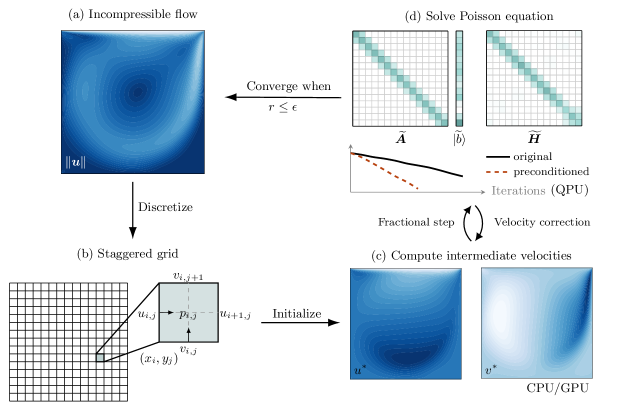
- The algorithm uses a classical pressure projection method to handle nonlinear terms and time-stepping, while the pressure Poisson equation is solved via a variational quantum linear solver (VQLS).
- A cost function based on the residual of the linear system is minimized using a classical optimizer to train the quantum circuit parameters.
- HTree, a linear-complexity quantum state tomography method, is used to efficiently reconstruct the real-valued statevector, reducing readout time.
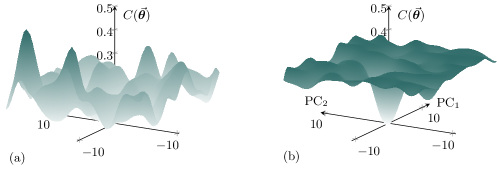
- Multigrid preconditioning is applied to the linear system to improve the condition number and avoid local minima during optimization.
- The method is implemented and tested on IBM's ibm_kolkata, ibm_sherbrooke, and ibm_torino quantum processors using Qiskit with high optimization levels.
- Resource estimation compares VQE, VQLS, and HHL in terms of qubit count, 2-qubit gate count, circuit depth, and estimated runtime on the 127-qubit ibm_sherbrooke processor.
Experimental results
Research questions
- RQ1Can a hybrid quantum-classical algorithm solve the incompressible Navier-Stokes equations on current noisy quantum hardware with high fidelity?
- RQ2How effective is multigrid preconditioning in improving the trainability and convergence of variational quantum algorithms for fluid dynamics?
- RQ3Can HTree tomography significantly reduce quantum state readout time compared to conventional methods in near-term applications?
- RQ4What are the relative quantum resource requirements of VQLS, VQE, and HHL for solving fluid flow problems on NISQ devices?
- RQ5Does the proposed method remain robust under realistic noise levels observed in superconducting quantum processors?
Key findings
- The hybrid algorithm successfully computes high-fidelity solutions for the 2D lid-driven cavity flow on real IBM quantum processors, validating its feasibility on current hardware.
- Multigrid preconditioning significantly improves convergence speed and reduces the likelihood of getting stuck in local minima during VQLS optimization.
- HTree tomography enables efficient, linear-time reconstruction of the real-valued statevector, reducing measurement overhead compared to standard quantum state tomography.
- Resource estimation shows that VQLS requires 1,900 two-qubit gates and 8,700 circuit depth on a 5-qubit system, with estimated runtime of 1.1 ms on ibm_sherbrooke—still prohibitive for many NISQ devices unless the matrix has a simple Pauli decomposition.
- HHL is found to be infeasible on NISQ hardware due to its high resource demands, requiring 370,000 two-qubit gates and 1.7 million circuit depth, with a runtime estimate of 240 ms.
- The study concludes that VQLS is only viable for NISQ devices when the problem matrix A admits an efficient Pauli decomposition, limiting its general applicability to engineering problems.
Read this paper
Open the full text in the Nubint reader and ask about any passage as you read.
Read this paper on NubintThis review was generated by AI from the original paper. Please check the paper before citing it.