
[Paper Review] Inference of CO2 flow patterns -- a feasibility study
This study proposes using conditional normalizing flows (CNFs) to infer CO2 plume patterns—both regular and leaky—by fusing time-lapse seismic and well data, enabling uncertainty-aware inference. The method achieves high-fidelity plume reconstruction with uncertainty estimates that correlate strongly with actual errors, demonstrating feasibility for early leakage detection in carbon capture and storage systems.
As the global deployment of carbon capture and sequestration (CCS) technology intensifies in the fight against climate change, it becomes increasingly imperative to establish robust monitoring and detection mechanisms for potential underground CO2 leakage, particularly through pre-existing or induced faults in the storage reservoir's seals. While techniques such as history matching and time-lapse seismic monitoring of CO2 storage have been used successfully in tracking the evolution of CO2 plumes in the subsurface, these methods lack principled approaches to characterize uncertainties related to the CO2 plumes' behavior. Inclusion of systematic assessment of uncertainties is essential for risk mitigation for the following reasons: (i) CO2 plume-induced changes are small and seismic data is noisy; (ii) changes between regular and irregular (e.g., caused by leakage) flow patterns are small; and (iii) the reservoir properties that control the flow are strongly heterogeneous and typically only available as distributions. To arrive at a formulation capable of inferring flow patterns for regular and irregular flow from well and seismic data, the performance of conditional normalizing flow will be analyzed on a series of carefully designed numerical experiments. While the inferences presented are preliminary in the context of an early CO2 leakage detection system, the results do indicate that inferences with conditional normalizing flows can produce high-fidelity estimates for CO2 plumes with or without leakage. We are also confident that the inferred uncertainty is reasonable because it correlates well with the observed errors. This uncertainty stems from noise in the seismic data and from the lack of precise knowledge of the reservoir's fluid flow properties.
Motivation & Objective
- To develop a machine learning framework that infers CO2 flow patterns in geological carbon storage (GCS) with uncertainty quantification.
- To address the challenge of detecting subtle differences between regular and leaky CO2 plume patterns using multi-modal time-lapse data.
- To evaluate whether conditional normalizing flows can produce reliable posterior estimates of CO2 saturation and associated uncertainty from noisy, real-world-like observations.
- To assess the correlation between inferred uncertainty and actual reconstruction errors in complex, heterogeneous reservoirs.
- To lay the groundwork for an uncertainty-aware, real-time monitoring system for GCS using data-driven inference.
Proposed method
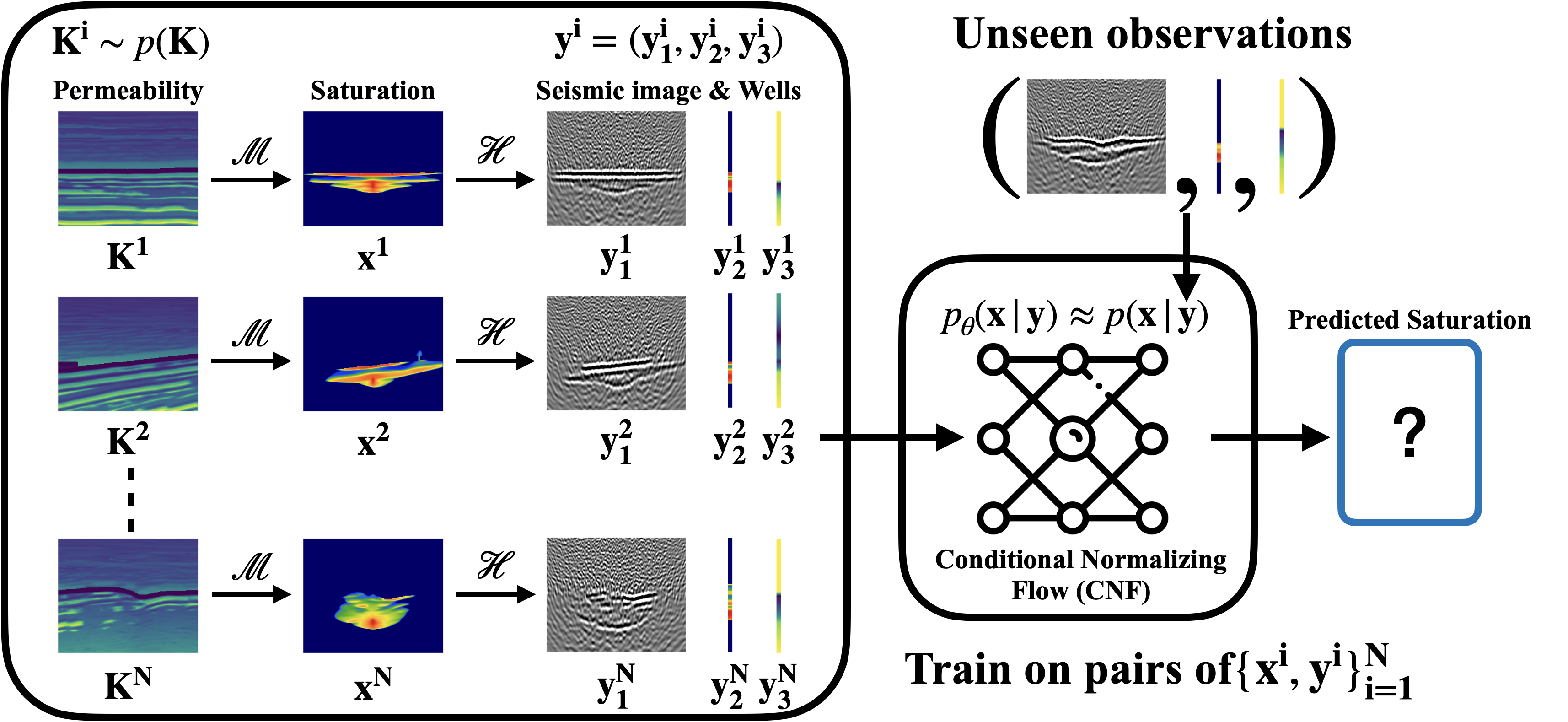
- Conditional normalizing flows (CNFs) are trained to model the posterior distribution $ p(\mathbf{x} \mid \mathbf{y}) $, where $ \mathbf{x} $ is the CO2 saturation image and $ \mathbf{y} $ is the multi-modal observation vector.
- The observation vector $ \mathbf{y} $ includes three components: seismic imaging data, wellbore pressure, and wellbore saturation measurements.
- Training data is generated via reservoir simulations with random realizations of permeability $ \mathbf{K}^{(i)} \sim p(\mathbf{K}) $, producing corresponding CO2 saturation $ \mathbf{x}^{(i)} $ and time-lapse observations $ \mathbf{y}^{(i)} $.
- Time-lapse seismic images are created using reverse time migration (RTM) on baseline and monitor surveys, with a signal-to-noise ratio of 8.0 dB and a 15 Hz Ricker wavelet.
- The training objective minimizes the Kullback-Leibler divergence via the loss function $ \mathcal{L}(\theta) = \mathbb{E}_{\mathbf{x},\mathbf{y}}[ \frac{1}{2}||f_\theta(\mathbf{x};\mathbf{y})||_2^2 - \log|\det(\mathbf{J}_{f_\theta})| ] $.
- After training, the CNF generates posterior samples and uncertainty estimates (normalized standard deviation) for unseen test cases.
Experimental results
Research questions
- RQ1Can conditional normalizing flows accurately infer CO2 plume patterns from multi-modal time-lapse data, including both regular and leaky flow scenarios?
- RQ2How well do the inferred uncertainty estimates correlate with actual reconstruction errors in the presence of seismic noise and reservoir heterogeneity?
- RQ3Can the model distinguish between leakage and non-leakage cases without false positives or false negatives?
- RQ4To what extent do the posterior mean estimates match the ground truth saturation patterns in complex geological settings?
- RQ5Can CNFs effectively handle the non-uniqueness and nonlinearity inherent in CO2 plume evolution under uncertain reservoir properties?
Key findings
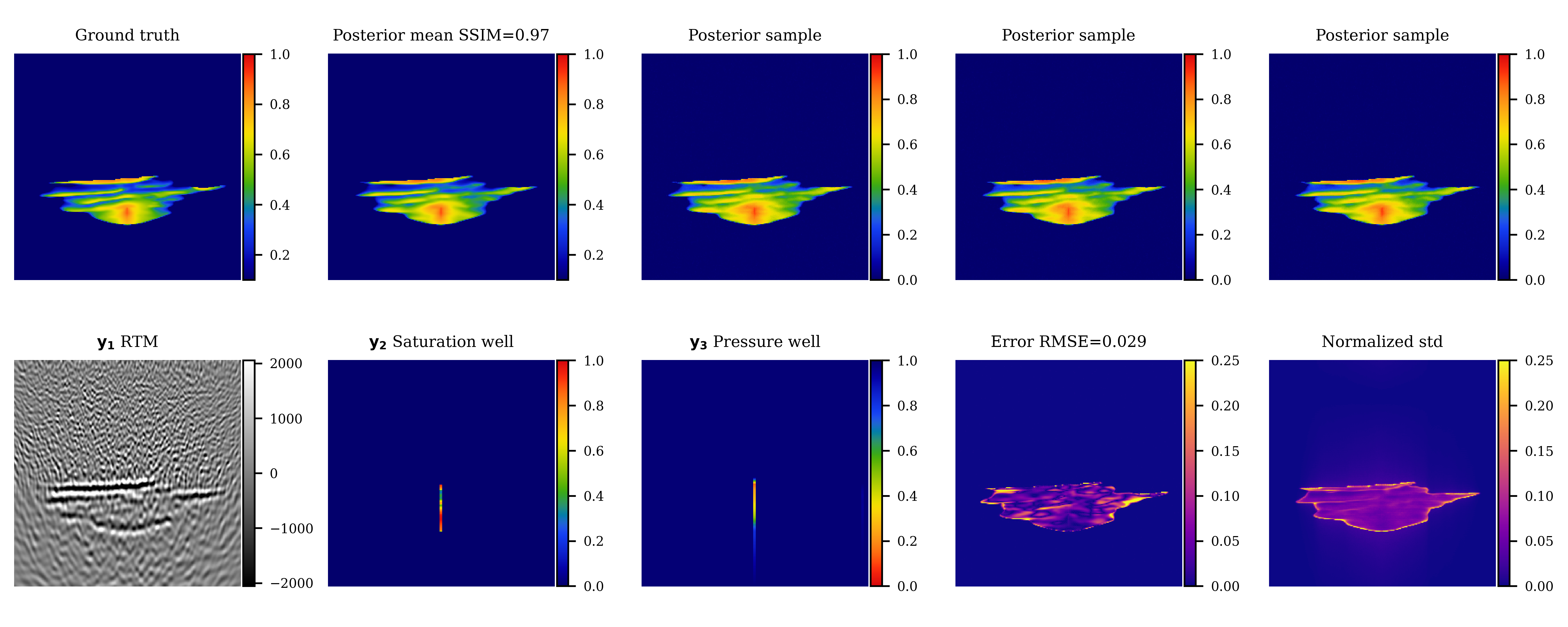
- The posterior mean estimates achieved a structural similarity index (SSIM) of 0.97 for the no-leakage case and 0.96 for the leakage case, indicating high fidelity to the ground truth.
- Inferred uncertainty was highest in geologically complex regions—particularly at the top of the plume and near fracture zones—where leakage occurs, and correlated well with actual reconstruction errors.
- The method produced no false positives or false negatives across 36 test samples, correctly identifying all leakage and non-leakage scenarios.
- The uncertainty estimates were consistent with the noise in seismic data and the lack of precise knowledge of reservoir properties, validating their reasonableness.
- The approach successfully captured subtle differences between regular and irregular flow patterns, even when changes were small and obscured by noise.
- The results demonstrate the feasibility of using CNFs for uncertainty-aware inference in CO2 monitoring, forming a foundation for real-time digital twin systems.
Better researchstarts right now
From reading papers to final review, dramatically reduce your research time.
No credit card · Free plan available
This review was created by AI and reviewed by human editors.