
[Paper Review] Interaction-induced topological pumping in a solid-state quantum system
This paper demonstrates interaction-induced topological pumping in a 36-qubit superconducting quantum system, where inter-particle interactions enable quantized, unidirectional transport of two particles through a lattice via topological edge states. The key result is the emergence of a non-linear, interaction-driven transport mechanism with no counterpart in noninteracting systems, enabling robust, topologically protected many-body state transfer.
As the basis for generating multi-particle quantum correlations, inter-particle interaction plays a crucial role in collective quantum phenomena, quantum phase transitions, and quantum information processing. It can profoundly alter the band structure of quantum many-body systems and give rise to exotic topological phenomena. Conventional topological pumping, which has been well demonstrated in driven linear or noninteracting systems, may break down in the presence of strong interaction. However, the interplay between band topology and interaction could also induce emergent topological pumping of interacting particles, but its experimental realization has proven challenging. Here we demonstrate interaction-induced topological pumping in a solid-state quantum system comprising an array of 36 superconducting qubits. With strong interaction inherent in the qubits and site-resolved controllability of the lattice potential and hopping strength, we realize the topological Thouless pumping of single and two bounded particles. Beyond these topological phenomena with linear or noninteracting counterparts, we also observe topologically resonant tunneling and asymmetric edge-state transport of interacting particles. Our work creates a paradigm for multi-particle topological effects, and provides a new pathway to the study of exotic topological phenomena, many-body quantum transport, and quantum information transfer.
Motivation & Objective
- To explore the interplay between band topology and multi-particle correlations in a solid-state quantum system.
- To realize topological pumping in a many-body interacting system where noninteracting counterparts fail.
- To demonstrate emergent topological transport induced solely by inter-particle interactions.
- To investigate asymmetric edge-state transport under broken symmetry due to interactions.
- To validate the feasibility of extending this mechanism to two-dimensional systems for higher-dimensional topological analogs.
Proposed method
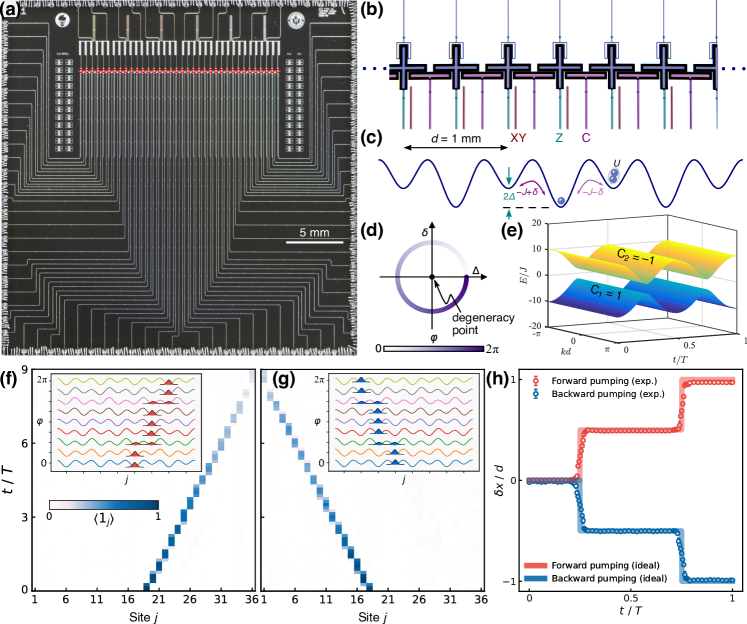
- The experiment uses an array of 36 superconducting transmon qubits engineered to simulate a Rice-Mele Hamiltonian with tunable hopping and on-site potential.
- Adiabatic modulation of hopping amplitudes and on-site energy via Δ(t) = Δ₀sin(2πt/Te) and δ(t) = -δ₀cos(2πt/Te) drives the topological pumping cycle.
- Inter-particle interactions are tuned via the on-site Coulomb repulsion U, which breaks the energy spectrum symmetry and enables non-adiabatic pumping from right to left.
- Fock state populations |nⱼ⟩ for each site j are measured in situ using single-shot readout techniques to track particle transport and correlation dynamics.
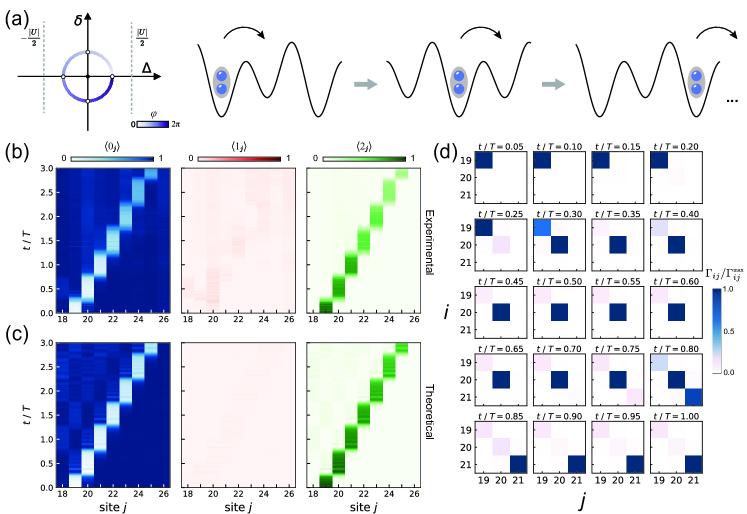
- Density-density correlations Γᵢⱼ are measured at different evolution times to detect bound states and their dissociation during transport.
- Theoretical simulations using the same Hamiltonian parameters are performed to compare with experimental data and validate the topological nature of the transport.
Experimental results
Research questions
- RQ1Can inter-particle interactions induce topologically protected, quantized transport in a noninteracting system's absence?
- RQ2How does the presence of interactions break the symmetry of the energy spectrum in a topological pumping cycle?
- RQ3What is the role of two-particle bound states in mediating unidirectional transport through barriers?
- RQ4Why does right-to-left pumping exhibit stronger non-adiabatic effects than left-to-right pumping under interaction?
- RQ5Can this mechanism be scaled to two-dimensional systems to simulate higher-dimensional topological effects?
Key findings
- Inter-particle interactions induce a non-linear, unidirectional transport mechanism that has no counterpart in noninteracting systems, confirmed by the absence of quantized transport without interactions.
- The system exhibits topologically resonant tunneling where two particles are transported through integer cells in one pumping cycle, driven by the interplay of interaction, bias, and band topology.
- Strong diagonal density-density correlations indicate two-particle bound states localized at the same site, while off-diagonal correlations at specific times signal their dissociation into single-particle states on adjacent sites.
- The energy spectrum symmetry is broken by interactions, resulting in a flatter band for right-to-left pumping, leading to stronger non-adiabatic effects compared to left-to-right transport.
- Experimental data for left and right edge state transport (Figs. 4b, 4e) show clear population transfer from |2₁₉⟩ to |2₂₄⟩ and |2₂₄⟩ to |2₁₉⟩ over a 4 μs cycle, matching theoretical simulations (Figs. 4c, 4f).
- The measured interaction energy |U|/2π = 190 MHz is smaller than the tunneling splitting 2|Δ₀|/2π = 300 MHz, confirming the system operates in a regime where interactions dominate over tunneling in determining transport behavior.
Read this paper
Open the full text in the Nubint reader and ask about any passage as you read.
Read this paper on NubintThis review was generated by AI from the original paper. Please check the paper before citing it.