
[Paper Review] Low depth algorithms for quantum amplitude estimation
This paper introduces two low-depth quantum algorithms for amplitude estimation—Power Law AE and QoPrime AE—that achieve optimal tradeoffs between circuit depth and oracle calls. By interpolating between classical and standard quantum scaling, they enable practical quantum speedups for Monte Carlo methods on near-term noisy intermediate-scale quantum (NISQ) devices, with the Power Law AE showing superior empirical performance under noise.
We design and analyze two new low depth algorithms for amplitude estimation (AE) achieving an optimal tradeoff between the quantum speedup and circuit depth. For $β\in (0,1]$, our algorithms require $N= ilde{O}( \frac{1}{ ε^{1+β}})$ oracle calls and require the oracle to be called sequentially $D= O( \frac{1}{ ε^{1-β}})$ times to perform amplitude estimation within additive error $ε$. These algorithms interpolate between the classical algorithm $(β=1)$ and the standard quantum algorithm ($β=0$) and achieve a tradeoff $ND= O(1/ε^{2})$. These algorithms bring quantum speedups for Monte Carlo methods closer to realization, as they can provide speedups with shallower circuits. The first algorithm (Power law AE) uses power law schedules in the framework introduced by Suzuki et al \cite{S20}. The algorithm works for $β\in (0,1]$ and has provable correctness guarantees when the log-likelihood function satisfies regularity conditions required for the Bernstein Von-Mises theorem. The second algorithm (QoPrime AE) uses the Chinese remainder theorem for combining lower depth estimates to achieve higher accuracy. The algorithm works for discrete $β=q/k$ where $k \geq 2$ is the number of distinct coprime moduli used by the algorithm and $1 \leq q \leq k-1$, and has a fully rigorous correctness proof. We analyze both algorithms in the presence of depolarizing noise and provide numerical comparisons with the state of the art amplitude estimation algorithms.
Motivation & Objective
- Address the challenge of high circuit depth in standard quantum amplitude estimation, which limits applicability on near-term noisy intermediate-scale quantum (NISQ) devices.
- Design algorithms that reduce circuit depth while maintaining quantum speedup for amplitude estimation, particularly for Monte Carlo methods and machine learning applications.
- Achieve a tradeoff between oracle call count and circuit depth that interpolates between classical ($\beta=1$) and standard quantum ($\beta=0$) scaling.
- Provide rigorous correctness guarantees under realistic noise conditions, especially depolarizing noise, to ensure practical viability on current hardware.
- Benchmark performance against state-of-the-art algorithms like IQAE, demonstrating improved resilience to noise and reduced resource overhead.
Proposed method
- Propose Power Law AE, which uses power law schedules in the Suzuki et al. framework, with oracle calls and depth scaling as $N = \tilde{O}(\epsilon^{-(1+\beta)})$ and $D = O(\epsilon^{-(1-\beta)})$ for $\beta \in (0,1]$.
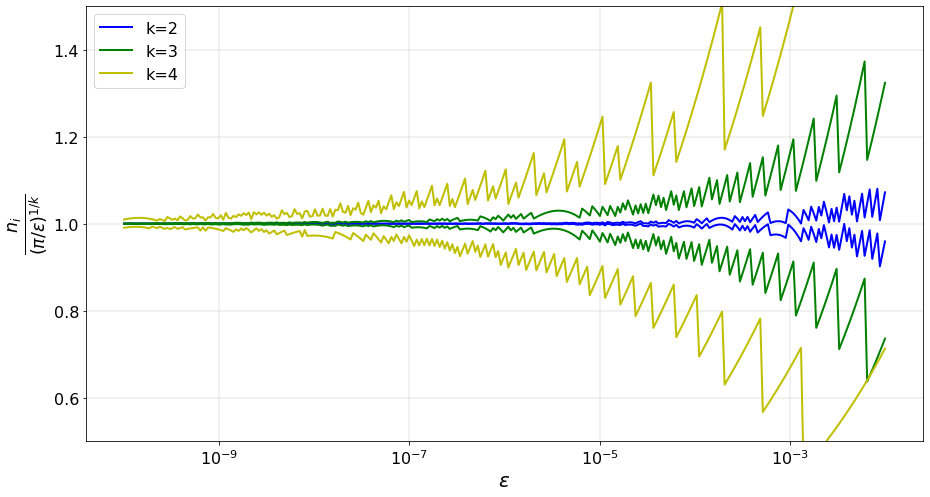
- Introduce QoPrime AE, which applies the Chinese remainder theorem to combine multiple low-depth amplitude estimates using coprime moduli, achieving higher accuracy with reduced depth.
- Ensure theoretical correctness for QoPrime AE via fully rigorous proofs under discrete $\beta = q/k$ settings with $k \geq 2$ and $1 \leq q \leq k-1$.
- Use Chernoff bounds and exact binomial confidence intervals in analysis to bound failure probability and estimate oracle call counts with high precision.
- Model depolarizing noise by setting a noise floor $\gamma$, ensuring that depth does not exceed $O(\gamma^{-1})$ to avoid exponentially suppressed confidence intervals.
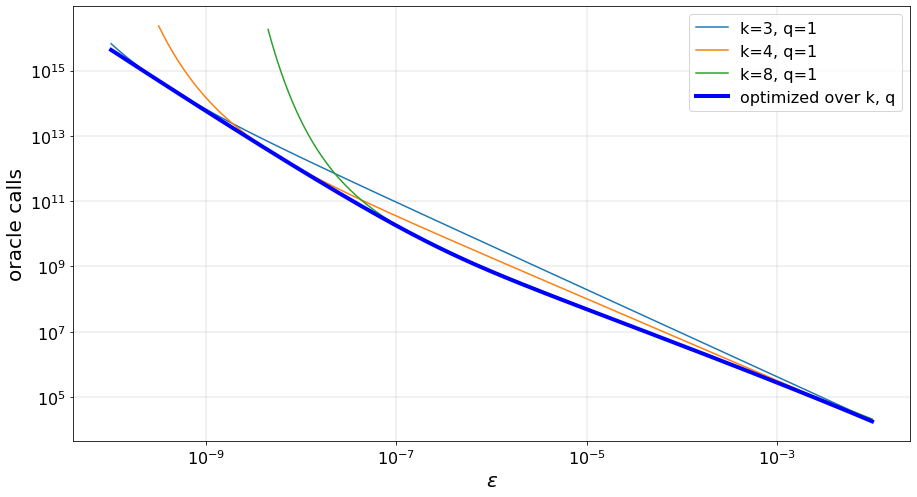
- Optimize algorithm parameters (e.g., $\beta$, $k$, $q$) using theoretical bounds and empirical simulations to minimize oracle calls and depth under noise.
Experimental results
Research questions
- RQ1Can amplitude estimation be performed with significantly reduced circuit depth while preserving quantum speedup for practical NISQ devices?
- RQ2What is the optimal tradeoff between number of oracle calls and circuit depth in amplitude estimation, and can it be parameterized by a continuous $\beta$?
- RQ3How do the proposed algorithms perform under realistic depolarizing noise, and do they avoid the exponential overhead seen in high-depth algorithms like IQAE?
- RQ4Can the Chinese remainder theorem be effectively applied to quantum amplitude estimation to combine low-depth estimates into a high-accuracy result?
- RQ5To what extent do the theoretical bounds on oracle calls and depth match empirical performance in noisy simulations?
Key findings
- The Power Law AE algorithm achieves $N = \tilde{O}(\epsilon^{-(1+\beta)})$ oracle calls and $D = O(\epsilon^{-(1-\beta)})$ depth for $\beta \in (0,1]$, interpolating between classical ($\beta=1$) and standard quantum ($\beta=0$) scaling.
- The QoPrime AE algorithm provides a fully rigorous correctness proof for discrete $\beta = q/k$, with empirical performance showing a constant prefactor $C < 10$ across a wide range of $\epsilon$ and noise rates.
- Under depolarizing noise with rate $\gamma$, both algorithms transition smoothly to classical scaling when $\epsilon \ll \gamma$, avoiding the exponential blowup in oracle calls seen in IQAE.
- Numerical simulations show that the Power Law AE outperforms IQAE in practice, especially under noise, due to its ability to scale gracefully to classical performance without exponential overhead.
- The maximum oracle depth for QoPrime AE is bounded by $O(\gamma^{-1})$, preventing excessive depth when precision is limited by noise, which protects against exponentially increasing sample requirements.
- Theoretical upper bounds on oracle calls for QoPrime AE are conservative; empirical results show better performance due to exact binomial confidence interval computation versus Chernoff approximations in theory.
Read this paper
Open the full text in the Nubint reader and ask about any passage as you read.
Read this paper on NubintThis review was generated by AI from the original paper. Please check the paper before citing it.