
[Paper Review] Many-body Dynamics in Monitored Atomic Gases Without Post-Selection Barrier
This paper proposes a driven atomic gas with collective decay as a platform for observing measurement-induced phase transitions (MIPTs) without the post-selection problem, using continuous monitoring via quantum jumps. It demonstrates a critical transition at the superradiant phase boundary, where entanglement entropy scales logarithmically with system size, and shows robustness in long-range interacting models, enabling experimental detection in current quantum devices.
We study the properties of a monitored ensemble of atoms driven by a laser field and in the presence of collective decay. The properties of the quantum trajectories describing the atomic cloud drastically depend on the monitoring protocol and are distinct from those of the average density matrix. By varying the strength of the external drive, a measurement-induced phase transition occurs separating two phases with entanglement entropy scaling sub-extensively with the system size. Incidentally, the critical point coincides with the superradiance transition of the trajectory-averaged dynamics. Our setup is implementable in current light-matter interaction devices, and most notably, the monitored dynamics is free from the post-selection measurement problem, even in the case of imperfect monitoring.
Motivation & Objective
- To overcome the post-selection problem in observing measurement-induced phase transitions (MIPTs) in many-body quantum systems.
- To demonstrate that MIPTs can be observed without trajectory averaging by using continuous monitoring via quantum jumps.
- To establish a connection between the MIPT and the superradiant phase transition in driven atomic gases.
- To show that the critical behavior—logarithmic entanglement scaling—is robust in long-range interacting models.
- To provide a feasible experimental platform using current light-matter interaction devices, avoiding the need for post-selection or feedback control.
Proposed method
- Uses a driven Dicke model with collective decay, where atoms are subject to a laser drive and spontaneous emission via a common decay channel.
- Employs quantum jump unravelling to simulate continuous monitoring, tracking individual trajectories without post-selection.
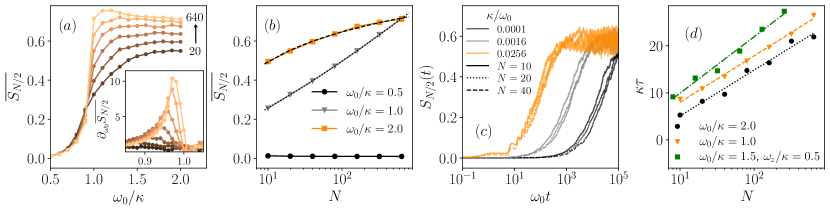
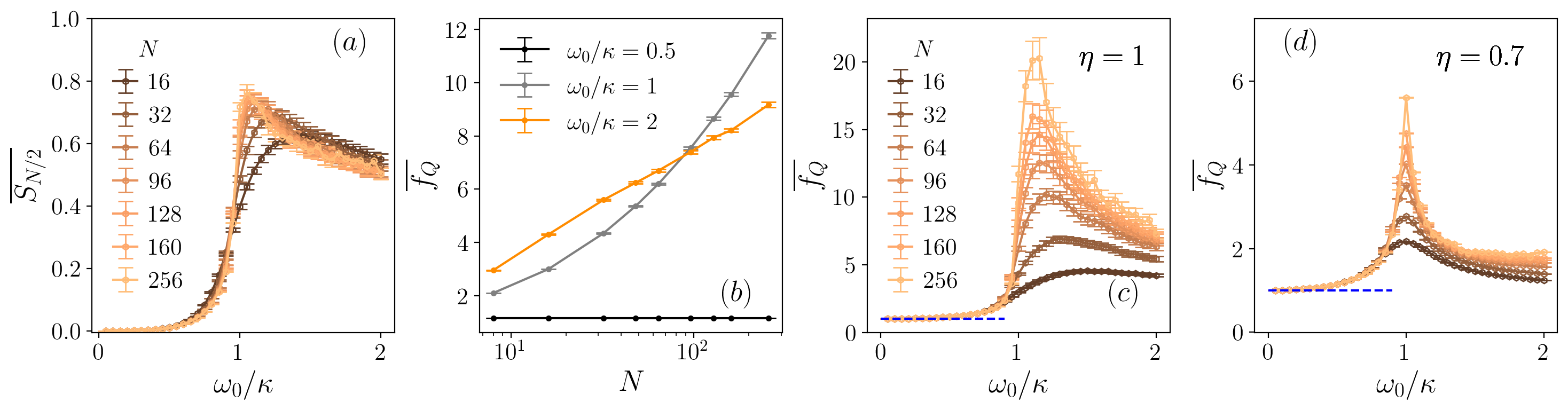
- Analyzes the half-chain entanglement entropy $ S_{N/2} $ as a function of system size $ N $ and drive strength $ \omega_0/\kappa $, identifying critical scaling.
- Introduces a power-law long-range interaction model $ \hat{\mathcal{H}} = \omega_0\hat{J}_x + \frac{\omega_z}{\mathcal{Z}_{\alpha,N}}\sum_{j>i}\frac{\hat{\sigma}^{z}_i\hat{\sigma}^{z}_j}{d(i,j)^\alpha} $ to test robustness of results.
- Performs exact diagonalization simulations for small systems ($ N \sim O(10) $) with $ \mathcal{N} = 1000 $ trajectory averages to compute entanglement dynamics.
- Uses the saturation time $ \tau $ of entanglement entropy as a proxy for post-selection overhead, showing $ \tau \sim \ln N $ in long-range regimes.
Experimental results
Research questions
- RQ1Can measurement-induced phase transitions be observed in many-body systems without requiring post-selection of quantum trajectories?
- RQ2What is the scaling behavior of entanglement entropy at the critical point of a monitored atomic gas with collective decay?
- RQ3How does the presence of long-range interactions affect the robustness of the MIPT and the saturation time of entanglement?
- RQ4Is the critical point of the MIPT coincident with the superradiant phase transition in driven atomic gases?
- RQ5Can the post-selection problem be mitigated in experimental implementations using continuous monitoring and collective decay?
Key findings
- The system exhibits a measurement-induced phase transition at $ \omega_0/\kappa = 1 $, where entanglement entropy scales logarithmically with system size $ N $, indicating a critical regime.
- In the subcritical phase ($ \omega_0/\kappa < 1 $), entanglement entropy follows an area law, while in the supercritical phase ($ \omega_0/\kappa > 1 $), it scales sub-logarithmically as $ \overline{S_{N/2}} \sim \ln^\beta N $ with $ \beta \sim 0.2 $.
- The saturation time $ \tau $ of entanglement entropy scales logarithmically with $ N $, i.e., $ \tau \sim \ln N $, indicating minimal post-selection overhead.
- In the long-range power-law model ($ \alpha = 0.2 $), the logarithmic scaling of $ \tau $ is preserved, confirming robustness to long-range interactions.
- In contrast, for short-range interactions ($ \alpha = 3.0 $), the saturation time grows faster than logarithmic, indicating increased post-selection overhead.
- The critical point of the MIPT coincides with the superradiant phase transition, linking quantum measurement dynamics to collective emission phenomena.
Read this paper
Open the full text in the Nubint reader and ask about any passage as you read.
Read this paper on NubintThis review was generated by AI from the original paper. Please check the paper before citing it.