
[Paper Review] Massively Multi-Cultural Knowledge Acquisition & LM Benchmarking
This paper introduces CultureAtlas, a large-scale benchmark for evaluating language models' cultural reasoning across 1,000+ sub-country regions and 2,000+ ethnolinguistic groups. It leverages curated Wikipedia pages and link traversal to extract high-quality, self-contained cultural norm assertions, achieving a 90%+ human-validated data quality rate and enabling robust evaluation of cultural bias and reasoning in LMs.
Pretrained large language models have revolutionized many applications but still face challenges related to cultural bias and a lack of cultural commonsense knowledge crucial for guiding cross-culture communication and interactions. Recognizing the shortcomings of existing methods in capturing the diverse and rich cultures across the world, this paper introduces a novel approach for massively multicultural knowledge acquisition. Specifically, our method strategically navigates from densely informative Wikipedia documents on cultural topics to an extensive network of linked pages. Leveraging this valuable source of data collection, we construct the CultureAtlas dataset, which covers a wide range of sub-country level geographical regions and ethnolinguistic groups, with data cleaning and preprocessing to ensure textual assertion sentence self-containment, as well as fine-grained cultural profile information extraction. Our dataset not only facilitates the evaluation of language model performance in culturally diverse contexts but also serves as a foundational tool for the development of culturally sensitive and aware language models. Our work marks an important step towards deeper understanding and bridging the gaps of cultural disparities in AI, to promote a more inclusive and balanced representation of global cultures in the digital domain.
Motivation & Objective
- To address the cultural bias and lack of fine-grained cultural commonsense in pretrained large language models (LLMs), especially in non-Western and sub-regional contexts.
- To develop a scalable, high-quality data collection pipeline that captures nuanced cultural norms across diverse geographical and ethnolinguistic groups.
- To construct a benchmark dataset that enables rigorous evaluation of LMs' cultural reasoning capabilities beyond coarse-grained cultural categories.
- To identify and probe cultural reasoning weaknesses in state-of-the-art LMs using both factual (positive) and non-factual (negative) cultural knowledge samples.
- To promote fairness, inclusivity, and cultural alignment in NLP by providing a foundation for debiasing and enhancing cultural awareness in LMs.
Proposed method
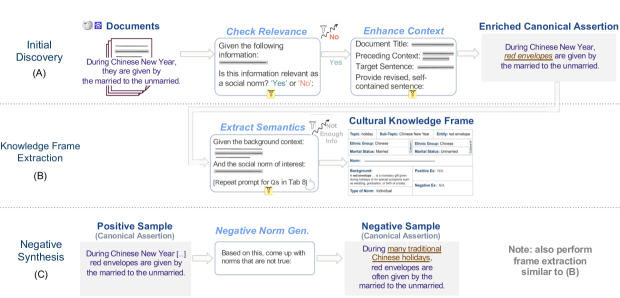
- Starting from curated Wikipedia articles on core cultural topics (e.g., holidays, marriage, education), the method expands via hyperlinked pages to build a network of culturally relevant content.
- Cultural knowledge assertions are extracted by using a pretrained LM to classify sentences as generalizable social norms rather than instance-specific facts or historical events.
- Negative (non-factual) cultural knowledge samples are generated and cross-validated via web search to test model robustness in detecting cultural errors.
- Fine-grained cultural profile fields—such as sub-country region, ethno-linguistic identity, and demographics—are extracted from the knowledge assertions for contextual analysis.
- A data quality check using human assessment confirms a 90%+ pass rate, ensuring high reliability of the positive and negative samples.
- The dataset is designed for benchmarking LMs on culturally nuanced reasoning, with a focus on detecting norm violations and cultural misalignment.
Experimental results
Research questions
- RQ1How can we systematically collect high-quality, fine-grained cultural knowledge across thousands of sub-country regions and ethnolinguistic groups?
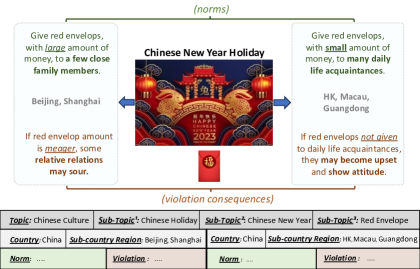
- RQ2To what extent do current large language models exhibit cultural bias when reasoning about region-specific norms, such as regional variations in Chinese New Year red envelope practices?
- RQ3Can a benchmark with both factual and non-factual cultural assertions effectively reveal weaknesses in LMs' cultural reasoning and norm violation detection?
- RQ4How does the inclusion of sub-regional and ethnolinguistic diversity in training and evaluation data affect model fairness and cultural sensitivity?
- RQ5What are the limitations of automated data labeling for cultural knowledge at scale, and how can human-in-the-loop validation improve reliability?
Key findings
- The CultureAtlas dataset covers over 1,000 sub-country regions and 2,000 ethnolinguistic groups, significantly expanding the scope of existing multicultural NLP benchmarks.
- The dataset achieved a 90%+ pass rate in human evaluation, confirming high data quality for both positive (factual) and negative (non-factual) cultural knowledge samples.
- State-of-the-art LMs showed measurable performance gaps in reasoning about culturally nuanced norms, particularly in non-Western and sub-regional contexts.
- The inclusion of negative samples enabled effective probing of model robustness, revealing vulnerabilities in detecting culturally incorrect assertions.
- The benchmark revealed that current LMs often fail to distinguish region-specific cultural practices, such as variations in red envelope customs across Chinese subregions.
- The study demonstrates that a combination of top-down topic guidance and bottom-up web traversal yields a scalable, high-quality method for cultural knowledge acquisition.
Read this paper
Open the full text in the Nubint reader and ask about any passage as you read.
Read this paper on NubintThis review was generated by AI from the original paper. Please check the paper before citing it.