
[Paper Review] MNISQ: A Large-Scale Quantum Circuit Dataset for Machine Learning on/for Quantum Computers in the NISQ era
MNISQ introduces a large-scale, 4.95-million-data-point quantum circuit dataset for machine learning in the NISQ era, encoding classical MNIST-like data into quantum circuits and QASM format. It enables dual evaluation: quantum kernel methods achieve 97% accuracy, while classical models like S4 reach 77% on QASM tokenized sequences, demonstrating both quantum advantage potential and classical model competence on quantum data.
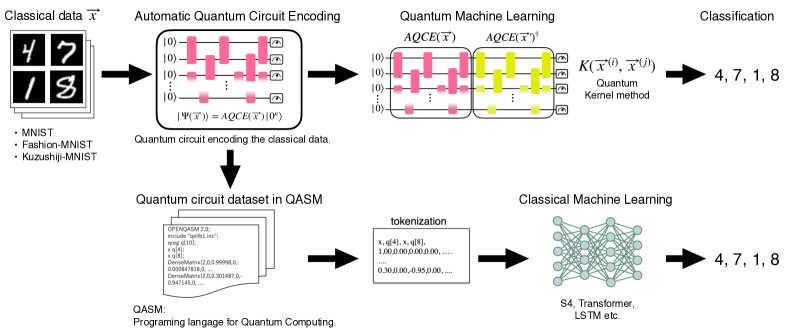
We introduce the first large-scale dataset, MNISQ, for both the Quantum and the Classical Machine Learning community during the Noisy Intermediate-Scale Quantum era. MNISQ consists of 4,950,000 data points organized in 9 subdatasets. Building our dataset from the quantum encoding of classical information (e.g., MNIST dataset), we deliver a dataset in a dual form: in quantum form, as circuits, and in classical form, as quantum circuit descriptions (quantum programming language, QASM). In fact, also the Machine Learning research related to quantum computers undertakes a dual challenge: enhancing machine learning exploiting the power of quantum computers, while also leveraging state-of-the-art classical machine learning methodologies to help the advancement of quantum computing. Therefore, we perform circuit classification on our dataset, tackling the task with both quantum and classical models. In the quantum endeavor, we test our circuit dataset with Quantum Kernel methods, and we show excellent results up to $97\%$ accuracy. In the classical world, the underlying quantum mechanical structures within the quantum circuit data are not trivial. Nevertheless, we test our dataset on three classical models: Structured State Space sequence model (S4), Transformer and LSTM. In particular, the S4 model applied on the tokenized QASM sequences reaches an impressive $77\%$ accuracy. These findings illustrate that quantum circuit-related datasets are likely to be quantum advantageous, but also that state-of-the-art machine learning methodologies can competently classify and recognize quantum circuits. We finally entrust the quantum and classical machine learning community the fundamental challenge to build more quantum-classical datasets like ours and to build future benchmarks from our experiments. The dataset is accessible on GitHub and its circuits are easily run in qulacs or qiskit.
Motivation & Objective
- To create a large-scale, dual-form dataset (quantum circuits and QASM) for benchmarking quantum and classical machine learning in the NISQ era.
- To enable comparative evaluation of quantum and classical models on quantum circuit classification tasks.
- To demonstrate that quantum circuit data can be effectively learned by state-of-the-art classical models, while also showing potential quantum advantage.
- To provide a publicly accessible, reproducible benchmark for future quantum-classical machine learning research.
Proposed method
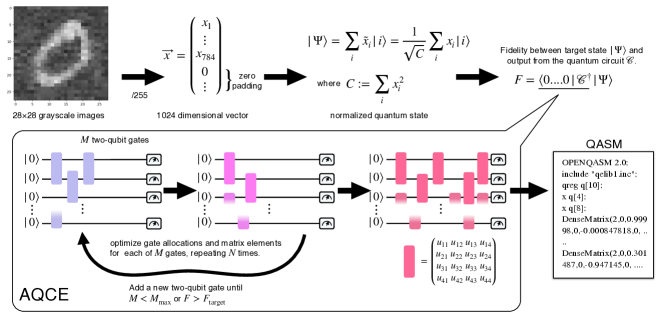
- The dataset is constructed by encoding classical image data (MNIST, Fashion-MNIST, Kuzushiji-MNIST) into quantum circuits using amplitude encoding.
- Each circuit is represented in two forms: as a quantum circuit (for quantum model training) and as QASM code (for classical model training).
- The dataset is split into 9 subdatasets based on data fidelity (80%, 90%, 95%) to evaluate model robustness under noise.
- Classical models (S4, Transformer, LSTM) are trained on tokenized QASM sequences, with numerical values truncated to three decimal places and treated as discrete tokens.
- Quantum kernel methods are applied directly to the quantum circuit data using a Hilbert-Schmidt kernel for classification.
- Hyperparameters are tuned via validation on the mnist_786 subset with fidelity 80, using AdamW with cosine annealing and weight decay.
Experimental results
Research questions
- RQ1Can classical machine learning models effectively classify quantum circuits encoded in QASM format, despite the non-trivial quantum mechanical structure of the data?
- RQ2Does quantum kernel learning on quantum circuit data achieve high accuracy, indicating potential quantum advantage in this task?
- RQ3How does model performance vary with increasing noise (fidelity) in the quantum circuit data?
- RQ4Can state-of-the-art sequence models like S4, Transformer, and LSTM generalize to quantum circuit representation in QASM?
- RQ5Is the MNISQ dataset suitable as a benchmark for future quantum-classical machine learning research?
Key findings
- Quantum kernel methods achieved a test accuracy of 97% on the MNISQ dataset, demonstrating strong performance on quantum circuit classification.
- The S4 model achieved 77% accuracy on tokenized QASM sequences, outperforming Transformer (58.84%) and LSTM (55.68%) on the same task.
- Classical models achieved near-baseline performance (~55%) on higher-fidelity data, indicating that quantum structure is non-trivial but learnable.
- The Transformer and LSTM models showed minimal performance gain with increased data fidelity, suggesting limited sensitivity to noise in the circuit representation.
- The MNISQ dataset is publicly available on GitHub with full metadata and tutorials, enabling reproducible benchmarking for future research.
- The dataset supports execution in qulacs and Qiskit, ensuring broad accessibility for quantum and classical ML experimentation.
Read this paper
Open the full text in the Nubint reader and ask about any passage as you read.
Read this paper on NubintThis review was generated by AI from the original paper. Please check the paper before citing it.