
[Paper Review] Money, Time, and Grant Design
This study uses a nationally representative survey of U.S. academic researchers to examine how grant design—specifically funding amount and duration—affects research strategies and researcher preferences. It finds that while longer grants increase risk-taking only among tenured faculty, researchers strongly prefer more money over longer durations, indicating that grant design primarily influences selection effects rather than behavioral responses to funding terms.
The design of research grants has been hypothesized to be a useful tool for influencing researchers and their science. We test this by conducting two thought experiments in a nationally representative survey of academic researchers. First, we offer participants a hypothetical grant with randomized attributes and ask how the grant would influence their research strategy. Longer grants increase researchers' willingness to take risks, but only among tenured professors, which suggests that job security and grant duration are complements. Both longer and larger grants reduce researchers' focus on speed, which suggests a significant amount of racing in science is in pursuit of resources. But along these and other strategic dimensions, the effect of grant design is small. Second, we identify researchers' indifference between the two grant design parameters and find they are very unwilling to trade off the amount of funding a grant provides in order to extend the duration of the grant $\unicode{x2014}$ money is much more valuable than time. Heterogeneity in this preference can be explained with a straightforward model of researchers' utility. Overall, our results suggest that the design of research grants is more relevant to selection effects on the composition of researchers pursuing funding, as opposed to having large treatment effects on the strategies of researchers that receive funding.
Motivation & Objective
- To understand how variations in grant design—specifically funding amount and duration—affect researchers’ strategic decisions in science.
- To identify researchers’ stated preferences over trade-offs between grant size and duration, using a thought experiment framework.
- To assess whether grant design can meaningfully influence research strategies, such as risk-taking, speed, or exploration/exploitation balance.
- To evaluate whether selection effects (who chooses which grants) are more important than treatment effects (how grants change behavior) in shaping scientific outcomes.
- To provide empirical evidence on researcher preferences that can inform funder policy in designing grants to achieve desired scientific impacts.
Proposed method
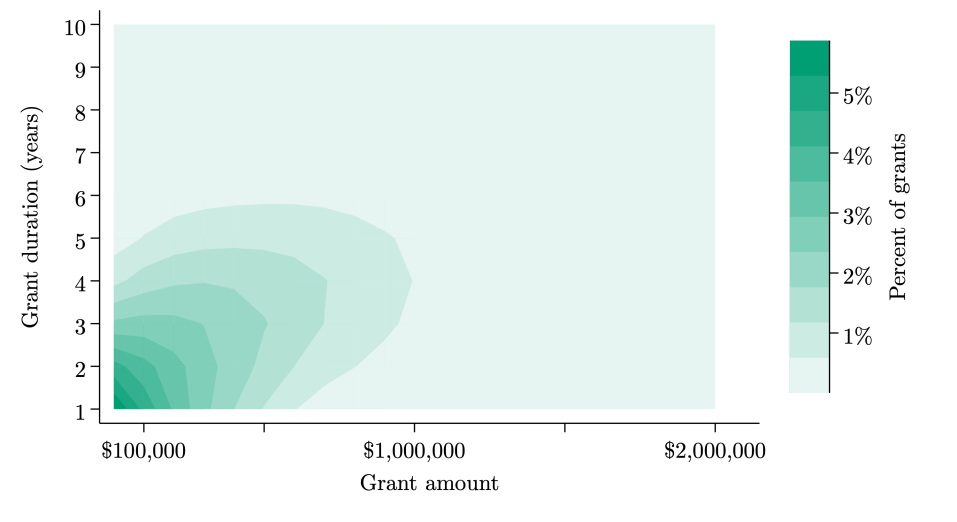
- Conducted two thought experiments using a nationally representative survey of 1,000+ research-active professors across U.S. research institutions.
- In the first experiment, researchers were presented with hypothetical grants with randomized combinations of funding level and duration, and asked how these would alter their research strategy.
- In the second experiment, researchers were asked to identify their indifference point between grant size and duration, enabling estimation of willingness to trade money for time.
- Used a structural model of utility to explain heterogeneity in preferences, with age as a proxy for discount rates.
- Applied sample selection correction techniques and validated response accuracy using salary comparisons to assess survey representativeness.
- Estimated the relative value of money versus time using a parameter ($\gamma$) representing the marginal rate of substitution between grant duration and size.
Experimental results
Research questions
- RQ1How do changes in grant duration and funding amount influence researchers’ willingness to take risks, prioritize speed, or shift toward exploration vs. exploitation strategies?
- RQ2What is the relative value researchers place on grant duration versus funding amount, and how does this vary across researcher subgroups?
- RQ3To what extent do grant design parameters affect actual research behavior (treatment effects), and how much is driven by who chooses which grants (selection effects)?
- RQ4How do tenured versus untenured researchers differ in their response to longer or larger grants?
- RQ5Can stated preferences in a survey accurately reflect real-world grant choices, and how representative is the sample of the broader academic research population?
Key findings
- Longer grants increase risk-taking, but only among tenured professors, suggesting job security and grant duration are complements in enabling bold research.
- Both longer and larger grants reduce researchers’ focus on speed, indicating that 'racing' in science is largely driven by competition for resources rather than intrinsic urgency.
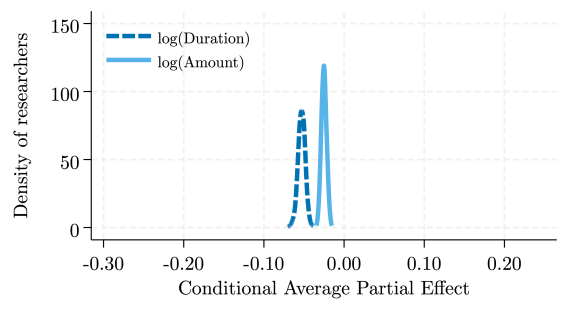
- Researchers are approximately four times more willing to trade off grant duration for increased funding, indicating that money is valued far more than time.
- The estimated marginal rate of substitution ($\gamma$) shows that researchers value a 1% increase in funding nearly four times as much as a 1% increase in grant duration.
- Treatment effects of grant design on research strategy are small—replacing an R01 with a MIRA-style grant would shift strategy probabilities by only about 1 percentage point.
- Selection effects—how grant design shapes which researchers pursue which grants—are likely more important than treatment effects in determining the overall impact of grant funding on scientific direction.
Read this paper
Open the full text in the Nubint reader and ask about any passage as you read.
Read this paper on NubintThis review was generated by AI from the original paper. Please check the paper before citing it.