
[Paper Review] Near Delay-Optimal Scheduling of Batch Jobs in Multi-Server Systems
This paper proposes near delay-optimal scheduling policies—Fewest Unassigned Tasks (FUT), Earliest Due Date (EDD), and First-Come, First-Served (FCFS)—for batch jobs in multi-server systems with New-Better-than-Used (NBU) service time distributions. It proves that FUT achieves a constant additive delay gap from optimality for mean average delay, while FCFS is within twice the optimum for mean maximum delay and p-norm delay, using novel sample-path stochastic ordering techniques.
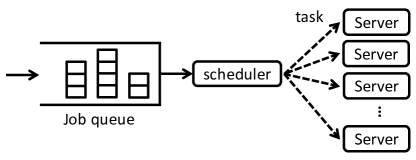
We study a class of scheduling problems, where each job is divided into a batch of unit-size tasks and these tasks can be executed in parallel on multiple servers with New-Better-than-Used (NBU) service time distributions. While many delay optimality results are available for single-server queueing systems, generalizing these results to the multi-server case has been challenging. This motivated us to investigate near delay-optimal scheduling of batch jobs in multi-server queueing systems. We consider three lowcomplexity scheduling policies: the Fewest Unassigned Tasks first (FUT) policy, the Earliest Due Date first (EDD) policy, and the First-Come, First-Served (FCFS) policy. We prove that for arbitrary number, batch sizes, arrival times, and due times of the jobs, these scheduling policies are near delay-optimal in stochastic ordering for minimizing three classes of delay metrics among all causal and non-preemptive policies. In particular, the FUT policy is within a constant additive delay gap from the optimum for minimizing the mean average delay, and the FCFS policy within twice of the optimum for minimizing the mean maximum delay and the mean p-norm of delay. The key proof tools are several novel samplepath orderings, which can be used to compare the sample-path delay of different policies in a near-optimal sense.
Motivation & Objective
- Address the challenge of delay-optimal scheduling in multi-server systems, where generalizing single-server delay-optimal results is notoriously difficult.
- Overcome the NP-hardness of average delay minimization in multi-server deterministic systems and the intractability of stochastic scheduling in multi-class multi-server settings.
- Develop low-complexity, causal, and non-preemptive scheduling policies that are provably near-optimal for various delay metrics under arbitrary job parameters.
- Establish a unified sample-path method using stochastic ordering to compare policy performance without relying on specific system model assumptions.
Proposed method
- Introduce three low-complexity scheduling policies: FUT, EDD, and FCFS, designed for causal, non-preemptive task assignment in multi-server systems.
- Use novel sample-path orderings to compare the delay performance of different policies, enabling stochastic dominance comparisons without requiring full system model specification.
- Apply stochastic orders such as stochastic dominance ($\leq_{\text{st}}$) and increasing convex order ($\leq_{\text{icx}}$) to bound residual service times under NBU distributions.
- Leverage properties of exponential random variables as stochastically dominant proxies for residual NBU service times to derive upper bounds on completion delays.
- Construct couplings between policy trajectories to prove weak work-efficiency ordering, ensuring that one policy consistently performs at least as well as another in sample-path delay.
- Derive analytical bounds on delay gaps using conditional expectations of maximum residual service times over active servers, exploiting memoryless properties and order statistics.
Experimental results
Research questions
- RQ1Can low-complexity scheduling policies achieve near delay-optimality in multi-server batch job systems with arbitrary job parameters and NBU service time distributions?
- RQ2How close can the FUT policy come to the optimal mean average delay, and what is the additive delay gap from optimality?
- RQ3What performance guarantees can be established for the FCFS policy in minimizing mean maximum delay and p-norm of delay?
- RQ4Can a unified sample-path method be developed to compare policy delays across different scheduling policies without relying on system-specific assumptions?
- RQ5Under what conditions do FUT, EDD, and FCFS policies achieve near delay-optimality for general classes of delay metrics?
Key findings
- The FUT policy achieves a constant additive delay gap from the optimal mean average delay, with the bound depending only on server service rates and the number of tasks per job.
- The FCFS policy is within twice the optimal value for minimizing both the mean maximum delay and the mean $p$-norm of delay, providing a multiplicative performance guarantee.
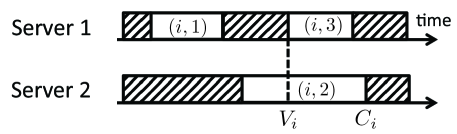
- For the FUT policy, the expected completion delay beyond the time all tasks are assigned is bounded by $\sum_{l=1}^{k_i \wedge m} \frac{1}{\sum_{j=1}^{l} \mu_j}$, which is further upper bounded by $\ln(k_i \wedge m) + 1$.
- The residual service time of a partially completed task under NBU distributions is stochastically dominated by an exponential random variable with the same mean, enabling tractable bounds.
- The sample-path method establishes that FUT is weakly more work-efficient than any other causal, non-preemptive policy, ensuring better or equal delay performance in sample-path comparison.
- The results hold for arbitrary job arrival times, due times, batch sizes, and numbers of jobs, and are valid even under non-stationary arrival processes where steady-state distributions do not exist.
Better researchstarts right now
From reading papers to final review, dramatically reduce your research time.
No credit card · Free plan available
This review was created by AI and reviewed by human editors.