
[Paper Review] Neural functional theory for inhomogeneous fluids: Fundamentals and applications
This paper introduces a hybrid machine learning and classical density functional theory framework that uses a deep neural network to learn the functional dependence of the one-body direct correlation function on the density profile in inhomogeneous fluids. The method enables accurate prediction of thermodynamic and structural properties—including free energy and pair correlations—via automatic differentiation and functional line integration, outperforming state-of-the-art fundamental measure theory while maintaining microscopic precision at macroscopic scales.
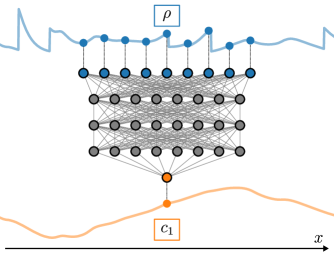
We present a hybrid scheme based on classical density functional theory and machine learning for determining the equilibrium structure and thermodynamics of inhomogeneous fluids. The exact functional map from the density profile to the one-body direct correlation function is represented locally by a deep neural network. We substantiate the general framework for the hard sphere fluid and use grand canonical Monte Carlo simulation data of systems in randomized external environments during training and as reference. Functional calculus is implemented on the basis of the neural network to access higher-order correlation functions via automatic differentiation and the free energy via functional line integration. Thermal Noether sum rules are validated explicitly. We demonstrate the use of the neural functional in the self-consistent calculation of density profiles. The results outperform those from state-of-the-art fundamental measure density functional theory. The low cost of solving an associated Euler-Lagrange equation allows to bridge the gap from the system size of the original training data to macroscopic predictions upon maintaining near-simulation microscopic precision. These results establish the machine learning of functionals as an effective tool in the multiscale description of soft matter.
Motivation & Objective
- To develop a machine learning-based approach for constructing accurate density functionals in inhomogeneous fluids where exact functionals are unknown.
- To overcome the limitations of traditional approximations in classical density functional theory by leveraging neural networks to learn the functional map from density profile to direct correlation function.
- To enable the prediction of higher-order correlation functions, free energy, and equations of state using functional calculus on the trained neural functional.
- To validate the framework's consistency with known physical laws, such as thermal Noether sum rules, and demonstrate its use in self-consistent density profile calculations.
- To establish a scalable, multiscale method that maintains near-simulation precision even for macroscopic systems, bridging the gap between microscopic training data and large-scale predictions.
Proposed method
- Train a deep neural network to represent the functional map from the local density profile ρ(r) to the one-body direct correlation function c₁(r;[ρ]) using grand canonical Monte Carlo simulation data in planar geometry.
- Use randomized external potentials in simulations to generate diverse training data covering a broad range of inhomogeneous environments.
- Implement functional calculus via automatic differentiation to compute higher-order correlation functions from the neural functional.
- Compute the excess Helmholtz free energy via functional line integration along a reference path, enabling thermodynamic consistency.
- Apply the neural functional in the DFT Euler-Lagrange equation for self-consistent density profile calculations, forming a neural DFT framework.
- Leverage symmetry-aware architectures such as equivariant neural networks to extend the method to anisotropic particles and higher-dimensional geometries with reduced data requirements.
Experimental results
Research questions
- RQ1Can a deep neural network accurately learn the functional dependence of the one-body direct correlation function on the density profile in inhomogeneous fluids?
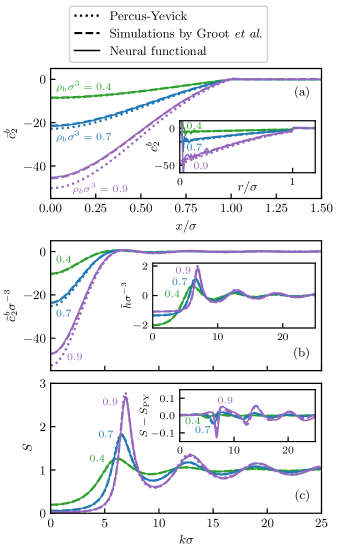
- RQ2Can the learned neural functional reproduce known physical quantities such as pair structure, free energy, and equations of state with high precision?
- RQ3Does the neural functional support functional calculus via automatic differentiation to access higher-order correlation functions and thermodynamic properties?
- RQ4Can the neural DFT framework outperform established analytic approximations like fundamental measure theory in predicting equilibrium fluid structure?
- RQ5To what extent can the method generalize from planar training data to macroscopic, three-dimensional systems while preserving microscopic accuracy?
Key findings
- The neural functional achieves higher accuracy in predicting density profiles than state-of-the-art fundamental measure theory, particularly in complex inhomogeneous environments.
- Functional calculus via automatic differentiation successfully computes higher-order correlation functions, with results consistent with established theoretical expectations.
- The free energy computed via functional line integration matches known thermodynamic relations and validates thermal Noether sum rules explicitly.
- Self-consistent solutions of the Euler-Lagrange equation using the neural functional yield stable and accurate density profiles across a range of external potentials.
- The method maintains near-simulation-level microscopic precision even when extrapolating to macroscopic system sizes, demonstrating strong multiscale capability.
- The framework generalizes to other systems, including truncated Lennard-Jones fluids, and is extendable to anisotropic particles and 3D geometries using equivariant neural networks.
Read this paper
Open the full text in the Nubint reader and ask about any passage as you read.
Read this paper on NubintThis review was generated by AI from the original paper. Please check the paper before citing it.