
[Paper Review] Noise-assisted digital quantum simulation of open systems
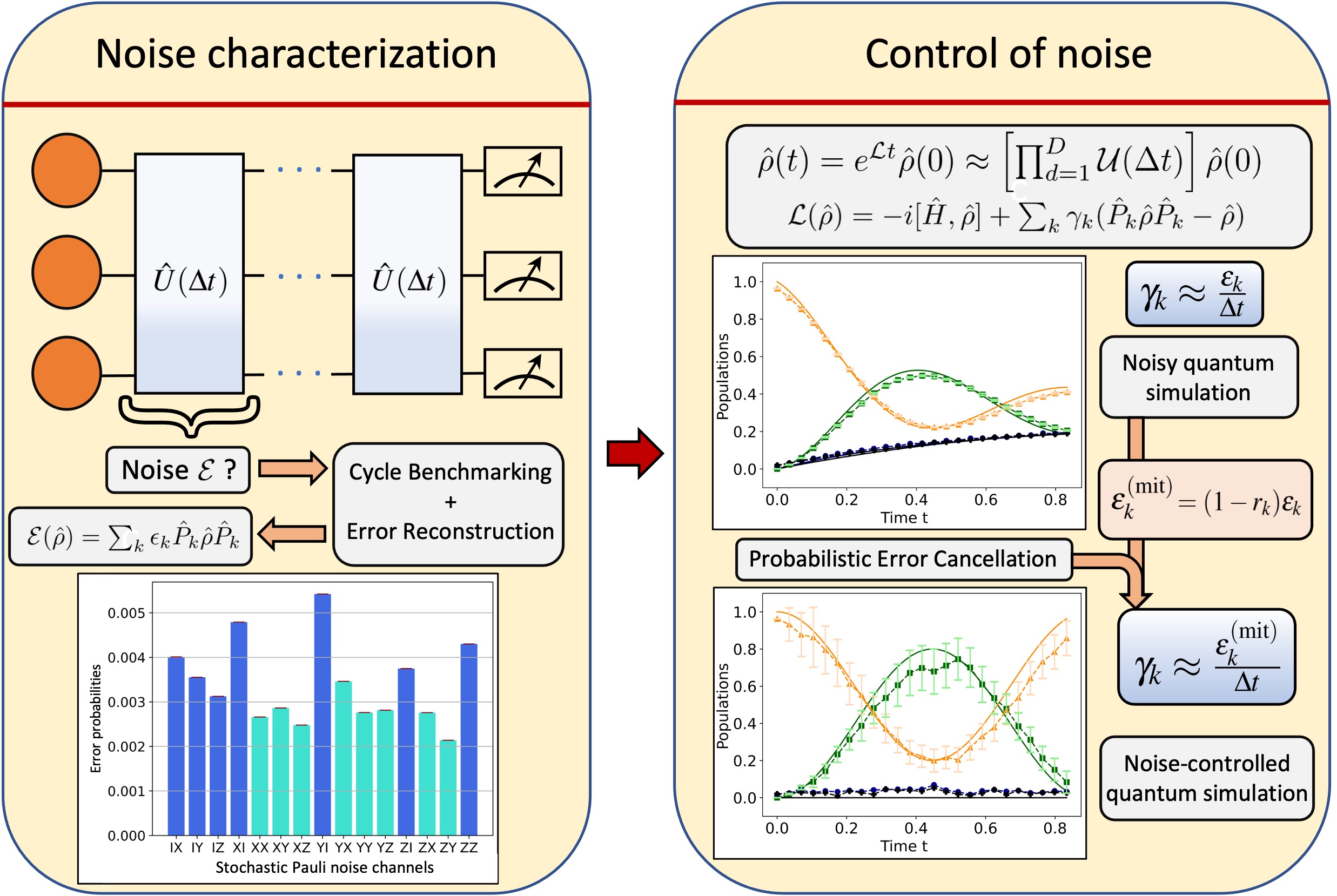
This paper introduces a noise-assisted digital quantum simulation framework that leverages intrinsic noise in NISQ devices to simulate open quantum systems more efficiently. By combining randomized compiling and Pauli error mitigation, it selectively controls decoherence rates to achieve accurate simulations of open system dynamics on real and emulated IBM Quantum devices, demonstrating good agreement with classical Lindblad equation solutions.
Quantum systems are inherently open and susceptible to environmental noise, which can have both detrimental and beneficial effects on their dynamics. This phenomenon has been observed in bio-molecular systems, where noise enables novel functionalities, making the simulation of their dynamics a crucial target for digital and analog quantum simulation. Nevertheless, the computational capabilities of current quantum devices are often limited due to their inherent noise. In this work, we present a novel approach that capitalizes on the intrinsic noise of quantum devices to reduce the computational resources required for simulating open quantum systems. Our approach combines quantum noise characterization methods with quantum error mitigation techniques, enabling us to manipulate and control the intrinsic noise in a quantum circuit. Specifically, we selectively enhance or reduce decoherence rates in the quantum circuit to achieve the desired simulation of open system dynamics. We provide a detailed description of our methods and report on the results of noise characterization and quantum error mitigation experiments conducted on both real and emulated IBM Quantum computers. Additionally, we estimate the experimental resource requirements for our techniques. Our approach holds the potential to unlock new simulation techniques in Noisy Intermediate-Scale Quantum (NISQ) devices, harnessing their intrinsic noise to enhance quantum computations.
Motivation & Objective
- To address the challenge of simulating open quantum systems on noisy intermediate-scale quantum (NISQ) devices, where standard error correction is impractical.
- To explore whether intrinsic device noise can be harnessed as a resource rather than a hindrance in quantum simulations.
- To develop a method that enables precise control over decoherence rates in quantum circuits to simulate desired open system dynamics.
- To demonstrate the feasibility of noise-controlled quantum simulations on real and emulated IBM Quantum hardware.
Proposed method
- The method employs randomized compiling to transform coherent noise into stochastic Pauli noise, enabling efficient error mitigation via the Pauli error mitigation (PEM) scheme.
- It applies non-uniform mitigation factors to different stochastic Pauli channels, allowing selective enhancement or reduction of decoherence rates in the quantum circuit.
- The approach uses a first-order Trotter-Suzuki decomposition to simulate time evolution under a Lindbladian master equation on a 4-qubit system.
- Noise characterization is performed on both real and emulated IBM Quantum devices (e.g., ibmq lagos), with results validated against classical simulations of the Lindblad equation.
- The technique leverages the fact that stochastic Pauli channels can be efficiently canceled using the probabilistic error cancellation (PEC) method, making them ideal for control.
- Circuits are compiled such that added Pauli strings are absorbed into single-qubit gates, preserving circuit structure while enabling noise manipulation.
Experimental results
Research questions
- RQ1Can intrinsic noise in NISQ devices be systematically controlled to simulate open quantum system dynamics more efficiently?
- RQ2To what extent can randomized compiling and Pauli error mitigation be used to tailor decoherence rates in quantum circuits?
- RQ3How accurately can noise-assisted simulations reproduce the dynamics of open systems compared to classical solutions?
- RQ4What are the experimental resource requirements for implementing noise-controlled quantum simulations on current quantum hardware?
Key findings
- The quantum simulation results for a 4-qubit open system showed good qualitative agreement with classical solutions of the corresponding Lindblad equation, particularly in population dynamics of the reduced two-qubit density matrix.
- Non-uniform mitigation factors—r_k = 0.5 for dominant dephasing channels and r_k' = 0.1 for weaker channels—enabled effective control over decoherence rates.
- The method successfully transformed coherent noise into stochastic Pauli noise via randomized compiling, enabling efficient error mitigation using PEC.
- Experiments on both real and emulated IBM Quantum devices demonstrated that noise-assisted simulation is feasible and accurate under realistic NISQ constraints.
- The technique achieved accurate simulation of open system dynamics with only 90C_tot^2 circuits in the PEC protocol, indicating low resource overhead.

Better researchstarts right now
From reading papers to final review, dramatically reduce your research time.
No credit card · Free plan available
This review was created by AI and reviewed by human editors.