
[Paper Review] Stable Quantum-Correlated Many Body States through Engineered Dissipation
The paper demonstrates engineered dissipation to prepare and stabilize entangled, many-body states on superconducting qubits, revealing long-range quantum correlations and non-equilibrium transport phenomena.
Engineered dissipative reservoirs have the potential to steer many-body quantum systems toward correlated steady states useful for quantum simulation of high-temperature superconductivity or quantum magnetism. Using up to 49 superconducting qubits, we prepared low-energy states of the transverse-field Ising model through coupling to dissipative auxiliary qubits. In one dimension, we observed long-range quantum correlations and a ground-state fidelity of 0.86 for 18 qubits at the critical point. In two dimensions, we found mutual information that extends beyond nearest neighbors. Lastly, by coupling the system to auxiliaries emulating reservoirs with different chemical potentials, we explored transport in the quantum Heisenberg model. Our results establish engineered dissipation as a scalable alternative to unitary evolution for preparing entangled many-body states on noisy quantum processors.
Motivation & Objective
- Show that dissipative reservoirs can steer a many-body system toward correlated steady states useful for quantum simulation.
- Demonstrate long-range quantum correlations and nontrivial ground-state fidelity scaling across system sizes.
- Explore non-equilibrium transport by coupling the system to reservoirs with different chemical potentials.
- Provide evidence that dissipative preparation can outperform unitary-state preparation in scalability and robustness.
Proposed method
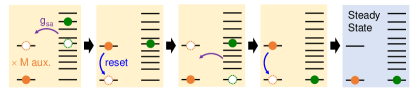
- Use M dissipative auxiliary qubits connected to L system qubits to implement dissipative cooling toward low-energy states of the TFIM.
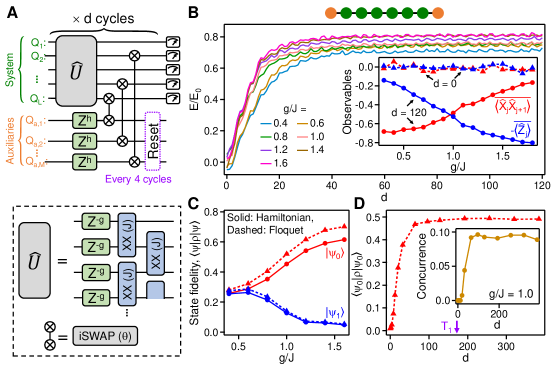
- Employ a periodic quantum circuit that implements a Floquet-like evolution with a cycle unitary U built from XX/YY-type and Z rotations.
- Tune system-reservoir coupling g_sa via a partial iSWAP gate with angle theta and adjust auxiliary energies with Z^h gates.
- Reset auxiliaries periodically to realize an autonomous feedback loop that stabilizes the cooled state.
- Characterize states via quantum state tomography and purification of the 1RDM to estimate ground-state fidelity.
- Measure mutual information and nonlocal correlators to diagnose quantum correlations beyond nearest neighbors.
Experimental results
Research questions
- RQ1Can engineered dissipation prepare and stabilize entangled many-body states in scalable superconducting quantum processors?
- RQ2How does the steady state fidelity with respect to TFIM ground/low-lying states scale with system size in 1D and 2D geometries?
- RQ3What nonlocal quantum correlations (and entanglement measures) emerge in the steady state, and how do they compare to ground-state expectations?
- RQ4How does coupling to reservoirs with different chemical potentials drive non-equilibrium transport in spin models like XXZ?
Key findings
- Steady-state energy E/E0 ranges from 0.7 in the 1D antiferromagnetic phase to 0.8 in the paramagnetic phase for d>50.
- Ground-state fidelity with purified 1RDM at the critical point g/J=1.0 is 0.92 (L=6), 0.90 (L=12), and 0.86 (L=18).
- Nearest-neighbor concurrence stabilizes to about 0.1 in the 1D TFIM steady state.
- Nonlocal quantum correlator C_q shows edge-mode correlations in the antiferromagnetic regime and power-law decay at the critical point, mirroring ground-state behavior.
- In 2D TFIM (35 qubits, 14 auxiliaries), E/E0 = 0.58 at the critical point g/J=1.5, with long-range mutual information indicating correlated steady states beyond nearest neighbors.
- Using boundary-driven Floquet XXZ, the experiment reveals ballistic transport in easy-plane, insulator-like behavior in easy-axis, and sub-diffusive transport with a ≈ -2/3 exponent at the isotropic point, highlighting a new non-equilibrium transport regime.
Read this paper
Open the full text in the Nubint reader and ask about any passage as you read.
Read this paper on NubintThis review was generated by AI from the original paper. Please check the paper before citing it.