
[Paper Review] Noisy Qudit vs Multiple Qubits : Conditions on Gate Efficiency for Enhancing Fidelity
This paper compares the gate fidelity of single qudit systems versus multiple qubit systems under identical Hilbert space dimensions and noisy environments, using first-order average gate infidelity (AGI) in the Lindblad formalism. It derives a critical curve, $(d^2 - 1)/(3\log_2 d)$, defining the threshold for gate efficiency relative to decoherence time, showing that certain qudit platforms can match or exceed state-of-the-art qubit systems in fidelity scaling when gate times are sufficiently short relative to decoherence times.
Today, multiple new platforms are implementing qudits, $d$-level quantum bases of information, for Quantum Information Processing (QIP). It is therefore crucial to study their efficiencies for QIP compared to more traditional qubit platforms. We present a comparative study of the infidelity scalings of a qudit and $n$-qubit systems, both with identical Hilbert space dimensions and noisy environments. The first-order response of the Average Gate Infidelity (AGI) to the noise in the Lindblad formalism, which was found to be gate-independent, was calculated analytically in the two systems being compared. This yielded a critical curve $O(d^2/\log_2(d))$ of the ratio of their respective gate times in units of decoherence time. This quantity indicates how time-efficient operations on these systems are. The curve delineates regions where each system has a higher rate of increase of the AGI than the other. This condition on gate efficiency was applied to different existing platforms. It was found that specific qudit platforms possess gate efficiencies competitive with state-of-the-art qubit platforms. Numerical simulations complemented this work and allowed for discussion of the applicability and limits of the linear response formalism.
Motivation & Objective
- To evaluate whether single qudit systems can outperform equivalent multiqubit systems in computational fidelity under noisy conditions.
- To identify the conditions under which qudit-based platforms maintain or exceed the average gate infidelity (AGI) performance of multiqubit systems despite increased error channels.
- To establish a quantitative benchmark for qudit platform viability by comparing gate efficiency relative to decoherence timescales.
- To validate the linear response approximation of AGI under weak noise and assess its limits via numerical simulations.
Proposed method
- Analytically compute the first-order response of average gate infidelity (AGI) to noise in the Lindblad formalism for both single qudit and n-qubit systems with identical Hilbert space dimensions.
- Use the Haar measure to average over all unitary gates, ensuring state-independent fidelity metrics.
- Derive the AGI scaling for a single qudit under dephasing noise using trace-based expressions involving the dimension $d$ and noise rate $γ$.
- Derive the corresponding AGI scaling for $n$ qubits under pure dephasing, using the same formalism and comparing with the qudit case.
- Define a figure of merit as the ratio of gate time to decoherence time, and derive a critical curve $ (d^2 - 1)/(3\log_2 d) $ that separates regions of superior performance between the two systems.
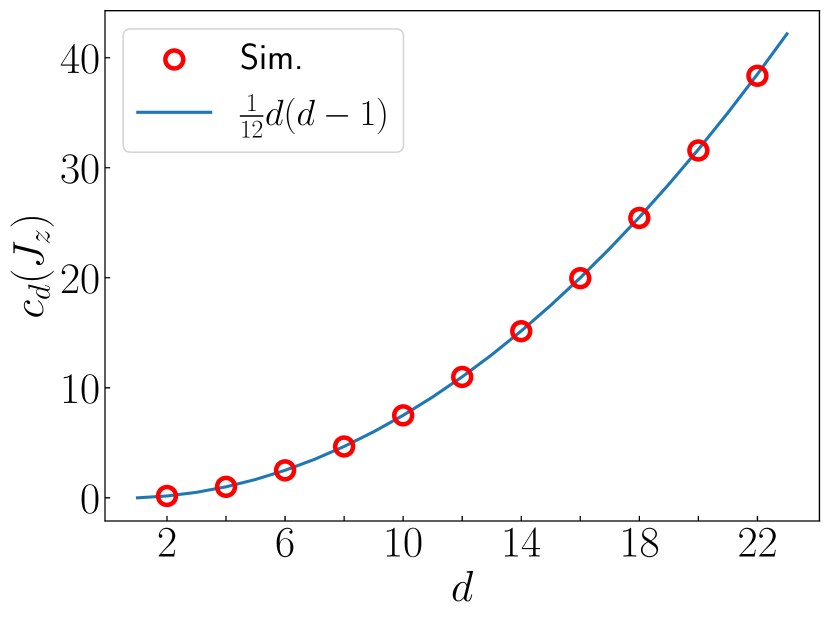
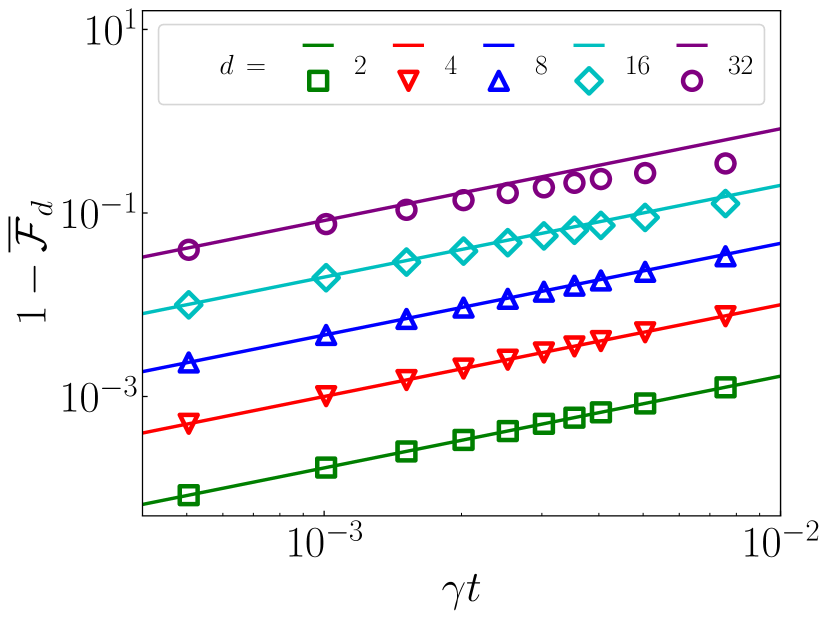
- Perform numerical simulations of $N_g = 4400$ gates for $d=4$ and $d=8$ to assess deviations from linear AGI scaling and gate dependence at higher noise levels.
Experimental results
Research questions
- RQ1Under what conditions on gate efficiency does a single qudit system maintain lower average gate infidelity than an equivalent multiqubit system?
- RQ2How does the number of error channels in a qudit system affect its fidelity scaling compared to a multiqubit system with the same Hilbert space dimension?
- RQ3To what extent is the linear response approximation of AGI valid for qudit and multiqubit systems under weak noise?
- RQ4What is the threshold ratio of gate time to decoherence time that determines whether qudit or multiqubit systems exhibit superior fidelity scaling?
- RQ5How do numerical simulations reveal the limits of the linear response formalism in predicting AGI growth under increasing noise?
Key findings
- The critical curve $ (d^2 - 1)/(3\log_2 d) $ defines the threshold for gate efficiency ratio (gate time / decoherence time) where qudit and multiqubit systems have comparable AGI scaling.
- For $d=4$, the critical ratio is approximately $ (16 - 1)/(3 \cdot 2) = 2.5 $, indicating that qudit systems can outperform multiqubit systems if gate times are less than 2.5 times the decoherence time.
- Numerical simulations show that AGI deviates from linear behavior at higher $\gamma t$, with higher $d$ values exhibiting noticeable nonlinearity at smaller $\gamma t$.
- The AGI for a single qudit scales as $ \overline{\mathcal{F}}(\mathcal{E}_z) = \frac{d + d^2 - \frac{\gamma t}{12}d^2(d^2 - 1)}{d(d+1)} + o(\gamma t) $, confirming a quadratic dependence on $d$ in the leading-order noise term.
- For $n$ qubits, the AGI scales as $ \overline{\mathcal{F}}(\mathcal{E}_z) = \frac{2^n + 2^{2n} - \frac{\gamma t}{4}n2^{2n}}{2^n(2^n + 1)} + o(\gamma t) $, showing a linear dependence on $n$ in the noise coefficient.
- The study confirms that specific qudit platforms can achieve gate efficiencies competitive with state-of-the-art qubit platforms when gate times are sufficiently short relative to decoherence times.
Read this paper
Open the full text in the Nubint reader and ask about any passage as you read.
Read this paper on NubintThis review was generated by AI from the original paper. Please check the paper before citing it.