
[Paper Review] Parity Quantum Optimization: Encoding Constraints
This paper introduces a parity quantum optimization framework that encodes equality constraints in quantum optimization problems without energy penalties by leveraging exchange interactions and single-spin flip terms in a parity-encoded lattice gauge model. The method enables efficient implementation of k-body constraints using only local interactions on 2D quantum devices, significantly reducing qubit overhead and improving compatibility with current quantum hardware for both quantum annealing and digital quantum computing.
Constraints make hard optimization problems even harder to solve on quantum devices because they are implemented with large energy penalties and additional qubit overhead. The parity mapping, which has been introduced as an alternative to the spin encoding, translates the problem to a representation using only parity variables that encodes products of spin variables. In combining exchange interaction and single spin flip terms in the parity representation, constraints on sums and products of arbitrary k-body terms can be implemented without additional overhead in two-dimensional quantum systems.
Motivation & Objective
- To address the challenge of encoding constraints in quantum optimization problems without introducing large energy penalties.
- To reduce qubit and coupling overhead typically associated with penalty-based constraint encoding in quantum annealing and QAOA.
- To enable efficient implementation of general k-body equality constraints, including sums and products of spin variables, on current quantum hardware.
- To develop a framework compatible with both analog (quantum annealing) and digital (QAOA) quantum computing models.
- To demonstrate that constraints can be encoded via local exchange and spin-flip interactions in a parity representation, avoiding non-local or fully connected couplings.
Proposed method
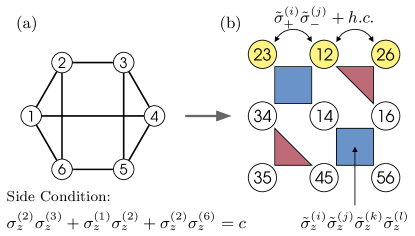
- The paper employs the parity mapping, which encodes products of spin variables into single parity variables, transforming the optimization problem into a lattice gauge model with local 3- and 4-body interactions.
- Constraints are implemented using a combination of exchange interactions (acting on qubits involved in constraints) and single-spin flip terms (acting on the rest), both of which are local and geometrically flexible.
- The method uses a compiler to map logical qubits onto a square lattice, enabling close placement of qubits involved in constraints to support local hopping terms.
- The Hamiltonian is structured such that the constraint terms commute with the exchange unitary, preserving the constraint during evolution.
- The approach is applied to QAOA simulations using partitioned mixing unitaries, with multiple parameterization strategies (single, shared, or independent parameters) tested for performance.
- The framework supports both equality and inequality constraints by rewriting inequalities as equalities through additional qubits, with focus on disjoint, binary-coefficient constraints (g^{(m)}_{\alpha} = 0 or 1).
Experimental results
Research questions
- RQ1Can general k-body equality constraints, including sums and products of spin variables, be encoded in quantum optimization without energy penalties?
- RQ2How can constraints be implemented using only local interactions in a 2D quantum architecture to reduce qubit and coupling overhead?
- RQ3What is the performance impact of partitioning the exchange unitary into sequential two-qubit operations in QAOA?
- RQ4How do different parameterization strategies (single, shared, or independent parameters) affect the success probability of finding the target state under constraints?
- RQ5To what extent can the parity encoding framework be applied to both quantum annealing and digital quantum computing models?
Key findings
- The parity encoding enables constraint implementation without energy penalties, eliminating the need for large-scale, fully connected couplings.
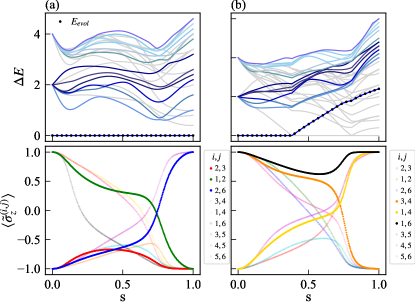
- The method achieves high success probabilities in QAOA simulations—reaching up to 90% for certain constraint configurations—when using partitioned mixing unitaries with independent parameters.
- Using a single shared parameter for partitioned exchange terms yields performance close to the complete unitary, with only a slight decrease in success probability.
- Partitioning the exchange unitary with independent parameters improves performance slightly but increases classical optimization parameters, indicating a trade-off between fidelity and complexity.
- The framework supports a broad class of optimization problems, including those with mixed sums and products of k-body terms, by encoding them via parity variables and local interactions.
- The approach is compatible with current quantum hardware, as demonstrated by successful simulation of QAOA on constrained problems using local, two-qubit operations.
Read this paper
Open the full text in the Nubint reader and ask about any passage as you read.
Read this paper on NubintThis review was generated by AI from the original paper. Please check the paper before citing it.