
[Paper Review] Predicting Inflation with Recurrent Neural Networks
This paper applies Long Short-Term Memory (LSTM) recurrent neural networks to forecast US inflation using the FRED-MD dataset, demonstrating that LSTMs outperform traditional models at long horizons and during periods of macroeconomic instability. The model also serves as a nonlinear dimension reduction tool, extracting economically meaningful factors correlated with the output gap and inflation predictors, while highlighting the critical role of ensemble methods due to sensitivity to initialization and architecture.
This paper applies a recurrent neural network, the LSTM, to forecast inflation. This is an appealing model for time series as it processes each time step sequentially and explicitly learns dynamic dependencies. The paper also explores the dimension reduction capability of the model to uncover economically-meaningful factors that can explain the inflation process. Results from an exercise with US data indicate that the estimated neural nets present competitive, but not outstanding, performance against common benchmarks (including other machine learning models). The LSTM in particular is found to perform well at long horizons and during periods of heightened macroeconomic uncertainty. Interestingly, LSTM-implied factors present high correlation with business cycle indicators, informing on the usefulness of such signals as inflation predictors. The paper also sheds light on the impact of network initialization and architecture on forecast performance.
Motivation & Objective
- To evaluate the performance of LSTM networks in forecasting US inflation compared to traditional and machine learning benchmarks.
- To explore whether LSTMs can extract nonlinear, economically meaningful factors that explain inflation dynamics.
- To assess the impact of network initialization and architecture on forecast accuracy.
- To provide practical guidance on implementing neural networks for macroeconomic forecasting, emphasizing ensemble techniques.
Proposed method
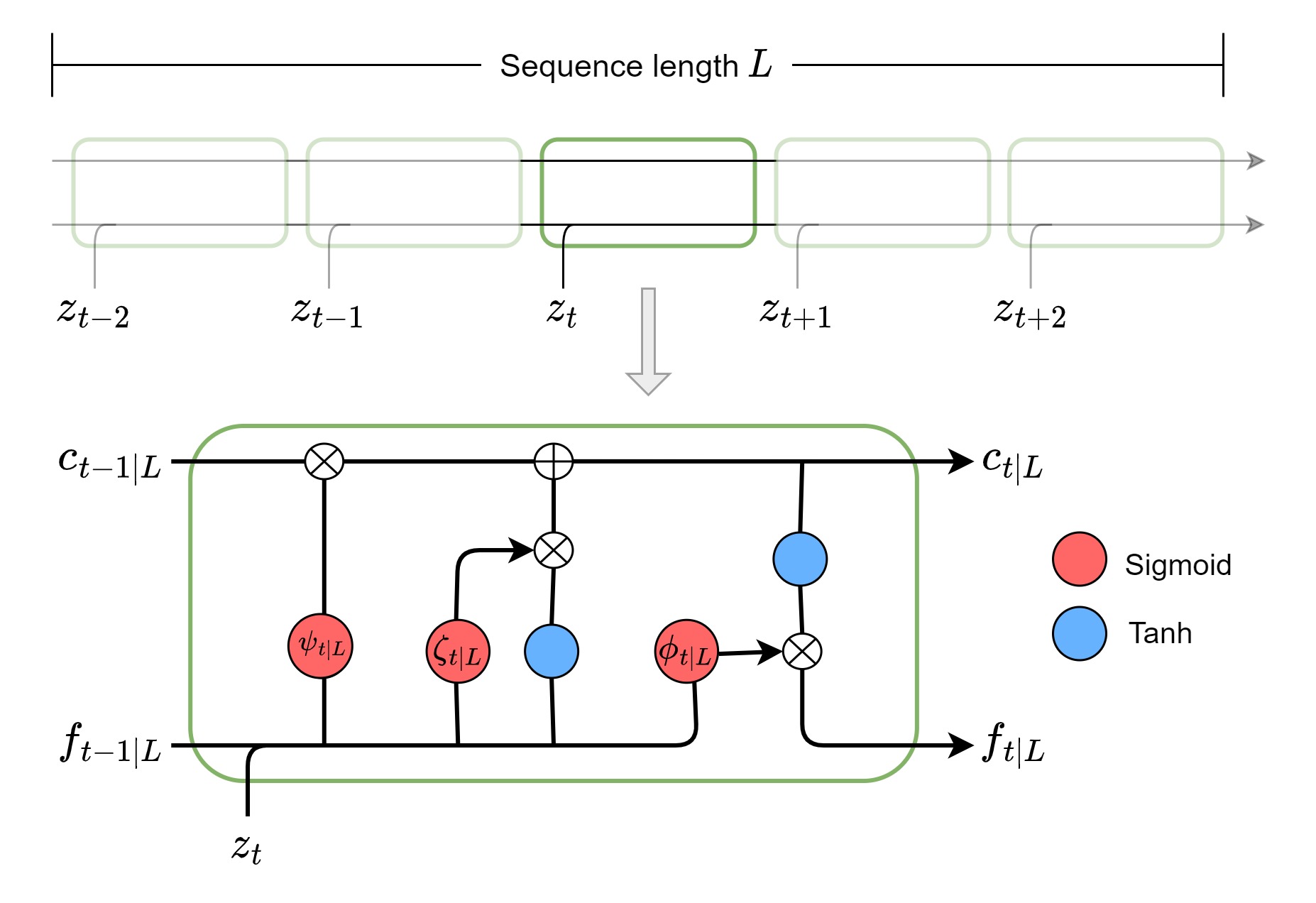
- The study employs a Long Short-Term Memory (LSTM) recurrent neural network to model sequential inflation data, capturing long-term dependencies through gated memory units.
- The model is trained on the FRED-MD dataset, incorporating 137 macroeconomic and financial indicators to predict US CPI and PCE inflation.
- Nonlinear factors are extracted from the LSTM's hidden layer, interpreted as supervised, predictive latent states that generalize PCA in a forecasting context.
- Forecast performance is evaluated using out-of-sample mean squared prediction error (MSPE) and Diebold-Mariano tests against benchmarks, including Random Forest, LASSO, Ridge, Elastic-net, and feed-forward networks.
- An ensemble approach is implemented by averaging predictions across 1,400 different random initializations to mitigate sensitivity to initialization and improve robustness.
- Variance decomposition and correlation analysis are used to interpret the economic content of the LSTM-derived factors, linking them to business cycle indicators and known inflation predictors.

Experimental results
Research questions
- RQ1How does the LSTM model compare to traditional and machine learning benchmarks in forecasting US inflation across different horizons?
- RQ2Can LSTM networks extract nonlinear, economically interpretable factors that capture the underlying inflation trend and business cycle dynamics?
- RQ3To what extent is forecast performance sensitive to network initialization and architecture in LSTM models?
- RQ4Does ensemble averaging of multiple initializations significantly improve forecast accuracy and robustness?
Key findings
- The LSTM model delivers competitive forecasting performance, particularly excelling at long horizons (e.g., 24-month forecasts) and during periods of high macroeconomic uncertainty, such as post-GFC.
- The LSTM outperforms most benchmarks but is outperformed by the Random Forest model, which shows superior overall accuracy.
- LSTM-derived factors exhibit high correlation (r > 0.7) with the output gap and other business cycle indicators, suggesting they capture key inflation drivers.
- The variance decomposition of LSTM factors shows significant loading on housing starts and corporate bond spreads—key predictors identified in the inflation literature.
- Network initialization has a substantial impact on predictions, with individual runs showing large variation; the ensemble average consistently outperforms any single initialization at the 5% significance level in Diebold-Mariano tests.
- Larger networks are more sensitive to initialization, and no consistent performance advantage is found for larger architectures, underscoring the need for ensemble methods to stabilize predictions.
Read this paper
Open the full text in the Nubint reader and ask about any passage as you read.
Read this paper on NubintThis review was generated by AI from the original paper. Please check the paper before citing it.