
[Paper Review] Proof-of-work consensus by quantum sampling
This paper proposes a quantum-based Proof-of-Work (PoW) consensus mechanism using coarse-grained boson sampling (CGBS) to replace classical hashing in blockchains. By leveraging quantum sampling with Fock or Gaussian input states, the scheme ensures computational intractability for classical miners while enabling quantum advantage, thus achieving energy efficiency and resistance to quantum advantage attacks, with a Nash equilibrium that incentivizes honest participation.
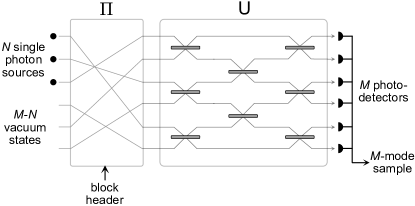
Since its advent in 2011, boson sampling has been a preferred candidate for demonstrating quantum advantage because of its simplicity and near-term requirements compared to other quantum algorithms. We propose to use a variant, called coarse-grained boson-sampling (CGBS), as a quantum Proof-of-Work (PoW) scheme for blockchain consensus. The users perform boson sampling using input states that depend on the current block information and commit their samples to the network. Afterwards, CGBS strategies are determined which can be used to both validate samples and reward successful miners. By combining rewards for miners committing honest samples together with penalties for miners committing dishonest samples, a Nash equilibrium is found that incentivizes honest nodes. We provide numerical evidence that these validation tests are hard to spoof classically without knowing the binning scheme ahead of time and show the robustness of our protocol to small partial distinguishability of photons. The scheme works for both Fock state boson sampling and Gaussian boson sampling and provides dramatic speedup and energy savings relative to computation by classical hardware.
Motivation & Objective
- To address the high energy consumption and environmental impact of classical Proof-of-Work (PoW) blockchains like Bitcoin.
- To design a PoW mechanism resilient to quantum advantage attacks, particularly from Grover’s algorithm.
- To leverage near-term quantum technologies—specifically boson sampling—for practical blockchain consensus.
- To establish a Nash equilibrium that incentivizes honest mining behavior through rewards and penalties.
- To demonstrate feasibility for both Fock-state and Gaussian boson sampling variants in a blockchain context.
Proposed method
- Proposes coarse-grained boson sampling (CGBS) as a quantum computational puzzle for blockchain mining.
- Uses input states—either Fock states or squeezed vacuum states—for quantum sampling, with the output distribution being #P-hard to compute classically.
- Employs the Hafnian of a matrix derived from the interferometer unitary and squeezing parameters to compute output probabilities.
- Applies a characteristic function approach to compute mode-binned probability distributions for Gaussian boson sampling, enabling validation via polynomial-time sampling.
- Introduces a reward and penalty mechanism to enforce honest behavior, creating a Nash equilibrium where cheating is suboptimal.
- Validates samples using the Hafnian-based probability distribution and a binned sampling protocol to ensure consistency and efficiency.
Experimental results
Research questions
- RQ1Can coarse-grained boson sampling serve as a secure and efficient computational puzzle for blockchain Proof-of-Work?
- RQ2How can quantum sampling be structured to ensure classical intractability while enabling quantum advantage for honest participants?
- RQ3What mechanisms can enforce honest mining behavior in a quantum PoW system, and does a Nash equilibrium exist?
- RQ4Can both Fock-state and Gaussian boson sampling be adapted to a blockchain consensus framework with equivalent security and efficiency?
- RQ5How does the proposed scheme mitigate the threat of quantum speedups like Grover’s algorithm in PoW mining?
Key findings
- The proposed CGBS-based PoW scheme provides a dramatic speedup and energy savings compared to classical PoW, leveraging quantum advantage in sampling.
- The scheme is secure against classical miners due to the #P-hardness of computing Hafnian-based output probabilities.
- A Nash equilibrium is achieved where honest mining is incentivized through rewards and penalties, discouraging cheating.
- The method works for both Fock-state and Gaussian boson sampling, with the latter using characteristic functions and covariance matrices to compute binned distributions.
- The probability distribution for Gaussian boson sampling is derived via the Hafnian of a transformed matrix and validated using the characteristic function approach.
- The protocol enables efficient validation of quantum samples using polynomial-time evaluations of the characteristic function at discrete points.

Read this paper
Open the full text in the Nubint reader and ask about any passage as you read.
Read this paper on NubintThis review was generated by AI from the original paper. Please check the paper before citing it.