
[Paper Review] Properties of Chebyshev polynomials
This paper investigates the properties of Chebyshev polynomials as solutions to the Chebyshev differential equation, a special case of the Sturm-Liouville boundary value problem. It demonstrates that Chebyshev polynomial interpolation provides superior accuracy and faster convergence than Fourier series when approximating polynomial functions, achieving exact interpolation with N terms for an Nth-degree polynomial, while Fourier series require more terms for comparable accuracy on non-polynomial functions.
Ordinary differential equations and boundary value problems arise in many aspects of mathematical physics. Chebyshev differential equation is one special case of the Sturm-Liouville boundary value problem. Generating function, recursive formula, orthogonality, and Parseval's identity are some important properties of Chebyshev polynomials. Compared with a Fourier series, an interpolation function using Chebyshev polynomials is more accurate in approximating polynomial functions. -------- Des équations différentielles ordinaires et des problèmes de valeurs limites se posent dans de nombreux aspects de la physique mathématique. L'équation différentielle de Chebychev est un cas particulier du problème de la valeur limite de Sturm-Liouville. La fonction génératrice, la formule récursive, l'orthogonalité et l'identité de Parseval sont quelques propriétés importantes du polynôme de Chebyshev. Par rapport à une série de Fourier, une fonction d'interpolation utilisant des polynômes de Chebyshev est plus précise dans l'approximation des fonctions polynomiales.
Motivation & Objective
- To examine the Chebyshev differential equation as a special case of the Sturm-Liouville boundary value problem.
- To analyze key properties of Chebyshev polynomials, including generating functions, recursive formulas, orthogonality, and Parseval’s identity.
- To compare the convergence and accuracy of Chebyshev polynomial interpolation versus Fourier series in approximating polynomial and non-polynomial functions.
- To demonstrate the superiority of Chebyshev approximation for polynomial functions and the faster convergence of Fourier series for non-polynomial functions.
Proposed method
- Derive the Chebyshev differential equation from the Sturm-Liouville form using specific interval and weight functions.
- Define Chebyshev polynomials via the trigonometric identity $ T_n(x) = \cos(n \cos^{-1}x) $, establishing their orthogonality and recursive structure.
- Prove the generating function identity $ \frac{1 - zx}{1 - 2zx + z^2} = \sum_{n=0}^\infty T_n(x) z^n $ using complex exponential series and Euler's formula.
- Use the $ L^2 $-norm minimization to determine optimal coefficients $ C_n $ in the interpolation $ P_N(x) = \sum_{n=0}^N C_n T_n(x) $.
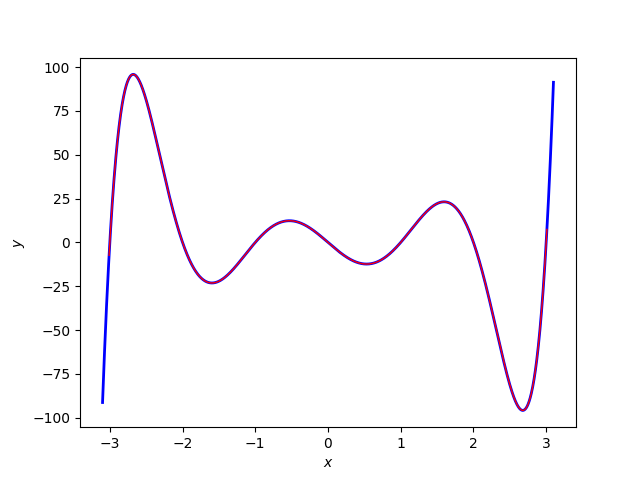
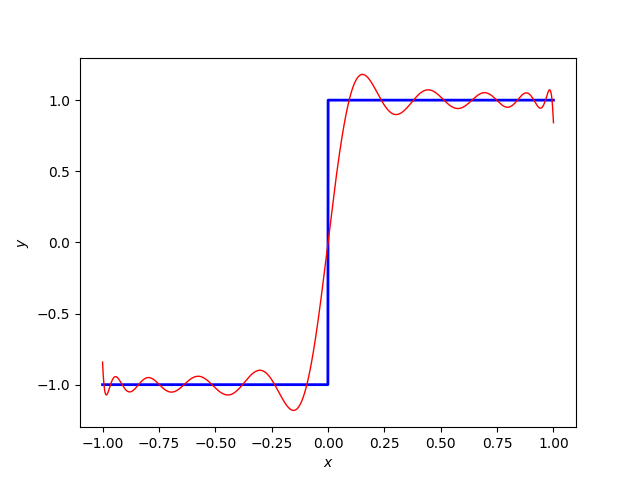
- Compare numerical approximations of polynomial and non-polynomial functions (e.g., seventh-order polynomial, Heaviside step function) using both Chebyshev and Fourier series with varying $ N $.
- Analyze the Gibbs phenomenon in both approximation methods, noting its presence near discontinuities.
Experimental results
Research questions
- RQ1How do Chebyshev polynomials arise as solutions to a Sturm-Liouville boundary value problem?
- RQ2What are the key analytical properties of Chebyshev polynomials, such as generating functions, recursive formulas, and orthogonality?
- RQ3Why does Chebyshev interpolation achieve exact representation of polynomials with $ N $ terms, while Fourier series require more terms for comparable accuracy?
- RQ4How does the convergence rate of Chebyshev interpolation compare to Fourier series for non-polynomial functions?
- RQ5To what extent does the Gibbs phenomenon affect both approximation methods, and how do their error behaviors differ near discontinuities?
Key findings
- Chebyshev polynomial interpolation with $ N = 7 $ terms achieves exact interpolation of a seventh-order polynomial, while a Fourier series requires at least $ N = 10 $ terms to reach comparable qualitative accuracy.
- For polynomial functions, Chebyshev approximation with $ N $ terms yields zero error, demonstrating exact interpolation, whereas Fourier series require more terms for similar accuracy.
- For non-polynomial functions such as the Heaviside step function, Fourier series with $ N = 10 $ terms achieve comparable accuracy to Chebyshev interpolation with $ N = 20 $, indicating faster convergence of the Fourier series.
- The Gibbs phenomenon occurs in both approximation methods, manifesting as oscillations near discontinuities, but the amplitude and width of the overshoot are similar across both approaches.
- Chebyshev polynomials are even or odd functions depending on the degree $ n $, which influences the sparsity of coefficients in the expansion, especially for odd functions where even-indexed coefficients vanish.
- The generating function $ \frac{1 - zx}{1 - 2zx + z^2} = \sum_{n=0}^\infty T_n(x) z^n $ is rigorously derived using complex exponentials and geometric series summation.
Read this paper
Open the full text in the Nubint reader and ask about any passage as you read.
Read this paper on NubintThis review was generated by AI from the original paper. Please check the paper before citing it.