
[Paper Review] Quafu-RL: The Cloud Quantum Computers based Quantum Reinforcement Learning
This paper presents Quafu-RL, a framework for executing quantum reinforcement learning (QRL) on real cloud-based NISQ devices using hardware-efficient parameterized quantum circuits (PQCs). By employing a multi-objective evolutionary algorithm to design PQCs and an adaptive learning algorithm tailored for Quafu’s quantum hardware, the authors successfully train RL agents on 10-, 18-, and 136-qubit devices, achieving stable performance with relaxed objectives in under 100 training episodes.
With the rapid advent of quantum computing, hybrid quantum-classical machine learning has shown promising computational advantages in many key fields. Quantum reinforcement learning, as one of the most challenging tasks, has recently demonstrated its ability to solve standard benchmark environments with formally provable theoretical advantages over classical counterparts. However, despite the progress of quantum processors and the emergence of quantum computing clouds in the noisy intermediate-scale quantum (NISQ) era, algorithms based on parameterized quantum circuits (PQCs) are rarely conducted on NISQ devices. In this work, we take the first step towards executing benchmark quantum reinforcement problems on various real devices equipped with at most 136 qubits on BAQIS Quafu quantum computing cloud. The experimental results demonstrate that the Reinforcement Learning (RL) agents are capable of achieving goals that are slightly relaxed both during the training and inference stages. Moreover, we meticulously design hardware-efficient PQC architectures in the quantum model using a multi-objective evolutionary algorithm and develop a learning algorithm that is adaptable to Quafu. We hope that the Quafu-RL be a guiding example to show how to realize machine learning task by taking advantage of quantum computers on the quantum cloud platform.
Motivation & Objective
- To demonstrate the feasibility of training quantum reinforcement learning agents on real noisy intermediate-scale quantum (NISQ) devices using cloud-based quantum computing platforms.
- To address the challenge of limited qubit count, decoherence, and gate infidelity in NISQ devices by designing hardware-efficient PQC architectures.
- To develop a learning algorithm adaptable to Quafu’s quantum hardware, improving trainability and performance on real devices.
- To validate the approach on a standard benchmark environment (CartPole) and assess performance under realistic noise and resource constraints.
- To provide a reproducible pipeline for deploying PQC-based QRL and other quantum machine learning tasks on cloud quantum platforms.
Proposed method
- Employed a multi-objective evolutionary algorithm to search for hardware-efficient PQC architectures that balance expressivity and low entanglement for better trainability on NISQ devices.
- Designed a custom REINFORCE-based learning algorithm adapted to Quafu’s quantum computing stack, incorporating classical optimization with quantum policy evaluation.
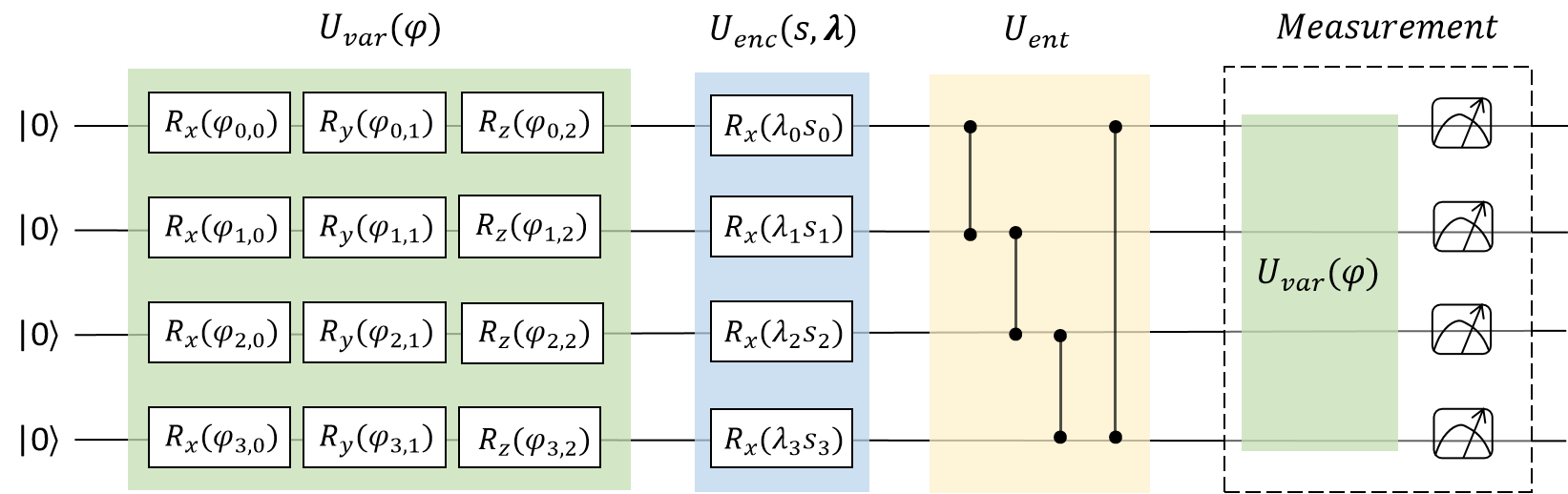
- Integrated the selected PQC architecture into a quantum policy network that maps states to action probabilities via parameterized quantum circuits.
- Executed training and inference on Quafu’s cloud-based quantum processors: ScQ-P10 (10 qubits), ScQ-P18 (18 qubits), and ScQ-P136 (136 qubits).
- Used TensorFlow Quantum for classical simulation of the optimization loop and quantum circuit evaluation during training.
- Applied a discount factor γ = 1.0 and used the observable $[Z_0Z_1Z_2Z_3]$ to compute expected returns in the policy gradient update.
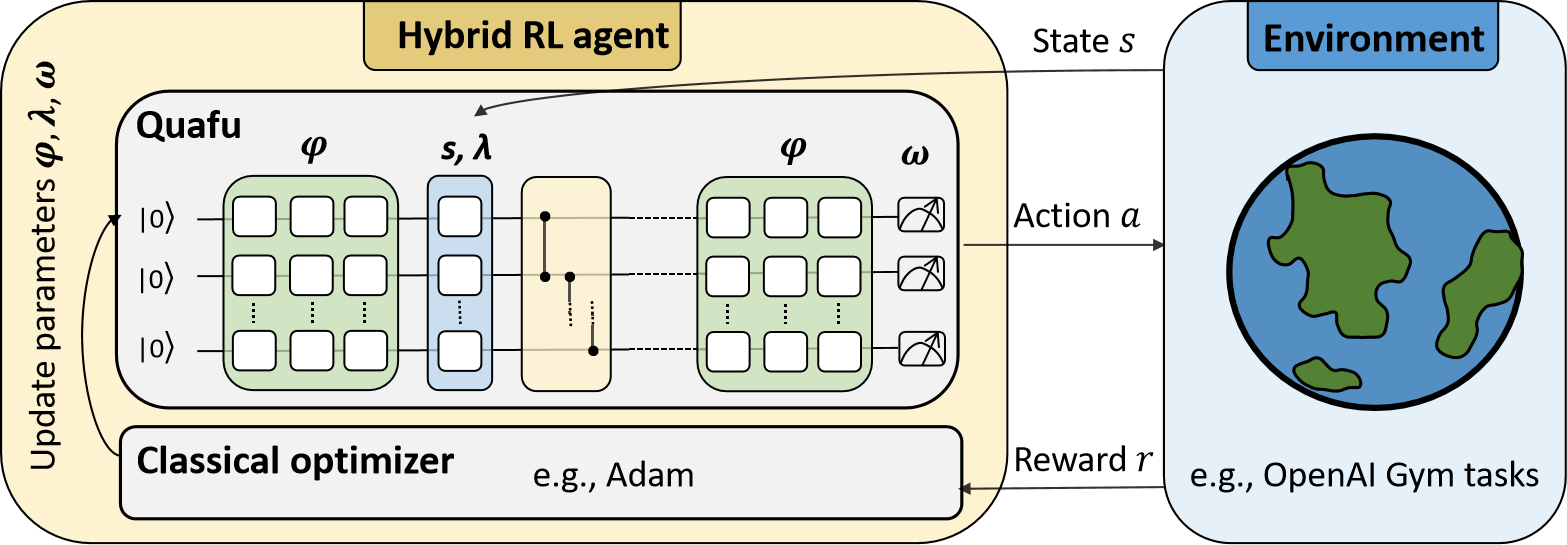
Experimental results
Research questions
- RQ1Can quantum reinforcement learning agents be successfully trained on real NISQ devices with limited qubit counts and high noise levels?
- RQ2How do hardware-efficient PQC architectures impact the performance and stability of QRL agents on real quantum hardware?
- RQ3To what extent can a custom, device-adapted learning algorithm improve training convergence and reward acquisition on noisy quantum processors?
- RQ4Can QRL agents achieve meaningful performance on standard benchmark environments like CartPole when trained on real quantum devices with relaxed objectives?
- RQ5What are the practical limitations of current NISQ devices in supporting scalable quantum machine learning workloads?
Key findings
- The RL agent trained on the 10-qubit ScQ-P10 device achieved a maximum episode reward of 132 within 100 training episodes, with a stable average reward of approximately 30.
- On the 18-qubit ScQ-P18 device, the agent reached a maximum reward of 86 and maintained a mean reward of around 30 over 100 episodes.
- The 136-qubit ScQ-P136 device enabled the highest performance, achieving a maximum reward of 94 and a stable mean reward of approximately 30.
- Inference on the pre-trained model from ScQ-P10 achieved a mean reward of about 50 over 100 episodes, indicating successful generalization despite noisy training.
- The training process showed signs of convergence, with moving averages stabilizing above 50 reward after 80 episodes on the 10-qubit device, even though the original CartPole goal (200) was not fully met.
- The results demonstrate that with relaxed objectives and optimized PQC design, QRL agents can be successfully trained and evaluated on real NISQ devices within practical runtime limits.
Read this paper
Open the full text in the Nubint reader and ask about any passage as you read.
Read this paper on NubintThis review was generated by AI from the original paper. Please check the paper before citing it.